

- Mecca Pact Puts Bangladesh’s Foreign Policy to New Test |
- Remittance reaches $2.34 billion in first 24 days of August |
- BSF men flee leaving behind 2 shotguns, walkie-talkie |
- Bhutan King makes brief stopover in Dhaka, meets President |
- Eid-e-Miladunnabi being observed today |
Mecca Pact Puts Bangladesh’s Foreign Policy to New Test
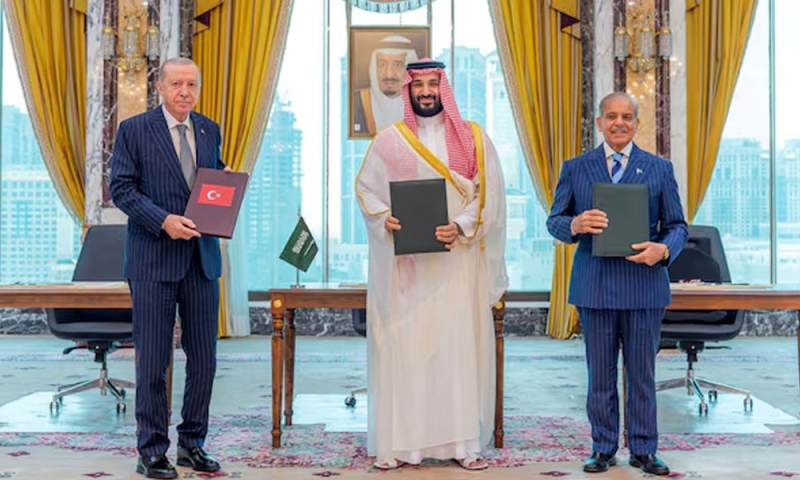
Bangladesh may consider joining the Mecca Pact, a mutual defence agreement signed this month by Saudi Arabia, Türkiye and Pakistan, according to a Bangladeshi minister.
Foreign Affairs State Minister Humayun Kabir said Bangladesh could consider participating in any security arrangement among Muslim-majority countries in the Middle East and viewed such an initiative positively.
“Bangladesh may consider participating if there is a security agreement among Islamic countries in the Middle East,” he told reporters on Monday.
He also said Bangladesh’s leadership, particularly Prime Minister Tarique Rahman, had been invited to participate in the initiative.
A source at Bangladesh’s Foreign Ministry said Saudi Arabia had invited Bangladesh to join the pact, although it was not immediately clear when the invitation was extended.
The agreement was signed this month in the Saudi holy city of Mecca by the three Sunni Muslim-majority countries. Modelled partly on NATO’s collective defence principle, the pact states that an armed attack on one member will be treated as an attack on all members.
Türkiye has said the agreement could be expanded to include additional countries.
The pact comes as regional tensions continue to rise, with conflict involving Iran adding to instability across the Middle East. Türkiye, like Bangladesh, is a secular republic, while more than 90% of Bangladesh’s population identifies as Sunni Muslim.
A test for Bangladesh’s foreign policy
Analysts say joining a military alliance could pose a significant test for Bangladesh’s long-standing foreign policy approach.
Bangladesh has traditionally sought to maintain balanced relations with different countries while prioritising trade, investment, exports and economic cooperation. Joining a military bloc could therefore have implications for its relations with countries on opposing sides of regional and global geopolitical divides.
Bangladesh’s economy is heavily dependent on exports, particularly ready-made garments, with major markets in the United Kingdom, European Union and United States. Remittances from millions of Bangladeshis working abroad, particularly in the Middle East, are also a major source of foreign exchange.
Geopolitical analyst Kallol Kibria said membership in a military alliance could complicate Bangladesh’s relations not only with India but also with China, Iran, Japan, Kuwait, Oman, Qatar, Russia, the United Arab Emirates and the United States.
He said such relations would not necessarily deteriorate immediately, but joining a military alliance could make it difficult for Bangladesh to avoid questions about which side it had chosen.
Potential impact on ties with India
The Saudi invitation comes as Bangladesh-India relations remain sensitive under the government led by Prime Minister Tarique Rahman.
Although both countries have sought to maintain ties, Bangladesh’s possible participation in a security pact involving Pakistan could add another layer of complexity to bilateral relations.
There is also uncertainty over whether Prime Minister Tarique Rahman will visit India. Dhaka is meanwhile awaiting New Delhi’s response to its request for the extradition of former prime minister Sheikh Hasina, who remains in India.
India’s Ministry of External Affairs has said it is closely monitoring developments in West Asia.
Analysts say India may view Bangladesh joining a security alliance involving Pakistan unfavourably. However, they also argue that Dhaka must assess the economic and strategic consequences of any such decision based on its own national interests.
Asif Shahan, a professor at the University of Dhaka’s Department of Development Studies, said joining a military alliance could create risks for Bangladesh’s export-dependent economy because the country relies heavily on stable trade and diplomatic relations with a wide range of countries.
He said some countries, including India, could be dissatisfied if Bangladesh joined the pact. However, he added that Bangladesh should not make such a decision solely on the basis of how other countries might react.