

- Govt pursuing zero tolerance against human trafficking, organised crime: Salahuddin |
- PM Seeks Japan’s Help to Build Technology, Innovation Hubs |
- Bangladesh Plans Bonded Warehouse Reforms to Diversify Exports |
- Dhaka ranks 4th among world's most polluted cities this morning |
- Lula re-elected Brazilian president in runoff |
India seeks forward-looking ties with Bangladesh
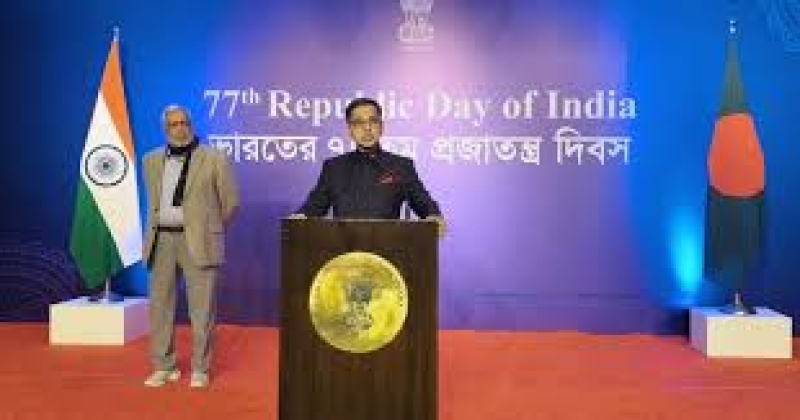
India on Saturday reaffirm the value of its long-standing partnership with Bangladesh and wished the people of Bangladesh peace, prosperity and success on their journey ahead.
"We have and will continue to support a democratic, stable, peaceful, progressive and inclusive Bangladesh," said Indian High Commissioner to Bangladesh Pranay Verma while commemorating India’s Republic Day in the evening.
Energy Adviser Md Fauzul Kabir Khan spoke at the reception held at a city hotel attended by political leaders, senior government officials, diplomats stationed in Dhaka, civil society members, cultural activists, among others.
Today, the High Commissioner said, as two fast-growing economies and aspiring societies, powered by young, skilled, and innovative populations, Bangladesh and India are capable of becoming catalysts for each other’s sustainable growth, enablers of each other’s future prosperity, and anchors for robust regional integration.
"Together, we can build regional value chains, shared digital ecosystems, and energy corridors that serve both our economies," he said.
Together, the High Commissioner said, they can ensure that the region’s energy future is clean, affordable and secure.
He said the two countries can work to address shared challenges of environmental sustainability and climate change for our shared ecology.
"In short, as forward moving societies, there is so much that we can offer to each other, and to our region, when we work together, transforming our geographical proximity into new opportunities," said the High Commissioner.
Collaborations that are anchored in their shared aspirations for prosperity, progress, and partnership, he said.
"Partnership that is rooted in trust. Partnership that is driven by innovation and technology; and a partnership that is nurtured and sustained by mutual interest, mutual benefit and mutual sensitivity," said the High Commissioner.
On 26 January 1950, the people of a newly-independent India gave themselves a new Constitution; declared their country a sovereign republic; and committed themselves to the ideals of justice, liberty, equality, and dignity for all.
In the 76 years since then, India has moved from being an impoverished nation to become the largest democracy and one of the largest economies in the world, a modern, confident nation that is today contributing to global progress and offering solutions to global challenges.
"Bangladesh has been an important co-traveler in this journey of ours. We share a special relationship, along with an indelible history of shared sacrifices during Bangladesh’s Liberation War of 1971," Pranay Verma said.
He said their shared love for literature, music, and art defines the Dhaka-Delhi ties.
"From Rabindranath Tagore and Kazi Nazrul Islam, whose works connect our cultures and literatures, to the rich traditions of dance, theater, and cinema – people of our two nations share a deep cultural affinity," said the High Commissioner.
Over the years, he said their mutual exchanges and shared interdependence have been reinforced by a rapidly transforming landscape of connectivity and economic engagement, bringing their societies, people and businesses closer together.
A cross-border pipeline carrying high-speed diesel from an Indian refinery to Bangladesh; the cross-border power transmission lines, bringing power from both India and Nepal to Bangladesh through the Indian grid –are some examples of how the two countries have, together, laid the foundations of energy connectivity leading to regional economic integration in a true sense, said the Indian envoy.
"Our supply chains fuel Bangladesh’s prolific RMG and pharmaceutical sectors, proving the merits of mutual cooperation and interdependence," the High Commissioner said.
He said there are numerous such examples of how the partnership has brought benefits to the people and businesses on both sides.
Moving forward, the High Commissioner said, these successes inspire us to seek even more forward-looking, and future-ready collaborations, reports UNB.