

- Flood on Nepal-Tibet Border Kills at Least 95 |
- US Suspends Visa Interviews Worldwide for Consular Training |
- Mecca Pact Puts Bangladesh’s Foreign Policy to New Test |
- Remittance reaches $2.34 billion in first 24 days of August |
- BSF men flee leaving behind 2 shotguns, walkie-talkie |
Flood on Nepal-Tibet Border Kills at Least 95
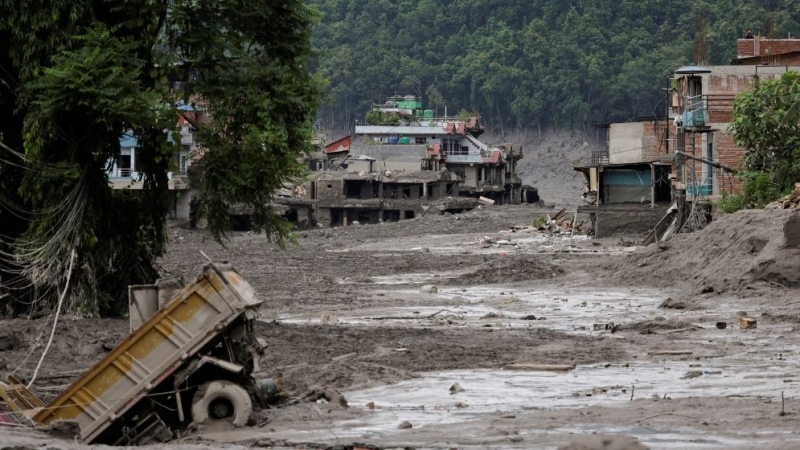
Mud covers a property following a flash flood at Trishuli in Nuwakot district, Nepal, 26 August 2026.
A massive flood triggered by a mudslide along the Nepal-China border has killed at least 95 people and left hundreds of tourists missing, authorities said on Wednesday.
The disaster struck the Himalayan border area after a wall of mud and rock collapsed into a river, sending torrents of water and debris into Nepal's Rasuwa district. Houses, roads, bridges and power infrastructure were swept away.
Verified video footage showed people fleeing as a massive surge of mud, water and debris destroyed buildings and vehicles near the border.
Nepal's tourism authority said at least 384 travellers were missing from the affected region, including 105 Indians, 93 Nepalis, three US citizens and 12 British nationals. About eight South Korean nationals were also reported missing.
Nepal's Foreign Minister Shisir Khanal told parliament that initial reports suggested an earthquake may have triggered an avalanche that caused the flooding, although the exact cause remained unconfirmed.
The German Research Centre for Geosciences said a magnitude-4.4 earthquake occurred about seven minutes before the incident captured on security footage.
An expert at the International Centre for Integrated Mountain Development said an ice-rock avalanche in the Lhende Khola River on the Nepali side may have triggered the disaster. However, the cause has not been conclusively established.
Authorities warned that a second flood could occur because debris remains lodged upstream along the Nepal-China border river. Residents living along the Bhote Koshi River were urged to move to higher ground.
Rescue helicopters were unable to land in some affected areas, including Syapru Besi and Timure in Rasuwa district, because of difficult conditions and debris blocking access routes.
China said the mudslide affected the Gyirong border port, cutting roads, communications and power links in the area. Chinese authorities deployed at least 574 rescuers to the Gyirong crossing.
Nepal's Energy Ministry said the disaster disrupted about 430 megawatts of electricity generation, mostly from hydropower projects.
Police and military personnel joined rescue operations in Nepal, while Chinese authorities also intensified search efforts for the missing.
Indian Prime Minister Narendra Modi said India was ready to provide humanitarian assistance, with teams from the two countries coordinating rescue and relief efforts.
Authorities on both sides of the border warned residents and travellers to remain alert as rescue operations continued and the risk of further flooding remained.