

- A New Arms Race is Threatening to Take-off—Now in Outer Space |
- Equality ‘ends at doors of Security Council’, Kenya’s Ruto at UNGA |
- কলাপাড়ায় প্রাথমিক শিক্ষায় হ-য-ব-র-ল |
- BDRCS and IFRC scale up dengue response to reach 300,000 people |
- World leaders approve new declaration to tackle rising sea levels |
BDRCS and IFRC scale up dengue response to reach 300,000 people
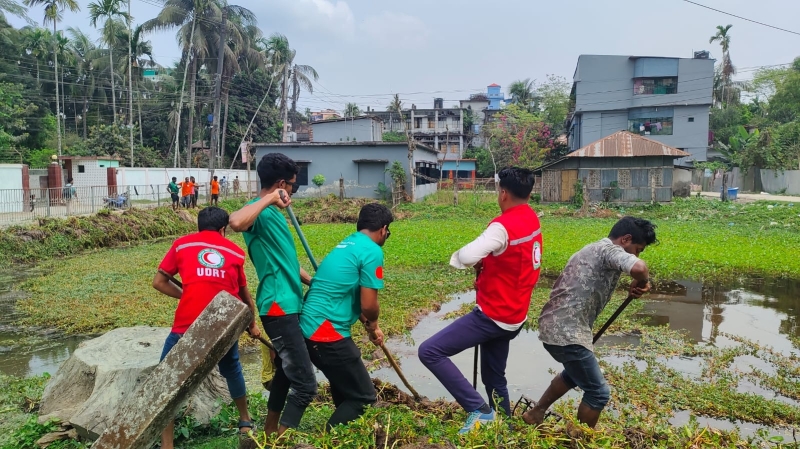
BDRC and IFRC join efforts to fight dengue epidemic in Bangladesh.
Dhaka, 24 September 2026: The Bangladesh Red Crescent Society (BDRCS), with support from the International Federation of Red Cross and Red Crescent Societies (IFRC) and partners, is scaling up its six-month dengue response to support approximately 300,000 people, prioritizing communities and vulnerable families in areas experiencing high dengue transmission.
Supported by the IFRC Disaster Response Emergency Fund (DREF), the operation will focus primarily on Dhaka, Khulna, Barishal, Chattogram, including camps for displaced people from Rakhine State, Myanmar and host communities in Cox’s Bazar. It can be expanded to other affected areas as the situation evolves.
The effort comes as dengue cases have increased sharply following heavy monsoon rains in late August. According to the Directorate General of Health Services (DGHS) data, till 23 September, 67,367 dengue patients had been hospitalised and 201 deaths recorded, compared with over 43,173 hospitalised and 184 deaths during the corresponding period in 2025.
‘This is a rapidly evolving public health situation, and our volunteers and teams are already supporting communities and coordinating closely with health authorities,’ said Md. Habibur Rahman Khan, Secretary General of BDRCS.
‘With support from the IFRC and partners, we are strengthening these efforts to reach more people in high-risk areas and help families cope with the health and economic impacts of dengue’, he added.
The operation complements the Government’s ongoing dengue response, led by the DGHS and supported through national and local health coordination mechanisms.
The BDRCS-IFRC response will combine community awareness, cleaning campaigns, health-service support, blood services and assistance to vulnerable households. Key initiatives include:
• Mobilizing 1,000 Red Crescent volunteers to raise community awareness on dengue prevention, health promotion, household-level awareness and community clean-up activities.
• Support public hospitals and BDRCS health facilities with 100,000 units of IV saline, 50,000 dengue test kits, 3,000 triple blood bags, 100 apheresis kits, and 2,500 mosquito nets.
• Providing one-time multipurpose cash assistance of BDT 10,000 to 2,500 vulnerable dengue-affected households, particularly families facing hospitalization, loss of income and increased healthcare-related expenses.
• Orienting 150 health professionals on the updated national dengue treatment guideline.
The wider Red Cross and Red Crescent network is already supporting the response. Through existing programmes, IFRC has contributed 38,000 NS1 dengue test kits to DGHS and 50 apheresis kits to the BDRCS Dhaka Blood Centre. Community engagement and surveillance activities are also ongoing.
‘Dengue is placing growing pressure on families, communities and health services across Bangladesh. While treatment and healthcare support are essential, preventing infections starts at the community level through awareness, early action and efforts to reduce mosquito breeding sites,’ said Seval Guzelkilinc, Head of Delegation, IFRC in Bangladesh.
She also said, ‘The strength of this response lies in linking community action with access to timely health services. Through the Bangladesh Red Crescent's volunteer network and close coordination with health authorities, we can help people protect themselves, access timely support and reduce the impact of dengue on the most vulnerable communities.’
Since dengue cases began rising, BDRCS has supported the national response through community awareness, cleanliness activities, health services and blood centres. On 12 September, it mobilized 1,000 volunteers for the Government’s nationwide dengue prevention campaign. – Press release