

- Trump says top tech firms have signed accord to 'self-police' AI dev |
- France Student Protests Spread Nationwide, Over 400 Detained |
- State Minister Amit urges global firms to join BD offshore bidding |
- Heart Disease Linked to 777 Daily Deaths in Bangladesh |
Dhaka to build ‘Strategic Energy Reserves’, amid uncertainty
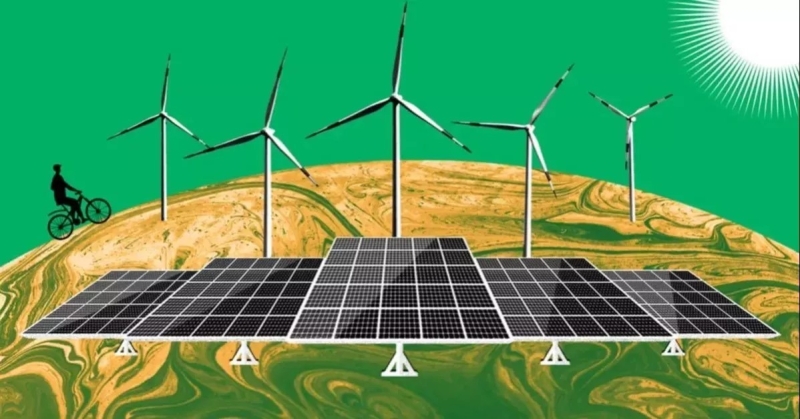
Energy mix - Fossil, solar and wave.
In a major step towards bolstering energy security, the government has launched initiatives to build Strategic Energy Reserves and supporting storage facilities to help safeguard fuel supplies against global market volatility and emergency disruptions while maintaining regional balance.
To address volatility in global markets and ensure uninterrupted supply during emergencies, initiatives have been undertaken to develop ‘Strategic Energy Reserves’ and related storage infrastructure, which will play an important role in strengthening national energy security and maintaining regional balance,according to a budget document.
According to the document, measures are being taken to establish cost-effective and sustainable infrastructure to maintain energy prices at affordable levels.
To further enhance energy security, the establishment of an additional LNG terminal at Moheshkhali is under review alongside the two existing floating LNG terminals.
Besides, the process of land acquisition and consultant appointment for a land-based LNG terminal at Matarbari, Moheshkhali is at its final stage.
An action plan is being formulated to supply gas from Bhola region to the national gas grid.
Installation of prepaid gas meters is being accelerated to reduce wastage, eliminate illegal connections and minimise system losses.
To reduce risks associated with imported energy and ensure continuity of supply, the government is pursuing a policy of energy source diversification.
This strategy seeks to reduce excessive dependence on the Middle East by expanding energy import cooperation with other potential regions, including Asia, Africa and Europe.
At the same time, initiatives are being undertaken to attract new investment through increased private sector participation, investment-friendly policies and the expansion of Public-Private Partnerships (PPP) in the energy sector.
Thr budget document said initiatives have been undertaken to ensure maximum utilisation of the existing 601.50 kilometres of fuel transportation pipelines.
To increase petroleum refining and storage capacity, the government has adopted a phased plan to establish a new crude oil refinery with an annual refining capacity of 50 lac metric tonnes in Chattogram or another coastal industrial zone.
As part of this initiative, steps have been taken to establish the Second Eastern Refinery Limited (ERL-2) with a capacity of approximately 30 lac metric tonnes.
In addition, a Smart Fuel Distribution Monitoring System has been introduced in 2,722 fuel tank lorries to strengthen monitoring of fuel transportation.
Measures have also been undertaken to operationalise the Single Point Mooring (SPM) facility for petroleum unloading.
To ensure the optimal utilisation of the country's mineral resources, production targets of 6 lac metric tonnes of coal and 14 lac metric tonnes of stone have been set for FY2026-27.
New projects have been undertaken for the development of the Barapukuria Second Phase and the Dighipara Coal Field to enhance coal extraction.
The government is also working towards the economic evaluation of valuable minerals such as zircon and monazite contained in the sands of the Jamuna and Meghna rivers, as well as the digital transformation of services provided by the Department of Explosives.
The document stated that prolonged policy failures, institutional irregularities, mismanagement and import dependency in the energy sector under the fascist government have plunged the sector into a deep crisis.
During that period, excessive emphasis was placed solely on the import of Liquefied Natural Gas (LNG) and petroleum products.
No meaningful initiatives were undertaken to explore gas resources onshore or in the Bay of Bengal, nor to expand refining and storage capacities for petroleum products.
Due to recent geopolitical tensions in the Middle East, international spot prices of petroleum products (particularly diesel) and LNG have risen abnormally.
Considering the hardships faced by the general people , the government has provided substantial subsidies to the energy sector and made only limited adjustments to fuel prices.
At the same time, gas supply has been maintained and gas prices have remained unchanged.
As per the budget document, the government has undertaken a range of initiatives to strengthen energy security by intensifying oil and gas exploration activities, increasing domestic production, expanding petroleum refining capacity and diversifying import sources.
It will establish a strategic fuel reserve system. The government is prioritising the exploration and production of natural gas both onshore and offshore.
The government is also giving priority to strengthening domestic capacity, the document stated.
Through the Bangladesh Petroleum Exploration and Production Company Limited (BAPEX), plans have been adopted to undertake 270 km of geological surveys, 700 line-km of two-dimensional (2D) seismic surveys and 700 square kilometres of three-dimensional (3D) seismic surveys during the period from FY2025-26 to FY2027-28. BAPEX also plans to drill 69 wells and carry out workover operations on 31 wells using its own drilling rigs.
Bangladeshcultural events
A new Bangladesh Offshore Bidding Round has been announced to facilitate oil and gas exploration in offshore areas.
In order to attract offshore exploration and production activities and ensure participation by international oil companies, the Model Production Sharing Contract (PSC) has been revised while safeguarding national interests.
Nine shallow-water blocks and fifteen deep-water blocks have been opened for international oil companies, where exploration activities will be undertaken under production-sharing agreements.
Furthermore, initiatives have been taken to procure two new exploration rigs for BAPEX to enhance national exploration capacity. Through the critical mineral exploration initiative, the Government is also placing special emphasis on offshore gas and unconventional hydrocarbon exploration beyond conventional energy resources. - UNB