

- Nepal-China flood death toll rises to 691, more than 3,000 missing |
- International Day of the Disappeared Today: 250 Cases Probed |
- Rising seas, rising stakes: What higher sea-levels mean to humanity |
- Nepal Disaster and Hydropower |
- Govt to Compensate Victims of Enforced Disappearance |
Beauty and Life in a War-Torn Strait of Hormuz
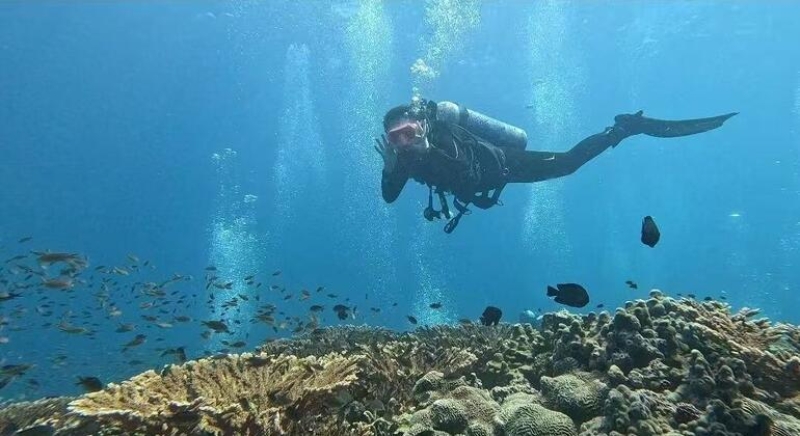
Diving near the war-torn Strait of Hormuz, Shanshan Du discovered an underwater world shaped by coral reefs, schools of fish, and ocean currents.
When US and Israeli forces launched strikes on Iran on 28 February, triggering one of the most serious geopolitical crises in years, the Strait of Hormuz—a narrow channel just 34 kilometres wide at its narrowest point—became a global flashpoint overnight.
Iran closed the waterway to foreign shipping, attacking merchant vessels and cutting off around 20 percent of the world’s seaborne oil trade. Some 20,000 seafarers were stranded in the Persian Gulf. The United Nations Secretary-General called for an immediate ceasefire.
Beneath all of it, the fish kept swimming.
Back in the Water
Three Chinese divers based in the United Arab Emirates (UAE)—diving instructor Rui Li, freediver Shanshan Du, and technical diver Jie Zhang—had been kept out of the water for weeks due to the coastal closure. When a ceasefire allowed limited access in mid-April, they immediately returned.
World Oceans Day, marked each year on 8 June, carries this year’s theme: “Reimagining the Relationship Between Humans and the Ocean.” For these three divers, that idea is far from abstract.
“We were actually a little worried before setting off,” said Du, who dived the narrowest stretch between the UAE and Oman on 18 April, just days after the UN welcomed Iran’s announcement that the strait would be open to commercial vessels during the ceasefire.
“But after more than two months, it was fantastic to be able to dive again. We encountered a large group of dolphins. There was none of the war-torn atmosphere I had imagined—only peace and beauty before my eyes.”
Zhang, who dived the area as recently as last week, described coral diversity rarely seen elsewhere, with soft and hard corals shaped by varying topography, and sea turtles gathering in large numbers, resembling a natural reserve.
She also noticed something more troubling.
“I saw more white debris on the seabed than before,” she said, unsure of its origin. “When we followed dolphins near the eastern side of the strait, the water around them was streaked with green algae, oil fumes, and floating rubbish.”
“I used to see clear blue water when chasing dolphins. Seeing this now is heartbreaking.”
Li is careful to hold both realities together. The strait is not the world’s most biodiverse marine zone, he notes, but its complex topography sustains coral formations “as white as silver needles” alongside others “as purple as pine forests,” as well as seahorses, whale sharks, and rare species.
He describes a boat captain who, unable to dive and lacking communication tools, could reliably find dolphins that seemed to recognize him.
“We would greet each other and then go our separate ways,” Li said. “This place is truly magical.”
Potential Catastrophe
Yet Li is also acutely aware of what armed conflict can do to such an environment. An attack on oil storage facilities, he warned, could be catastrophic for marine life.
“Many marine organisms are small and vulnerable. A single attack could wipe out species that humans have never even seen,” he said.
Zhang framed the ocean’s vulnerability more bluntly:
“No one can speak for the underwater ecosystem. Fish cannot speak, and neither can large animals.”
“We dump all our disputes, wars, and pollution into the ocean, ignoring the fact that it has no ability to protect itself and must bear the consequences of human activity.”
Underwater, she said, borders disappear. “Ocean currents and schools of fish move freely. Whale sharks follow routes across countries. They are free. Humanity should share this blue world instead of dividing it with conflict.”
Mother Ocean
Li offers a different metaphor—warmer and more reflective.
The relationship between people and the sea, he suggests, is like that between a child and a parent: the ocean sustains, nurtures, and sometimes punishes.
“We are old enough to try to protect it,” he said, “but what we can actually do remains small. Our parent ocean continues to quietly sustain us.”
Du, diving in a country where people of many nationalities meet, says the underwater world erases borders entirely. Communication happens only through gesture.
“Because of this hobby and the ocean, it creates a wonderful shared space for us,” she said.
Above the surface, tensions continue. Talks between Washington and Tehran remain fragile and volatile. But with 71 percent of the Earth covered by ocean, Li leaves a simple message: “Come and feel the water whenever you can.”