

- Kaptai Dam gates opened to 1 foot as lake water rises |
- Nepal-China flood death toll rises to 691, more than 3,000 missing |
- International Day of the Disappeared Today: 250 Cases Probed |
- Rising seas, rising stakes: What higher sea-levels mean to humanity |
- Nepal Disaster and Hydropower |
Middle East Conflict Hits Bangladesh Labour Market
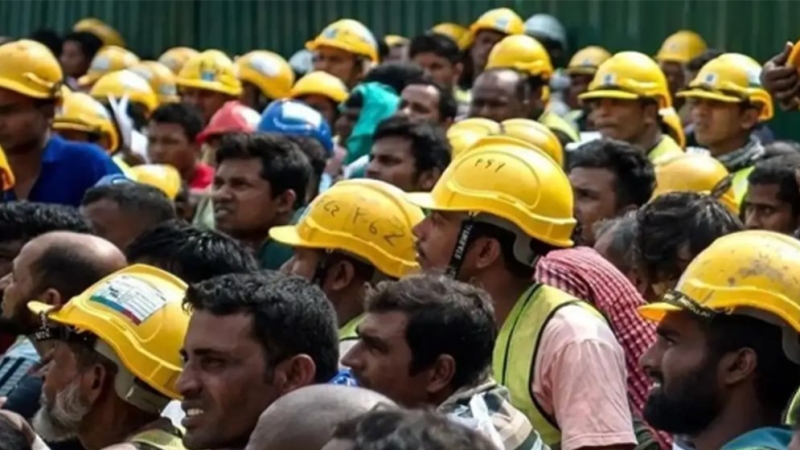
Bangladesh’s overseas labour market in the Middle East has come under renewed strain as the ongoing United States–Israel–Iran conflict disrupts worker recruitment, raises travel costs and forces some migrants to return home.
After gradually recovering from the economic shock of the COVID-19 pandemic, overseas employment in the region has again slowed, threatening remittance inflows and creating fresh uncertainty for thousands of aspiring migrant workers.
Officials and labour market analysts say demand for Bangladeshi workers in key destinations such as Saudi Arabia, Kuwait and Qatar has declined sharply since tensions escalated in the Middle East earlier this year.
According to data from the Bureau of Manpower, Employment and Training (BMET), 153,636 Bangladeshi workers went abroad for jobs between March and May this year, down from 260,438 during the same period last year — a decline of nearly 41 per cent.
Analysts say companies in sectors such as construction, tourism, services and trade have become more cautious about hiring due to uncertainty caused by the conflict.
The crisis has also disrupted travel. Hundreds of flights to Middle Eastern destinations have reportedly been cancelled or rescheduled, delaying worker departures and driving up airfares. Tickets that previously cost between Tk 50,000 and Tk 55,000 are now priced between Tk 90,000 and Tk 100,000 or more.
Bangladesh’s labour market remains heavily dependent on the Middle East, with Saudi Arabia, Qatar, Kuwait, the United Arab Emirates and Oman serving as major destinations for migrant workers.
Saudi Arabia continues to receive the highest number of Bangladeshi workers. BMET data show that from January 1 to June 5 this year, 314,362 Bangladeshis secured overseas jobs, including 190,072 in Saudi Arabia, 23,780 in Qatar, 8,753 in Kuwait, 7,353 in Jordan, 7,121 in the United Arab Emirates and 3,091 in Iraq.
However, concerns are mounting over job security and future recruitment.
A Bangladeshi expatriate running a restaurant in Dubai said the conflict had affected tourism and business activity in the United Arab Emirates, significantly reducing income and making it difficult to support family members back home.
Industry insiders also warn that visa processing and recruitment have slowed in several labour destinations. Some travel routes remain disrupted due to flight uncertainty and rising fuel costs.
Migration experts say Bangladesh’s continued dependence on a limited number of labour markets has increased vulnerability during regional crises.
They argue that despite years of discussion, insufficient efforts have been made to diversify labour destinations or strengthen workforce skills to access higher-income markets.
Experts also warn that prolonged instability in the Middle East could negatively affect remittance inflows if workers face job losses or wage disruptions.
They urged stronger bilateral agreements, expanded technical training and diplomatic efforts to explore alternative labour markets.
Some Bangladeshi workers have already returned from conflict-affected countries. Government-supported repatriation efforts have so far brought back more than 200 Bangladeshis from Iran and hundreds more from Bahrain this year.
The latest disruption has renewed concerns over the sustainability of Bangladesh’s labour migration model, with experts calling for greater emphasis on skilled migration and long-term workforce planning.