

- FY27 Budget Reflects Public Aspirations: Khosru |
- 3 Red Cards Mar Mexico vs South Africa World Cup Opener |
- Hwang In-beom inspires South Korea's 2-1 victory over Czech Republic |
- TIN mandatory for opening bank Ac; excise duty ceiling Tk 4 lakh |
- Tk 9.38 lakh crore budget with Tk 2.43 cr deficit placed |
Ocean Services Drive $2.5 Trillion Marine Trade
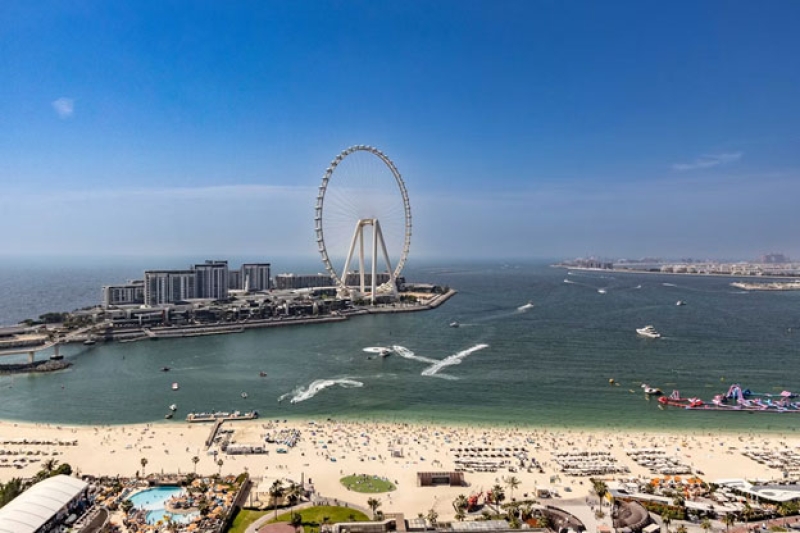
An aerial view of a beach with a ferris wheel, Ain Dubai, Bluewaters, Dubai, UAE.
The global ocean economy continues to expand, with ocean-related trade reaching USD 2.5 trillion in 2025. Ocean services now account for the majority of ocean trade, making up 58.9 percent of the total, up from 47.8 percent in 2020.
Ocean services alone are now valued at USD 1.44 trillion, marking an increase of USD 1.2 trillion since 2020 — a rise greater than the total size of global ocean trade in 2020. Compared with 2015, ocean services trade has grown by USD 476 billion, or 49.5 percent, from USD 961 billion.
“The ocean economy is expanding rapidly across sectors such as aquaculture, tourism and shipping. While this growth is vital for food security, employment and economic development, it is increasingly constrained by the declining health of the ocean,” said Rafael González Quiroz, co-director of the United Nations’ Third World Ocean Assessment and director of Spain’s Oceanographic Centre of Gijón (IEO-CSIC), during a press briefing held on World Ocean Day on June 8.
The UN World Ocean Assessment is a comprehensive global review of the ocean’s environmental, economic and social conditions. The report incorporates interdisciplinary contributions from more than 650 experts to provide a scientific basis for governments and policymakers addressing ocean-related challenges.
Quiroz said the findings reflect broader changes in the global ocean economy, with services playing an increasingly dominant role. One major example is the strong recovery of marine and coastal tourism following the COVID-19 pandemic.
Marine and coastal tourism now accounts for 32 percent of global ocean trade, up from 16 percent in 2020. The sector is valued at USD 785 billion, representing more than half of all ocean services trade. Maritime freight transport ranks second, generating roughly USD 487 billion, or 20 percent of total ocean trade.
Quiroz stressed that “a sustainable ocean economy can only exist if it is built upon a healthy and resilient ocean.”
Marine pollution, particularly plastic waste, remains one of the key challenges highlighted during the briefing. Globally, only 10 percent of plastics are recycled, while an estimated 52 million tonnes of plastic waste enter the ocean each year, affecting at least 4,000 marine species, according to the United Nations.
In response, the international community has spent the past six years negotiating a proposed global plastics treaty aimed at limiting plastic production and regulating the USD 1.1 trillion plastics industry. The agreement seeks to strengthen waste management standards, boost recycling requirements and create market opportunities for sustainable alternatives.
Achieving these goals may require changes in global trade incentives. According to UN Trade and Development (UNCTAD), “the key barrier is an uneven national and trade policy field.”
UNCTAD data show that tariffs on plastics have dropped from 34 percent to 7.2 percent over the past three decades, encouraging increased plastic production. Meanwhile, tariffs on alternatives such as bamboo, natural fibres, paper and seaweed have doubled to 14.4 percent, leaving conventional plastics as the cheaper option for manufacturers.
However, recent volatility in global energy markets linked to the Strait of Hormuz crisis has increased plastic production costs. UNCTAD reports indicate that, because plastics are around 98 percent fossil fuel-based, plastic prices in European markets have risen by 70–80 percent.
This market shift could create new opportunities for sustainable alternatives, encouraging companies to develop products that reduce dependence on polyethylene resin and other conventional plastics.