

- Umrah pilgrim from Cumilla killed in Riyadh airport attack |
- Senior Secy to represent Dhaka at 1st BIMSTEC HMs’ meet in Delhi |
- Rooppur Nuclear Power Plant achieves nuclear criticality |
- PM Orders Proper Use of Public Money for National Interest |
- PM Seeks Marubeni Investment in AI Data Centre, KAFCO |
Urgent action urged to save once-thriving Mathabhanga River
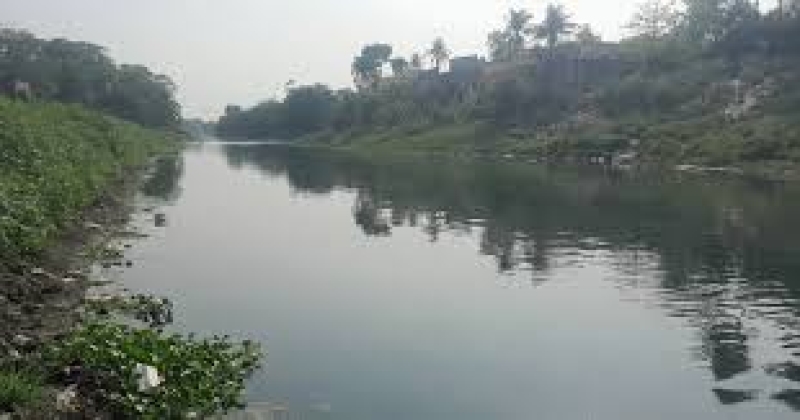
The Mathabhanga River, once known for its strong current and clear water, now faces severe pollution and encroachment, raising concerns among local residents and environmental activists over its future.
The 121-kilometre transboundary river, which flows through Chuadanga district town, has lost much of its natural flow due to years of pollution, encroachment and poor management.
While some stretches hold water during the monsoon, large parts of the river dry up in the dry season, resembling a stagnant canal.
Visiting different areas along the river, it was found that several municipal drains discharge untreated wastewater directly into the river. Waste from households, hotels, restaurants and markets, including plastic and other solid waste, is regularly dumped into the water, turning it black and producing a foul smell along the riverbanks.
Residents also alleged that illegal structures have been built on both sides of the river, narrowing its channel. Silt accumulation and the lack of regular dredging have further reduced its flow.
"I used to swim in this river with my friends when I was young 25 years ago. There was plenty of water and a strong current. Now, it is difficult to stand near the river because of the bad smell," said local resident Rimon Ali.
Another resident, Rabiul Mia, said boats once sailed on the river, but it has now become heavily silted and resembles a drain.
Principal Shahjahan Ali, former general secretary of the Save Mathabhanga River Movement, alleged that influential individuals and institutions had occupied parts of the river and its banks, affecting its natural course.
Hamidul Haque Munshi, convener of the organisation, blamed poor municipal waste management for the river's condition and called for immediate administrative action to protect it.
Executive Engineer of the Chuadanga Water Development Board Arif Ahmed acknowledged that the river has been affected by encroachment and pollution. He said the issue has been reported to the ministry and steps are being planned to restore the river.
Sharmin Akhter, administrator of Chuadanga municipality and deputy director of the Local Government Division, said some municipal drains discharge waste into the river.
She said the relevant officials have been instructed to take necessary measures after the matter came to her attention.
Experts say the Mathabhanga is an important source of several rivers in the south-western region, including the Chitra, Nabaganga and Bhairab.
They warned that further degradation of the river could have serious consequences for the region's environment, biodiversity and river ecosystem.
"I used to swim in this river with my friends when I was young 25 years ago. There was plenty of water and a strong current. Now, it is difficult to stand near the river because of the bad smell," said local resident Rimon Ali.
Another resident, Rabiul Mia, said boats once sailed on the river, but it has now become heavily silted and resembles a drain.
Principal Shahjahan Ali, former general secretary of the Save Mathabhanga River Movement, alleged that influential individuals and institutions had occupied parts of the river and its banks, affecting its natural course.
Hamidul Haque Munshi, convener of the organisation, blamed poor municipal waste management for the river's condition and called for immediate administrative action to protect it.
Executive Engineer of the Chuadanga Water Development Board Arif Ahmed acknowledged that the river has been affected by encroachment and pollution. He said the issue has been reported to the ministry and steps are being planned to restore the river.
Sharmin Akhter, administrator of Chuadanga municipality and deputy director of the Local Government Division, said some municipal drains discharge waste into the river.
She said the relevant officials have been instructed to take necessary measures after the matter came to her attention.
Experts say the Mathabhanga is an important source of several rivers in the south-western region, including the Chitra, Nabaganga and Bhairab.
They warned that further degradation of the river could have serious consequences for the region's environment, biodiversity and river ecosystem, reports UNB.