

- Dhaka's air 5th worst in the world this morning |
- Around 7,500 Bangladeshis imprisoned in Saudi Arabia: Shama Obaed |
- Bangladesh Outperforms India in Global Hunger Index 2026 |
- Covered van hits Gazipur police patrol team, killing SI, BNP leader |
- Korean City scrambles to rescue dusky shark after it returns to canal |
UN Warns of Rising Pressure on Scarce Water Resources
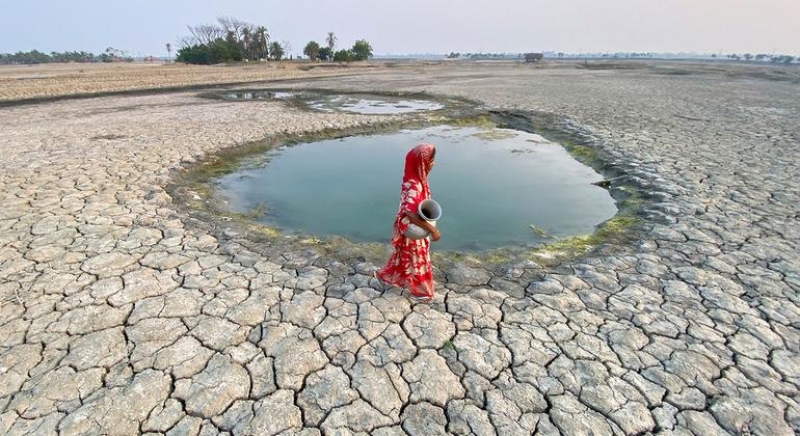
A woman collects water in drought-affected Satkhira district in western Bangladesh.
Pressure on freshwater resources is growing as demand rises in regions already affected by scarcity, the UN Food and Agriculture Organization (FAO) said in a report published on Friday.
The report provides an update on renewable water availability, which refers to the amount of freshwater replenished each year in rivers and aquifers through precipitation.
Renewable water availability per person has declined by seven per cent over the past decade — from 5,719 to 5,326 cubic metres (m³), according to the 2025 AQUASTAT Water Data Snapshot.
Regions such as Northern Africa, Southern Asia and Western Asia have the lowest freshwater resources per capita, with Kuwait, the United Arab Emirates, Qatar and Yemen ranking among the countries with the lowest total renewable water resources.
Increase in Freshwater Withdrawal
Several regions have also seen an increase in freshwater withdrawals in recent years, adding strain to already stressed river basins and aquifers.
“Northern Africa saw the largest increase, with freshwater withdrawals rising by 16 per cent,” the report said.
Globally, nearly 70 per cent of withdrawals came from surface water sources, while 23 per cent were drawn from groundwater.
Water for Agriculture
Agriculture remains the largest water-using sector, accounting for about 72 per cent of global freshwater withdrawals. The industrial and service sectors followed at 15 per cent and 13 per cent, respectively.
Sixty-six countries allocated more than 75 per cent of their total freshwater withdrawals to agriculture. In Afghanistan, the Lao People’s Democratic Republic, Mali, Nepal, Somalia and Sudan, the figure reached 95 per cent.
Shift in Availability and Demand
The report also shows how water availability and demand are shifting across regions.
In North Africa, freshwater availability per capita remains among the lowest globally, while withdrawals have increased by 16 per cent over the past decade.
In Western Asia — which the report defines as including most Middle Eastern countries — rapid population growth and rising agricultural demand are increasing pressure on limited water supplies.
Irrigation and Efficiency
The report highlights wide disparities in irrigation coverage and water-use efficiency across cultivated land.
“In parts of Latin America and Asia, irrigation supports a large share of crop production, whereas in sub-Saharan Africa, irrigated cropland represents only a small fraction of total cultivated land, reflecting persistent gaps in access to water infrastructure,” FAO said.
At the national level, Bahrain, Egypt, Saudi Arabia, Suriname and Uzbekistan reported the highest irrigation coverage, with more than 90 per cent of cultivated land equipped with irrigation infrastructure.
In contrast, about 35 countries — mainly in sub-Saharan Africa — had less than one per cent of cultivated land under irrigation.