

- Another July warrier shot in head, critical in Khulna hospital |
- NCP Khulna Chief Critically Shot Amid Rising Political Violence |
- Indian MP Warns Bangladesh Faces Rising Lawlessness |
- Law and Order Must Be Ensured Ahead of Polls: Prof Yunus |
- Tough times ahead, everyone must remain united: Tarique Rahman |
Farmers Can Measure Carbon and Earn From Fruit Trees
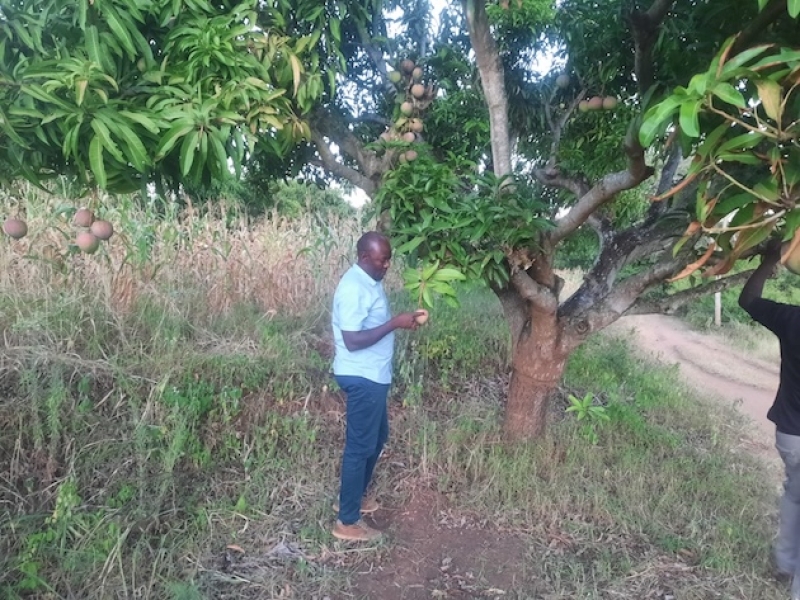
Jomo Kenyatta University of Agriculture and Technology (JKUAT) researcher Shem Kuya sampling a mango tree on a farm in makueni county.
Farmers can now measure and benefit from their contribution to climate change mitigation, thanks to a formula that calculates the amount of carbon stored in fruit trees.
Under a project titled Fruit Trees for Climate Change Mitigation and Adaptation in East Africa, the Jomo Kenyatta University of Agriculture and Technology (JKUAT), in collaboration with ICRAF, has developed a mathematical formula that enables farmers to determine how much carbon their fruit trees store.
The formula uses allometric equations in which farmers input a tree’s diameter to estimate its biomass, which is then used to calculate the amount of carbon stored. The project aims to encourage farmers to plant more fruit trees as a means of promoting climate change mitigation.
The formula primarily targets avocado and mango trees, the most common fruit trees grown by farmers practicing agroforestry in Kenya.
Traditionally, trees had to be cut down to determine their carbon content. With this new method, farmers can assess the carbon stored in a tree simply by taking measurements and performing a basic calculation, eliminating the need to fell the tree.
This knowledge allows farmers to better understand their role in climate change mitigation while protecting their livelihoods. It also helps them negotiate fair compensation in the rapidly growing carbon credit market.
Farmlands Key to Climate Change Control
According to Shem Kuyah, the researcher behind the formula, carbon sequestration has traditionally been associated with forests. However, rising human populations and increased deforestation have reduced forest cover, creating an urgent need for alternative carbon absorption strategies. Farmlands, he said, offer a viable solution through agroforestry.
Kuyah, a lecturer in the Department of Agroforestry at JKUAT, said one of the project’s main goals is to train farmers and raise awareness about the importance of tree planting for climate control.
As forest reserves declined despite the growing need for trees, farmlands were identified as suitable spaces for expanding tree cover through agroforestry. Since farmers depend on their land for income, the project focused on economically beneficial tree species.
Research found that farmers preferred fruit trees, with mango and avocado being the most commonly planted species.
Carbon Trade Incentive
Beyond environmental benefits, the project provides farmers with an added financial incentive by linking fruit tree planting to the carbon credit market.
Carbon credits are tradable certificates representing one metric tonne of carbon dioxide, or its equivalent, reduced or removed from the atmosphere. They allow high-emitting entities to offset emissions by supporting projects such as reforestation or renewable energy initiatives.
Kuyah explained that the project developed two formulas: a general one applicable to all tree species and a species-specific formula designed for fruit trees. The latter is more accurate, with a margin of error of about five percent, compared with up to 40 percent for the general formula.
By enabling farmers to quantify carbon without cutting down trees, the initiative promotes tree planting while supporting both livelihoods and climate action.
Global Climate Context
Ten years after the Paris Agreement set goals to limit global temperature rise and achieve net-zero emissions, many countries have struggled to meet their commitments. Carbon emissions are projected to reach record highs, underscoring the need for effective mitigation strategies and financing mechanisms.
Recent global climate talks have emphasized the expansion and standardization of carbon markets to mobilize funding for climate action and ensure transparency and fairness.
How Farmers Benefit
Since Kenya joined the carbon credit market in 2023, some farmers and landowners have raised concerns about inadequate compensation and lack of transparency in carbon offset agreements.
The fruit tree project seeks to address these concerns by training farmer cooperatives and extension officers to calculate carbon stored in trees accurately. This empowers farmers with knowledge and strengthens their position when negotiating carbon credit agreements.
Using a simple tape measure and calculator, farmers can determine the carbon value of their trees. An Excel-based tool has already been provided, and a mobile application is being developed to automate the process further.
By combining climate education, technology, and income generation, the initiative offers a practical solution that supports both environmental protection and rural livelihoods.