

- PM to address UNGA in Bangla today |
- UNGA President Warns Against Fading Attention to Rohingya |
- PM Proposes Five Urgent Steps to Resolve Rohingya Crisis |
- Govt Appoints Indonesian Firm to Operate Cox’s Bazar SPM |
- ADB lowers Bangladesh’s growth forecast to 4 % in FY2027 |
Harnessing Renewable Energy for Fisheries Protection Urged
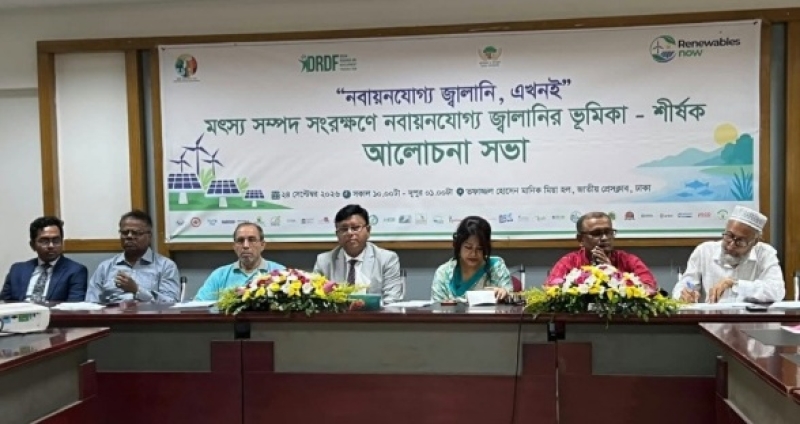
Speakers at a seminar on Renewable Energy for the Protection of Fisheries, Now, held at the National Press Club on Thursday, 24 Sept. 2026.
GreenWatch Desk
DHAKA, September 24, 2026 — As Bangladesh strives to secure its environmental future, the fisheries sector has emerged as the most prepared and strategic partner to help the nation meet its clean energy targets. This consensus was highlighted today during a seminar titled "Renewable Energy for the Protection of Fisheries, Now," held at the Tofazzal Hossain Manik Miah Hall of the National Press Club. The keynote paper was presented by Mir Mohammad Ali, Assistant Professor of the Department of Aquaculture at Sher-e-Bangla Agricultural University and Chairman of the Development Research and Development Foundation (DRDF).
Speakers - Eng Md Ashraf Uddin Bakul MP, Bithika Binte Hossain MP, Mostafa Kamal Majumder, Editor, GreenWatch Dhaka, Dr. Md. Anisur Rahman, ex-Principal Scientific Officer, BFRI, senior journalist Rafiqul Islam Azad and Abdul Qayyum, former District Fisheries Officer, DoF among others
The Government of Bangladesh has set an ambitious target to source 20% of its total electricity from renewable sources by 2030, and 30% by 2040. This includes a goal of generating 5,500 MW from rooftop solar and 4,500 MW from land-based solar installations. Currently, the country’s solar capacity stands at approximately 1,462 MW. Experts emphasize that the fisheries value chain—encompassing hatcheries, shrimp enclosures (ghers), fishing boats, fisherman villages, landing centers, ice plants, cold storage units, and dried-fish processing centers—is uniquely positioned for solar integration. Utilizing the banks of aquaculture enclosures, embankments, and the expansive roofs of ice plants and cold storages offers dual benefits. It provides space for solar panels while matching the high daytime electricity demand required for oxygen pumps, aerators, and ice production. Adopting solar technology across these stages could reduce farm fuel and energy costs by up to 80%. A successful precedent already exists in Chapainawabganj, where an 800 kW floating solar power plant on a fish pond has been supplying electricity to the national grid since 2023 without disrupting traditional fish farming.
The fisheries sector remains a vital pillar of the national economy. In the 2024–25 fiscal year, Bangladesh produced 5.111 million metric tons of fish, contributing 2.58% to the total GDP and 22.03% to the agricultural GDP. The sector directly supports the livelihoods of roughly 26 million people. However, growth has slowed to a five-year low of 1.85%. Marine fish catches have declined from 706,000 tons to 568,000 tons annually. Furthermore, the share of open-water catches (from rivers, haors, and beels) has drastically dropped from 63.59% in 1983–84 to just 28.13% in 2023–24. Alarmingly, 64 out of 253 freshwater fish species in Bangladesh are now endangered. The national fish, Hilsa (Ilish), is facing a similar crisis. Production dropped from 571,000 tons in 2022–23 to 504,000 tons in 2024–25, with informal estimates for the current year falling below 500,000 tons. The average length of a caught Hilsa has shrunk from 14.56 inches to 13.39 inches, heavily linked to a 68% reduction in Hilsa food-plankton within the Meghna River.
The keynote paper raised critical environmental concerns regarding the proximity of coal-fired power plants to delicate marine sanctuaries. The 1,320 MW Payra Power Plant sits directly adjacent to the Andharmanik Hilsa Sanctuary, while the Tetulia Sanctuary is located just 10 kilometers upstream. Together, these sanctuaries yield nearly 10,000 tons of Hilsa annually. Coal transportation routes pass directly through the Galachipa River, which serves as a primary upstream migration route for the fish. Other heavy industries include another 1,320 MW plant at the Rabnabad channel, a 307 MW plant on the banks of the Bishkhali River in Taltali, and the 1,320 MW Rampal Power Plant near the Pshur River by the Sundarbans. Research indicates that water temperatures in these sanctuary zones have risen by up to 3.5°C since operations began. Soil and water studies near Payra have confirmed heavy metal contamination—including arsenic, mercury, and cadmium—leaching from coal ash into the aquatic ecosystems. While Hilsa depletion is driven by multi-faceted issues such as loss of navigability, illegal netting, overfishing, and climate change, experts note that coal-plant pollution is a high-pressure factor that can be avoided through smarter policy shifts.
A positive shift in government policy was recently shared in Parliament. The government announced that the second phase of the Rampal project will pivot away from coal to feature a 460 MW solar power plant. Additionally, a 70 MW solar project will be built over the unused ash pond at the Matarbari site. The Power Development Board’s combined 442 MW project will be executed across 198.5 acres of vacant land at Rampal, leveraging the existing transmission grid infrastructure. This $1.9 billion investment is expected to introduce major cost savings and radically alter the local energy landscape.
To ensure long-term sustainability, environmental advocates have proposed a Seven-Point Recommendation Framework:
• Rigorous Monitoring: Enforce strict environmental compliance and oversight on all residential and industrial projects encroaching on transit links and the distribution grid.
• Localized Infrastructure: Construct regional micro-grids, implement smart grid piloting, and set up wind-resilient energy systems near coastal dikes and embankments.
• Dedicated Funding: Establish a national "Coal-to-Renewable Transition Fund" to systematically phase out fossil fuels.
• Targeted Allocations: Explicitly allocate and earmark specific "renewable" quotas within the broader 10,000 MW national goal.
• Agricultural Modernization: Standardize and incentivize the use of solar-powered pumps, aerators, and efficient drainage systems tailored for riverine and coastal terrains.
• Inter-Agency Clearance: Make it mandatory to seek formal evaluations and clearances from the Department of Fisheries and the BIWTA before designating sites for power infrastructure.
• Just Rehabilitation: Provide fair compensation and sustainable relocation frameworks for communities and local populations affected near the Sundarbans.