

- $7.3 Trillion Fuels Nature Destruction, Guterres Warns |
- Infantino apologizes for World Cup furore but critics unhappy |
- Teesta irrigation project: Water in canals inadequate to enter fields |
- Biodiversity Targets Lag as UN Warns of a War on Nature |
- 18 railway coaches made in India set to arrive this afternoon |
Govt Pledges Stronger Tobacco Control: State Minister
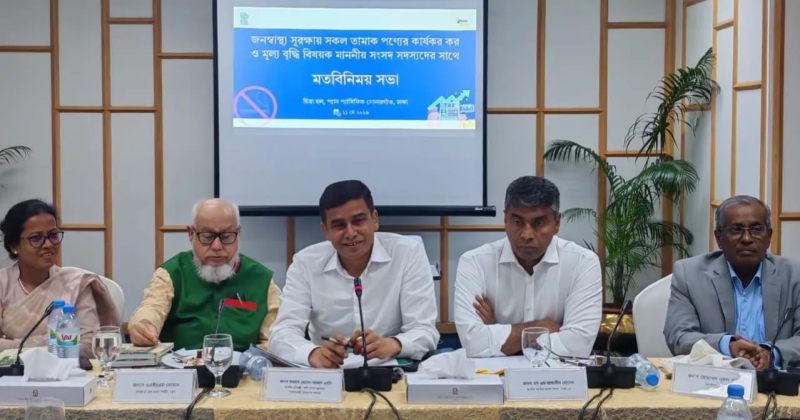
State Minister for Water Resources Farhad Hossain Azad has said that protecting public health and strengthening tobacco control are key commitments in the government’s election manifesto.
He made the remarks at a discussion held at the Pan Pacific Sonargaon Hotel in Dhaka, organized by the Development Organisation of the Rural Poor (DORP), where speakers called for stronger taxation and higher prices on tobacco products in the upcoming national budget for FY2026–27.
The state minister said tobacco control laws must be reinforced with effective taxation and regular price adjustments. Citing recent data, he noted that prices of essential goods rose by 27 to 89 percent between 2021 and 2023, while cigarette prices increased only by 6 to 15 percent during the same period.
He warned that cigarettes have become relatively cheaper in real terms, making them more accessible despite rising living costs, particularly among young people and low-income groups. He also said tobacco companies often target youths to secure long-term consumers and pledged to raise the issue in Parliament and with policymakers.
A keynote presentation at the event highlighted that Bangladesh currently follows a four-tier cigarette pricing system—low, medium, high, and premium—where around 90 percent of cigarettes sold fall into the low and medium categories. This, the presentation said, keeps tobacco products highly affordable and weakens control efforts.
It proposed merging the low and medium tiers and setting a minimum retail price of Tk100 per 10-stick pack, along with Tk150 for the high tier and Tk200 for premium cigarettes. It also recommended maintaining a 67 percent supplementary duty across all tiers and adding a specific tax of Tk4 per pack.
The study suggested that these measures could discourage more than 372,000 young people from starting smoking and help prevent over 185,000 premature deaths in the long term.
Special guest and MP Sultana Jesmin Jui said tobacco harms extend beyond users, affecting families, women, and children. She noted that Bangladesh has one of the highest tobacco consumption rates in South Asia, with nearly 200,000 premature deaths each year linked to tobacco use.
She also said that in 2024, the economic cost of tobacco-related health and environmental damage reached about Tk87,000 crore, more than double the revenue earned from the sector. Citing international examples, she pointed to the Philippines, where tax reforms significantly reduced cigarette sales while increasing government revenue.
Another MP S M Jahangir Hossain said the current tax structure is causing an estimated Tk44,000 crore loss in potential revenue each year. He added that stronger tobacco control could help boost funding for education, healthcare, and social protection.
The discussion began with a welcome speech by DORP Founder and CEO AHM Noman. Closing remarks were delivered by Chairman Mohammad Nurul Amin, while the session was moderated by Deputy Executive Director Mohammad Zobayer Hasan. Former BCIC Chairman Md. Mostafizur Rahman, youth representatives, and other stakeholders also attended.