

- Disasters Cause $228 Billion in Annual Housing Losses |
- UN Expert Warns Global Action to Protect Children Is Lagging |
- Petrobangla Extends Offshore Oil, Gas Bidding Deadline to 2027 |
- Bangladesh Seeks Additional $10b From World Bank |
- Fire at Chawkbazar market under control, four firefighters injured |
Shaista Khan Mosque: A 360-Year Witness to Dhaka’s History
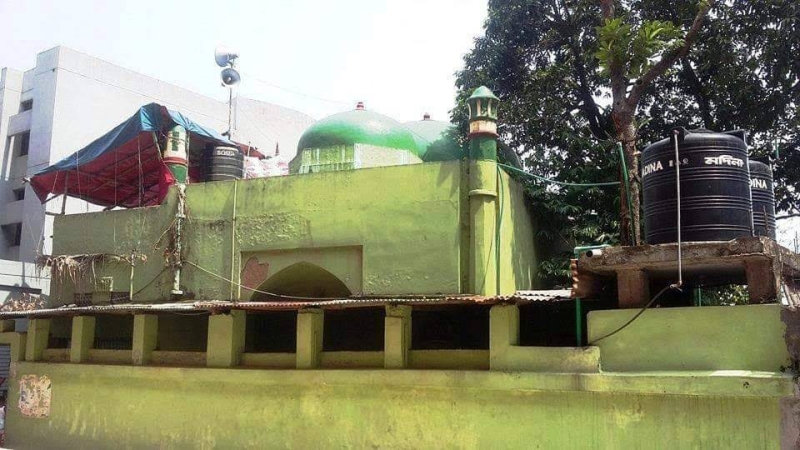
Shaista Khan Mosque
The Golden Age of Dhaka is widely associated with the rule of Shaista Khan. He governed Bengal from 1664 to 1677 and again from 1679 to 1688. During this period, Dhaka experienced remarkable prosperity, administrative stability, and architectural development.
The renowned European traveller William Hedges visited Dhaka in October 1682 during Shaista Khan’s second tenure as governor. In his travel account, he described his meeting with the Nawab:
“I left at nine in the morning to meet the Nawab, who sent for me half an hour later through a director. He was seated under a canopy surrounded by velvet curtains. The canopy was made of gold and silver velvet and stood upon four bamboo poles, which were decorated with golden lace.”
This description reflects the grandeur and ceremonial splendor that characterized the Mughal administration in Dhaka at the time.
However, the glory of Dhaka gradually faded in the centuries that followed. When Reginald Heber, the Bishop of Calcutta, visited Dhaka in 1824, he witnessed a city in decline. The once-thriving river routes had shifted, and the city’s commercial prosperity had diminished.
Despite this decline, Heber estimated the city’s population at around 300,000 inhabitants, noting the existence of approximately 90,000 houses and huts, which still indicated the scale of the once-magnificent metropolis.
Heber also left an interesting description of Dhaka’s architecture. He referred to Lalbagh Fort, observing that the structure was built primarily of brick, with some walls still standing. Its appearance reminded him of the fortress architecture of the Moscow Kremlin. Many Grecian-style houses had already been destroyed, while others had been lost to the shifting riverbanks.
A Historical Mosque, A Missing Grave, and Mughal Memories
Subedar of Bengal Shaista Khan is remembered in history as one of the most capable and benevolent rulers of the Mughal era. Contemporary accounts often mention that essential commodities were available at extremely low prices. A popular saying from that period claims that eight maunds of rice could be bought for just one taka, a reflection of the economic abundance and efficient governance of the time.
Beyond economic prosperity, Shaista Khan made a lasting contribution to the urban development and architectural heritage of Dhaka. Under his rule, the city witnessed the construction of numerous mosques, buildings, and public structures that helped shape Dhaka into a prominent Mughal provincial capital.
In the heart of old Dhaka, quietly standing behind the busy compound of Sir Salimullah Medical College Mitford Hospital, lies a forgotten Mughal monument—the historic Shaista Khan Mosque. In the Mughal era, this area was known as Katra Pakurtali, a riverside settlement along an important commercial route.
Though surrounded today by modern buildings and largely hidden from public view, the mosque remains a remarkable witness to Dhaka’s Mughal past and the architectural legacy of one of Bengal’s most famous governors.
The mosque was built in 1664 AD by the Mughal Subahdar of Bengal, Nawab Shaista Khan, during the reign of Mughal emperor Aurangzeb. It is believed to be one of the earliest architectural projects undertaken by Shaista Khan after he arrived in Dhaka to assume his responsibilities as the governor of Bengal.
Historical accounts suggest that Shaista Khan established a residential palace complex, an embankment, and a mosque in this area. Over the centuries, most of those structures disappeared due to urban development and natural decay. Today, only the mosque remains as a tangible reminder of that Mughal complex.
Because of its age and architectural features, several historians consider the mosque to be among the earliest Mughal mosques built in Dhaka during Shaista Khan’s administration.
The eminent historian Ahmad Hasan Dani provides a reliable description of the mosque. The current structure is not entirely original; the mosque was severely damaged by fire and later rebuilt during the British period following its earlier design. Consequently, some of its original beauty and architectural purity were altered.
Abdul Qayyum Chowdhury, the Pesh Imam of the historic Shaista Khan Mosque, has been leading prayers there for nearly three decades. He shared memories and historical insights about the centuries-old Mughal mosque.
Six notable tombs in Dhaka are attributed to Shaista Khan’s patronage for women identified as wives, concubines, or daughters: Bibi Pari, Bibi Champa, Lado Bibi, Dara Begum, Bibi Mariam, and an unnamed daughter buried near the Satgumbad Masjid in Mohammadpur. These tombs, though diverse in style and layout, collectively form part of the architectural narrative of Dhaka’s Mughal period.
One of his daughters Lado Bibi’s tomb once stood near a mosque in Babubazar. It was demolished during the construction of the Mitford Hospital’s ladies’ ward.
Qayyum Chowdhury said that the site once held the grave of Lado Bibi. “Her grave was located near this mosque, but today that place lies within the kitchen area of Sir Salimullah Medical College Mitford Hospital. With the construction and expansion of the hospital over time, the grave of Ladli Bibi has disappeared. It has been lost to history, and today the mosque remains the only surviving witness to that past.”
According to Chowdhury, the mosque also witnessed significant environmental and urban changes over the centuries. A dam was once built beside the mosque to control the flow of the Buriganga River. “The dam stood where the present pillars along the Buriganga embankment are located,” he explained. “It was known as the Dhaka City Dam or the Buckland Dam.”
The mosque has also endured several natural disasters. During the devastating floods of 1988 and 1998, the mosque’s floor went under nearly five feet of water. “Floodwater remained inside the mosque for about a month,” he recalled.
An ancient stone inscription once placed above the central entrance of the mosque provides valuable clues about its origin. However, the inscription has become difficult to read over time.
According to historical research conducted by scholars from the Arabic and Persian departments of University of Dhaka, the stone tablet was originally made of white stone with Persian writing.
The building itself bears marks of history. “The main structure of the mosque was not severely damaged, but it is known that during the Indian Rebellion of 1857 the mosque was set on fire. As a result, the original inscription plaque of the mosque turned black,” he said.
Over time, some changes were made to the mosque’s structure. Originally, the mosque had five main entrances. “Now the north and south entrances are no longer used,” Chowdhury explained. “For security reasons, they were later closed and turned into decorative windows. However, the three main arches remain as they were.”
An extension was added in the form of a veranda while preserving the original architectural style. The veranda measures about 37 feet in length and roughly 16 feet in width, with a height of around 17 to 18 feet. “The arches of the veranda were designed to match the old structure so that the historical character of the mosque remains intact,” he said.
Architecturally, the mosque originally had three large domes accompanied by six smaller domed towers. “The three main domes are still intact,” Chowdhury noted. “There are six smaller turrets or minaret-like structures — four on the eastern side and two on the western side. Overall, the shape and form of the mosque remain largely unchanged.”
Chowdhury also pointed out a historical connection with Lalbagh Fort, where Shaista Khan maintained his military headquarters. The mosque inside Lalbagh Fort bears similarities in design to this mosque.
“Inside Lalbagh Fort lies the grave of Pari Bibi,” he said, referring to Pari Bibi. “According to historical accounts, Lado Bibi — was related to her.”
Since its construction in the 17th century, the mosque has undergone three phases of renovation. The first renovation took place after the damage caused during the 1857 uprising. Another round of repairs was carried out during the Bangladesh Liberation War.
“In March 1971, when the Pakistani army attacked and shelled the Jinjira area, the mosque was also damaged,” he said. “At that time, the East Pakistan C&B carried out repair work. They welded and restored the domes but did not alter the mosque’s original structure.”
Later renovations followed the devastating floods of 1988 and 1998, when the veranda was extended. Apart from this addition, the main structure of the mosque remained unchanged.
Today the mosque is officially recognized as a heritage structure and is listed in the gazette under RAJUK regulations. “Because it is a protected heritage building, any renovation requires permission from RAJUK or clearance from the relevant government authorities,” Chowdhury said.
Despite the passage of centuries, the mosque remains an active place of worship. “Regular Friday prayers are held here every week, and Eid congregations are also arranged,” he said. “The mosque can accommodate around 100 worshippers inside, about 80 on the veranda, and around 70 more on the second floor. In total, nearly 250 people can pray here at once.”
Today, this centuries-old mosque silently narrates the story of a time when Dhaka flourished under Shaista Khan’s stewardship, reminding visitors of the enduring legacy of one of Bengal’s most celebrated rulers.
(Adnan Hadi is a senior journalist mainly writing on archeological sites and sports. He could be reached at: adnangreenblack1987@gmail.com)