

- Trump says top tech firms have signed accord to 'self-police' AI dev |
- France Student Protests Spread Nationwide, Over 400 Detained |
- State Minister Amit urges global firms to join BD offshore bidding |
- Heart Disease Linked to 777 Daily Deaths in Bangladesh |
Right Livelihood Award honors four groups, individuals fighting injustice
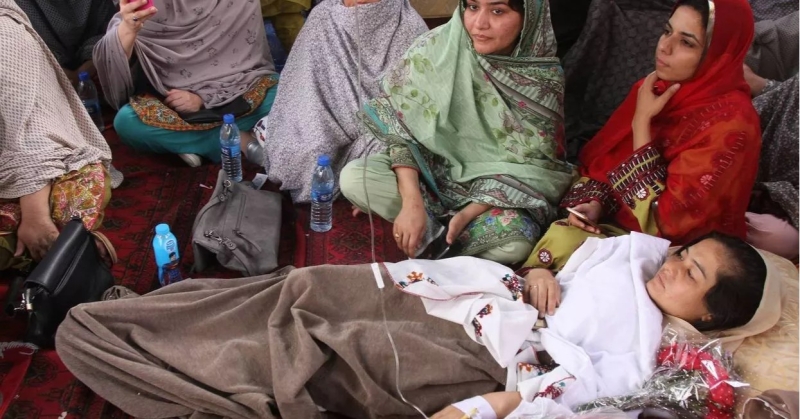
Pakistani lawyer Jalila Haider, on May 1, 2018 on a hunger strike, rests at a camp in Quetta, Pakistan. (AP Photo-Arshad Butt, File)
The Right Livelihood Award on Wednesday honoured two women and two women-led organisations for challenging authoritarian rule, violence and discrimination against women, and the harmful effects of artificial intelligence, the Stockholm-based foundation said.
The recipients are Pakistani human rights lawyer Jalila Haider, Ethiopian-born AI researcher Timnit Gebru, the Georgian Young Lawyers' Association and the Rural Women's Assembly, a network of women farmers across Southern Africa.
The annual award was established in 1980 by Swedish-German philanthropist Jakob von Uexkull to recognise work aimed at creating a more just and peaceful world. It is traditionally announced shortly before the Nobel Prizes, which are due to be announced from next Monday.
Right Livelihood said the recipients were selected for their “resistance to systems that push people to the margins” and their efforts to put people at the centre. They were chosen from 200 nominations from 72 countries.
“Ole von Uexkull, the founder's nephew and the organisation's executive director, said the award recognises women who challenged systems controlled by autocrats, patriarchal structures and powerful technology companies.
Jalila Haider
Haider, a human rights lawyer, was recognised for defending vulnerable communities in Pakistan against state repression, discrimination and ethnic violence.
She is the first female lawyer from Pakistan's Hazara community. Through legal work and community advocacy, she has helped thousands of ethnic, gender and religious minorities and refugees seek justice, the foundation said.
Her law firm has also helped more than 600 political activists and human rights defenders regain their right to travel freely.
Rural Women's Assembly
The Rural Women's Assembly was honoured for organising rural women across Southern Africa to defend land, seeds and bodily autonomy against corporate and patriarchal control.
The self-organised movement represents more than 178,000 small-scale farmers in 11 Southern African countries.
It has established 24 sites where farmers preserve and reproduce seeds for future planting and has documented hundreds of local seed varieties, helping protect traditional seed-saving and exchange practices.
Georgian Young Lawyers' Association
The Georgian Young Lawyers' Association received the award for its work to protect democracy and civic participation amid what Right Livelihood described as an authoritarian crackdown.
Founded in 1994 by volunteer lawyers, the organisation helped draft Georgia's first post-independence constitution.
According to the foundation, it has secured major legal victories, including protections for people with disabilities, free education for all children and compensation for victims of Soviet-era repression.
Timnit Gebru
AI researcher Timnit Gebru was recognised for challenging concentrated corporate power in artificial intelligence and promoting technology based on justice, human experience and individual agency.
Born in Ethiopia to a family of Eritrean origin, Gebru is the founder of the Distributed AI Research Institute.
Right Livelihood said her work examines the control of AI by a small number of powerful companies and highlights harms already caused by AI systems, particularly to communities facing discrimination and exclusion. - Agency