

- World Lost More Than 7 Million Hectares of Forest in 2025 |
- Bangladesh Ranks 84th in Global Hunger Index 2026 |
- 10 Die of Dengue in Bangladesh, 1,943 Hospitalised |
- 28 Killed as School Roof Collapses in Northwest Pakistan |
- Bangladesh Targets 8.5-Fold Rise in Cotton Output by 2050 |
15.9 Million Afghans Face Acute Hunger Amid Rights Abuses
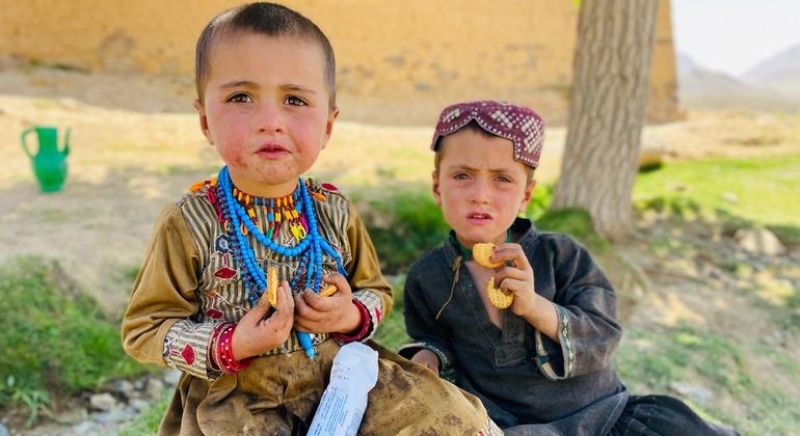
Two children in Afghanistan eat nutritional biscuits.
Afghanistan is facing record levels of hunger and acute malnutrition, with 15.9 million people experiencing acute food insecurity and conditions expected to deteriorate further in the coming months. At the same time, a separate UN report has documented serious human rights violations, including public floggings, restrictions on women and girls, and a new ban on demonstrations.
The Integrated Food Security Phase Classification (IPC), a global initiative that assesses food insecurity, found that more than 32 per cent of Afghanistan’s population is experiencing crisis-level food insecurity or worse. Among them, 3.4 million people are facing emergency conditions, the fourth phase of the classification system, which precedes famine.
The deterioration has been driven by disease outbreaks, inadequate water and sanitation, and sharply reduced access to nutrition services, according to the report.
Hunger crisis set to worsen
Food insecurity is expected to worsen during the winter lean season from November to April. Nearly 19.2 million people are projected to face crisis-level food insecurity or worse during this period, including five million experiencing emergency conditions.
Acute malnutrition is also expected to rise significantly. An estimated 4.04 million children under five will require treatment between January and December 2027.
Although improved rainfall and stronger agricultural production have helped increase food availability, declining humanitarian assistance is undermining households’ ability to cope, the report warned.
The World Food Programme (WFP) and the Food and Agriculture Organization (FAO) have called for urgent funding to expand food assistance, emergency agricultural support, and the prevention and treatment of malnutrition.
“We still have a window to act, but it is closing fast,” WFP Country Director John Aylieff said, warning that without urgent support, families could face increasingly desperate choices during the winter.
FAO representative Richard Trenchard stressed the need to help families secure reliable livelihoods so they can withstand future shocks, alongside assistance to get through the coming winter.
Women, girls and civic freedoms under pressure
Separately, the UN Assistance Mission in Afghanistan (UNAMA) reported continued erosion of basic human rights between July and September, with women and girls bearing the brunt of restrictions imposed by Taliban authorities.
Girls remain barred from formal education beyond grade six. Taliban authorities have defended the restrictions by citing considerations related to Sharia law.
UNAMA documented more than 50 cases involving hijab-related issues, mainly in Herat and Kabul. In one case, a 13-year-old girl was held overnight. Women were also prevented from entering health clinics and markets without a male guardian, known as a mahram.
The mission recorded at least 443 cases of arbitrary arrests and detentions, as well as 97 incidents of ill-treatment by virtue and vice inspectors. The reported offences included hijab violations, trimmed beards, missed prayers and listening to music.
Public floggings and media restrictions
UNAMA documented public lashings of 22 men and six women on charges including theft and adultery. The report noted that the de facto Supreme Court had stopped publicly announcing such cases on its website and social media accounts in April.
The mission also reported the arrest of 14 former members of the security forces and the killing of at least four others.
Media freedom and civic space have also come under pressure. Several media outlets were suspended without clear explanations or appeal procedures, while a journalist arrested in July 2025 remained in custody without a conviction.
A new police law published in August prohibits all demonstrations, according to the report.
Civilian casualties in cross-border violence
Cross-border violence has added to Afghanistan’s humanitarian challenges. Since October 2025, 512 civilians have been killed and 1,236 injured, according to UNAMA. The latest quarter alone saw 33 civilian casualties, including children killed in Pakistani airstrikes on homes in Kunar and Helmand.
The worsening food crisis, declining humanitarian assistance and continuing rights restrictions have left millions of Afghans facing growing hardship as the country approaches winter.