

- Intimidation or bloodshed cannot halt Bangladesh’s march to democracy |
- Khaleda Zia integral to an important chapter in BD history: Yunus |
- Enthusiasm marks Victory Day celebrations across Bangladesh |
- Dhaka-Delhi ties deep; to be shaped by trust, dignity, mutual respect |
- EU deploys election observation mission to Bangladesh |
Experts urge stronger social protection to curb child labour
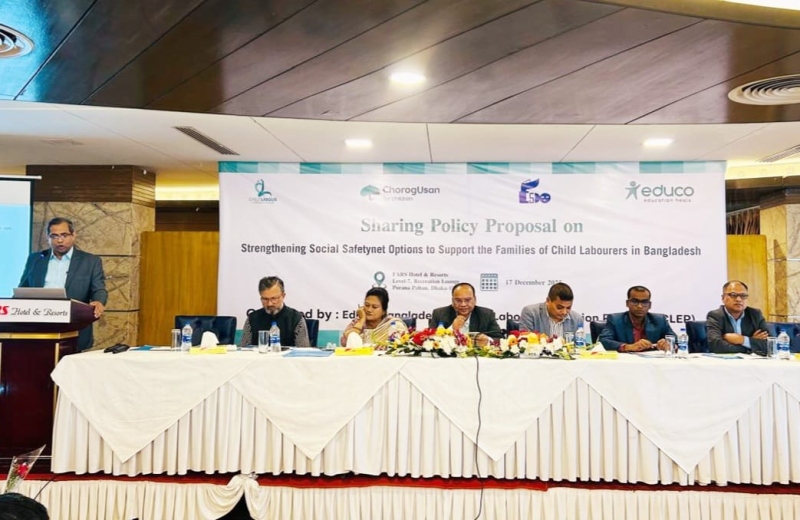
Nearly two-thirds of child labourers in Bangladesh are employed in industrial and factory settings, exposing them to severe health and safety risks, according to data presented at a policy-sharing event in Dhaka on Wednesday.
The findings were shared at a programme jointly organised by International Organisation Educo Bangladesh and the Child Labour Elimination Platform (CLAP), where experts called for strengthening social protectionmeasures to prevent child labour and support affected families.
The report revealed that 66.6 percent of child labourers are engaged in the industrial sector, while 44.4 percent work in services and 38.8 percent in agriculture. Many of these children are exposed to hazardous conditions that pose serious threats to their physical and mental wellbeing.
According to the data, hazardous child labour is most prevalent in the industrial sector, accounting for 54.7 percent of cases. The service sector follows with 29.9 percent, while agriculture accounts for the lowest share at 3.3 percent of children engaged in dangerous work.
The policy-sharing event, titled “Proposed Policy to Strengthen Social Security Programmes to Support Families of Child Labourers in Bangladesh”, was held at a hotel in the capital. Economist Dr Khondaker Golam Moazzem presented the policy recommendations, while Educo Bangladesh Country Manager Afzal Kabir Khan chaired the session.
Dr Moazzem said that despite international commitments, existing laws and social protection mechanisms, millions of children remain engaged in labour, particularly in the informal sector.
He noted that around 3.5 million children are involved in various forms of work, but official data is available for only 1.7 million of them. Of this number, about 100,000 children are engaged in hazardous occupations.
He explained that child labour is more visible in urban areas due to the availability of diverse job opportunities, but rural child labour remains significant, particularly in agriculture and seasonal work. To address the problem effectively, he recommended increasing budgetary allocations to social protection programmes and expanding their coverage to reach vulnerable families.
Speaking at the event, Md Kamal Uddin Biswas, additional secretary of the Ministry of Social Welfare, said the United Nations Sustainable Development Goals (SDGs) explicitly call for ending child labour, exploitation, trafficking and all forms of violence against children. He reaffirmed the government’s commitment to achieving the SDG targets.
He added that several initiatives, projects and programmes have already been undertaken by different ministries and departments to eliminate child labour. The government, he said, would take steps to implement recommendations aimed at bringing out-of-school children under social protection schemes and increasing allocations in this sector.
Associate Professor Md Aurangzeb Akand of Mawlana Bhashani Science and Technology University stressed the need for universal child benefits and adequate social protection systems. He called for increased investment in quality education and urged authorities to bring all out-of-school children back into classrooms.
He also emphasised greater spending on child protection, agricultural development, rural public services, infrastructure and livelihoods.
In his concluding remarks, Afzal Kabir Khan said that eliminating child labour requires a robust and inclusive social protection system. He underscored the importance of reducing gaps in coverage, expanding social safety net programmes and strengthening support for the families of child labourers to address the root causes of the problem.