

Friday, October 23, 2026
News update
- Covered van hits Gazipur police patrol team, killing SI, BNP leader |
- Korean City scrambles to rescue dusky shark after it returns to canal |
- PM inspects Mongla Port, Sundarbans, proposed economic zone |
- Early winter cucumber brings hope of bumper harvest in Sirajganj |
- Saudi coalition intercepts Houthi missile after blasts in Riyadh |
UNICEF: 17,000 Nepal Children Need Mental Health Support
GreenWatch Desk:
Humanitarian aid
2026-09-16, 9:50am
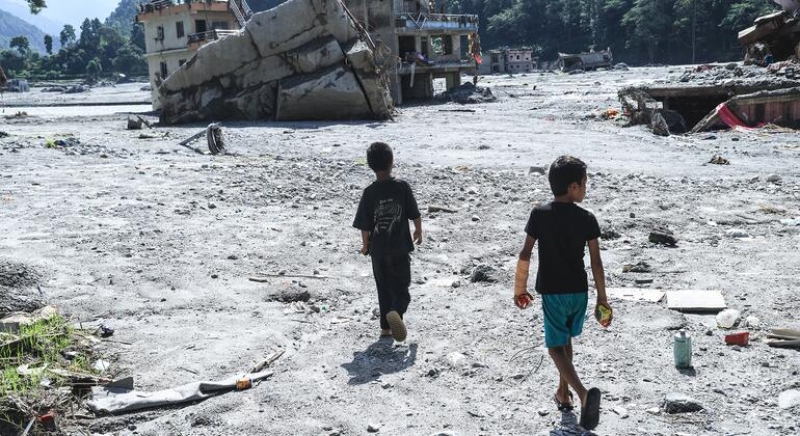
Children walk through the site of their school in Nuwakot District after the devastating floods that hit Nepal.
Three weeks after devastating flash floods struck Nepal, around 17,000 children urgently require mental health and psychosocial support, the UN Children’s Fund (UNICEF) said on Tuesday.
Triggered by a glacier collapse, the floods on 26 August affected more than 84,000 people, including approximately 32,000 children. The disaster damaged critical roads, schools, power grids and water systems across the northern regions of Rasuwa, Nuwakot and Dhading.
Local authorities reported that more than 1,300 people had been killed and over 5,000 remained missing on the Nepalese side of the border. On the Tibetan side, at least 43 people were killed and 519 remained missing, according to official Chinese government figures.
Many children witnessed the deaths of loved ones and the destruction of their schools, while others remain displaced from their communities.
UNICEF said 541 children were still separated from their families and required protection.
“Beyond the visible destruction, these floods have left deep emotional scars on children and families,” said Alice Akunga, UNICEF Representative in Nepal.
“Alongside humanitarian supplies and restoration of critical infrastructure, children need mental health and psychosocial support to help them process what happened, regain a sense of security and begin to recover.”
Why mental health support is needed
The flooding began at 8:37am local time, when many children were beginning their school day.
According to Akunga, children who witnessed distressing events are struggling with fear, anxiety and grief. Some are unable to speak about what they experienced.
Shitanshu Dhakal, a medical doctor at a hospital in Nuwakot and a mental health advocate, described the trauma faced by flood-affected children as an “invisible burden”.
“Children must be at the centre of the mental health response, with immediate psychological first aid and sustained support to prevent long-term consequences,” Dhakal said.
UNICEF stressed the importance of early intervention, noting that timely mental health support can help prevent acute stress from developing into long-term psychological disorders.
Support on the ground
UNICEF is working with the Nepalese Government and other partners to support affected children through family tracing, reunification and mental health services.
Eighteen children have already been reunited with their families, while 13 UNICEF-supported Child-Friendly Spaces have been established.
The agency is also helping arrange alternative family-based care for children who have lost both parents. Monitoring teams are working to identify children at risk and prevent exploitation.
Meanwhile, Education Cannot Wait (ECW), the UN’s global fund for education in emergencies, announced a $1 million allocation on Tuesday to support 17,000 children across Rasuwa, Nuwakot and Dhading.
Of them, 5,000 children will receive education and protection support, while 12,000 will benefit from risk-reduction interventions.
However, ECW said Nepal’s education system would need additional funding from governments, foundations and the private sector to fully recover, as nine schools were severely damaged or destroyed.
“With climate-related emergencies disrupting children’s education with increasing frequency, we must ensure that a temporary crisis does not turn into permanent learning loss,” said Maysa Jalbout, ECW Director of Education.