

- 7 killed as bus collides with auto-rickshaw in Mymensingh |
- Heatwaves Cost Bangladesh Nearly Tk 77,000 Crore a Year |
- Protecting Bangladesh’s coastal people From Tide-induced Loss, Damage |
- Four Warehouses Linked to Salman Muqtadir’s In-Laws Sealed |
- Dengue surge: N’ganj hospitals treat patients on floors, verandas |
Nuclear fears rise among youth amid global tensions
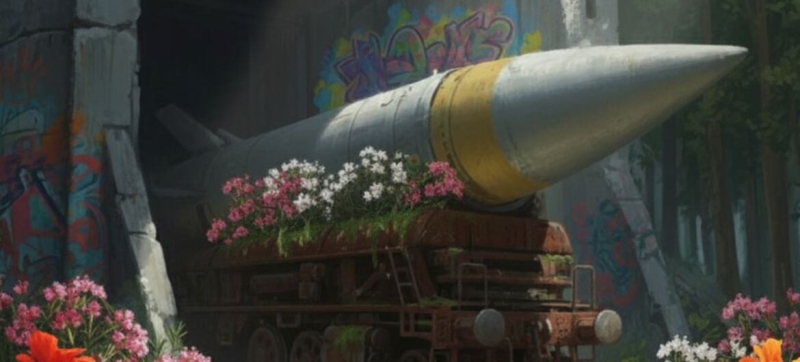
A piece of artwork by Youth Leaders Fund member Faid Arsyad.
The threat of nuclear Armageddon, once a constant fear for those who grew up during the Cold War, is once again becoming a concern for a growing number of young people.
For decades, the possibility of a full-scale nuclear confrontation between the Soviet Union and the United States shaped the deepest fears of many who lived through the 20th century.
While that existential threat never fully disappeared, it was largely replaced in younger generations by other global concerns such as the climate crisis and the rise of artificial intelligence.
However, the risk of nuclear conflict has never truly gone away. Thanks in part to the 56-year-old Nuclear Non-Proliferation Treaty (NPT), nuclear weapons have not been used in war since the bombings of Hiroshima and Nagasaki in 1945.
Return of nuclear concerns
In recent years, nuclear rhetoric has returned to global discussions, prompting the United Nations to engage younger generations on the dangers of nuclear weapons and the importance of disarmament.
“Nuclear war wasn’t high on my agenda, to be honest,” said 30-year-old Natalie Chen. “But disarmament is becoming a major concern given current conflicts such as Ukraine, Gaza, and Iran.”
Chen, a UK-based arts producer from Hong Kong and participant in the UN’s Youth Leader Fund for a World Without Nuclear Weapons, said she has gained a deeper understanding of nuclear risks and global security issues.
She recently took part in an event at the Poster House museum in New York, organised with support from the United Nations Office for Disarmament Affairs (UNODA), where young artists presented work focused on peace and disarmament.
Another participant, artist Abdul Mustafazade, said the programme helps simplify complex issues. “The language of disarmament is very technical, but art helps make it more accessible,” he said.
New generation of threats
Izumi Nakamitsu, head of UNODA, said there is an urgent need to involve young people in nuclear policy discussions, especially as new technologies reshape global security.
She noted that while the post-Cold War era reduced nuclear tensions for decades, geopolitical rivalries have now returned.
“New challenges such as artificial intelligence in nuclear command systems and cyber threats are very serious,” she said.
The discussions took place alongside the 2026 review conference of the NPT at UN Headquarters.
Nakamitsu stressed that despite its limitations, the treaty remains essential for global security, warning that without it, many more countries would likely have developed nuclear weapons.
Normalisation concerns
The Youth Leaders Fund aims to equip young advocates with knowledge to challenge the growing normalisation of nuclear weapons in public debate.
Experts warn against narratives suggesting that “limited” nuclear weapons could ever be used safely in conflict.
Nakamitsu said such thinking is dangerous, noting that the atomic bombs dropped on Hiroshima and Nagasaki would today be classified as low-yield weapons.
She urged continued efforts to preserve historical memory and reinforce the humanitarian consequences of nuclear warfare.