

- Seven Bangladeshis killed, 6 injured in Saudi road accident |
- Dhaka ranks 4th in global list of cities with worst air quality |
- Tarique Warns of Fresh Conspiracies, Vows to Defend Sovereignty |
- National Revolution and Solidarity Day Today |
- Tarique Rahman Pays Tribute at Zia, Khaleda’s Graves |
Herzog Names Eisenkot to Form Israel’s Next Government
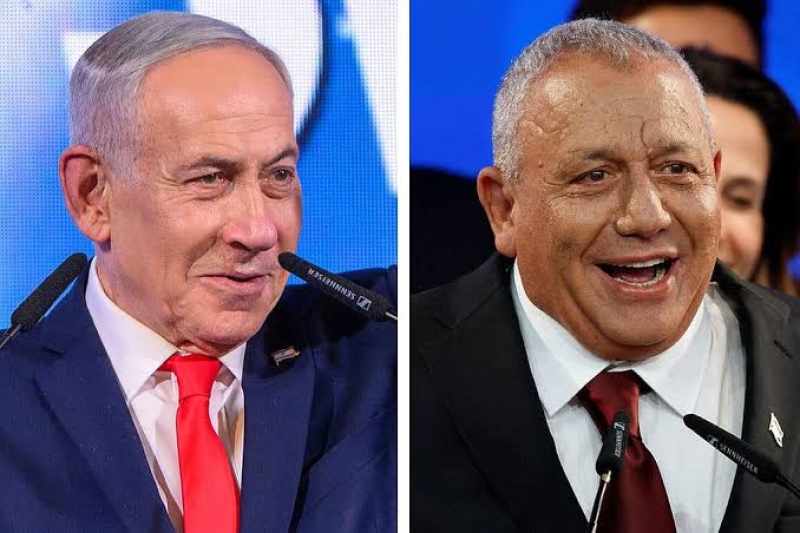
Benjamin Netanyahu and Gadi Eizenkot.
Israeli President Isaac Herzog has announced that opposition leader Gadi Eisenkot will be tasked with forming the country’s next government, giving him the first opportunity to build a governing coalition after last month’s inconclusive election.
Herzog informed Eisenkot of his decision on Saturday evening. The president’s spokesperson said a formal ceremony to hand over the mandate was scheduled for Sunday.
Following the October 27 general election, no political bloc secured the 61 seats required for a majority in Israel’s 120-member parliament, the Knesset. Herzog held consultations with representatives of political parties this week to determine who should receive the mandate to form a government.
During the consultations, lawmakers representing 67 members of the Knesset recommended Eisenkot, while representatives of factions with 46 members backed Prime Minister Benjamin Netanyahu. A seven-member faction did not recommend either candidate.
Herzog said the consultations had produced a clear picture but that the mutual opposition among political blocs made it difficult to determine who could form a stable government.
Eisenkot will have 28 days to form a government, with the president authorised to grant an extension of up to 14 days if necessary. A government requires the support of at least 61 members of the Knesset.
In the October election, Eisenkot’s four-party bloc secured 48 seats, while Netanyahu’s right-wing and religious alliance won 53. Arab-led parties representing Palestinian citizens of Israel secured a record 19 seats.
Although the Arab-led parties’ recommendations helped Eisenkot receive the largest number of nominations, he has ruled out forming a government with them. Their support would bring the combined number of seats backing his bloc to 67.
Another possible route could involve support from the ultra-Orthodox parties United Torah Judaism and Shas. Together, the two parties hold 13 seats, which, alongside Eisenkot’s 48-seat bloc, would reach the 61-seat threshold.
Eisenkot could also seek to form a minority government with support from parties outside the governing coalition. Such an arrangement would still need to secure enough backing to survive a confidence vote in parliament.
A report from Ramallah in the occupied West Bank said Herzog’s decision had been widely expected because Eisenkot received recommendations from the largest number of lawmakers.
The report noted that Eisenkot now faces the difficult task of forming a government without compromising his election campaign promises while also dealing with opposition from Netanyahu’s right-wing bloc.
If Eisenkot fails to form a government within the allotted period, Herzog can assign the task to another lawmaker. If the second nominee also fails, a majority of Knesset members may recommend a third candidate, who would receive a final 14-day period to form a government.
If all attempts fail, Israel would have to hold another election within 90 days. Netanyahu would remain caretaker prime minister in the meantime.
Eisenkot served as chief of staff of the Israel Defense Forces from 2015 to 2019. After Israel launched its military campaign in Gaza in October 2023, he served as an observer in Netanyahu’s wartime Cabinet for the first eight months.
In an interview on Saturday, Ahmad Tibi, a senior member of the Arab-led Joint List, said Herzog’s decision had been expected. However, he said the group had been concerned about the possibility of a national unity government based on a power-sharing arrangement between Eisenkot and Netanyahu.
Tibi said the Arab-led parties’ recommendations had given Eisenkot a significant advantage in the government formation process. He also suggested that Eisenkot could form a minority government with support from outside the Arab-led parties.