

- WB ready to support Bangladesh amid external economic shocks: Khosru |
- PM, World Bank President Discuss Bangladesh’s Development |
- Bus Fares Rise by 17 Paisa Per Kilometre |
- PM arrives in New York to attend 81st UNGA session |
UN Deputy Chief Warns of Deepening Global Teacher Crisis
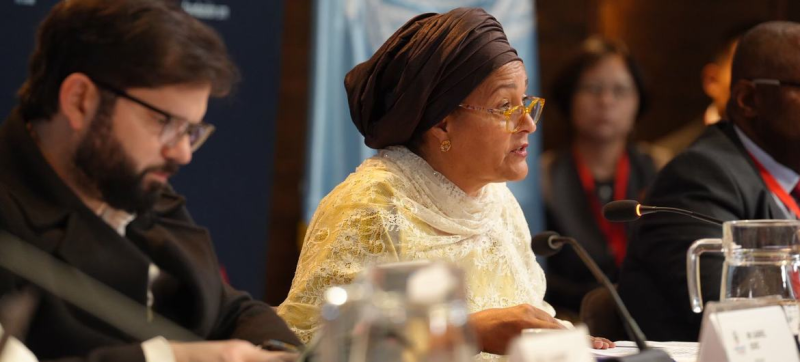
Deputy Secretary General Amina Mohammed delivers remarks to the World Summit on Teachers in Santiago, Chile.
Educators across the world are shaping generations – from preserving forests and writing poetry to building bridges and safeguarding democracy.
Their work, said UN Deputy Secretary-General Amina Mohammed, is “the beating heart of education, the cornerstone of sustainable development, and the guardians of our future.”
Speaking at the opening of the UNESCO World Summit on Teachers in Santiago, Chile, Ms. Mohammed called for urgent global action to tackle the worsening teacher crisis.
“Let us honour their influence with the policies and the respect that teachers need, and future generations deserve,” she urged, presenting a five-point plan to support educators and strengthen education systems worldwide.
The UN deputy chief warned that the world faces a “deepening teacher crisis” threatening progress on the Sustainable Development Goals.
She noted a global shortfall of 44 million teachers needed to meet universal education targets by 2030, calling it “a slow-burning emergency” that undermines learning outcomes, widens inequalities, and weakens communities.
UNESCO Director-General Audrey Azoulay also addressed the summit, stressing that the challenge cannot be solved by any single actor.
She pointed to low and delayed salaries, an ageing teacher workforce, surging school enrolments, and persistent gender inequalities—especially in STEM fields—as root causes of the crisis.
To achieve education goals by 2030, the world must recruit 44 million teachers—more than double Chile’s population. Instead, progress is reversing, with many young teachers leaving the profession due to low pay, heavy workloads, and lack of career development.
“Ultimately, we are asking the impossible of teachers: to build the future without the tools, trust, and conditions they need,” Ms. Mohammed warned.
Recruiting the teachers required by 2030 will cost an estimated $120 billion annually, but education financing is falling short.
“More than 40 per cent of the world’s population lives in countries where governments spend more on debt interest payments than on education or health,” she noted.
Aid to education is projected to drop 25 per cent between 2023 and 2027, with a 12 per cent fall already recorded last year.
Ms. Mohammed outlined a five-point plan:
Elevate the profession with fair pay, safe workplaces, and career growth.
Prioritise education financing through budgets, debt relief, and a Global Fund for Teachers.
Advance gender equality and women’s leadership in education.
Support digital transformation with training, AI standards, and inclusive access.
Protect teachers in conflict zones, ensuring resources and safety.
She urged leaders to transform summit outcomes into commitments before the World Social Summit in Doha this November, including teacher compacts, financing strategies, and digital pacts.
“Quality education is the foundation of everything we hope to achieve with the Sustainable Development Goals,” Ms. Mohammed concluded. “Without teachers, none of it is possible.”