

- BRTA tops corruption list among public service offices: BBS |
- Toll-free entry for vehicles via airport area expressway Thursday |
- ‘Very unhealthy’ air quality persists in Dhaka |
- Customs duty on dates imports cut ahead of Ramadan |
- NBR extends VAT exemption on Metro Rail services |
UN marks decade of youth role in peace and security
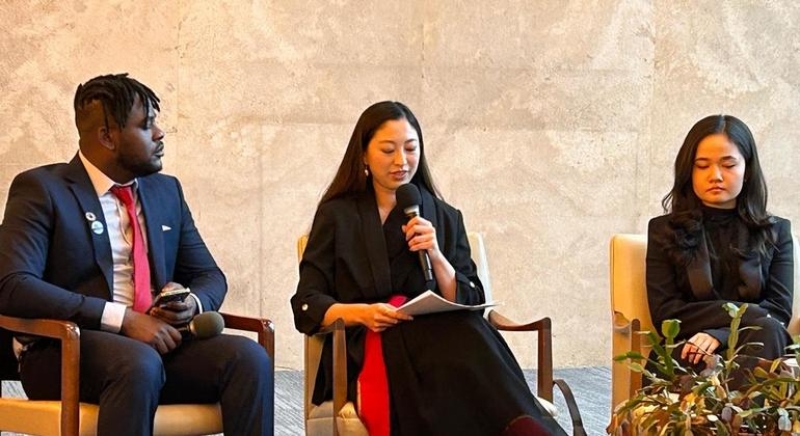
Young leaders take part in a Peace Circle at UNHQ (file Dec 2025)
The United Nations has long been at the forefront of efforts to involve young people in decision-making, and the past decade has seen significant progress following the adoption of a landmark Security Council resolution on Youth, Peace and Security. The resolution has led to wide-ranging changes, ensuring that young people’s voices are not only heard but also meaningfully incorporated into peace plans and policies.
In 2021, following the Taliban takeover, Nila Ibrahimi and her family fled Afghanistan. A vocal rights advocate since the age of 13, she had led a viral campaign that successfully overturned a government ban preventing Afghan girls over the age of 12 from singing in public. She knew her activism made her a potential target under the new regime.
After spending time in hiding, she now lives in Canada but has continued her advocacy work. From her new home, she founded HerStory, an organisation dedicated to documenting the experiences of girls inside Afghanistan and across the diaspora.
“I do my best to tell the stories of girls who have been banned from going to school. I was able to graduate, but my friends are still stuck in the ninth grade,” she said. “It’s emotional work, but if it motivates even one person to act, then I feel I have done enough.”
Ms Ibrahimi was speaking at an event held on 15 December to mark the tenth anniversary of Security Council Resolution 2250, which formally recognises young people as active partners in maintaining and promoting international peace and security.
Around half of the world’s population is under the age of 30, giving young people the greatest stake in the planet’s future. Despite this, they are often excluded from spaces where solutions to global challenges are shaped.
Since the adoption of the resolution, the UN has supported numerous initiatives to implement its recommendations. Countries including the Democratic Republic of the Congo, The Gambia and Honduras have developed Youth, Peace and Security national and local action plans. The African Union has held the continent’s first dialogue on the issue, culminating in the Bujumbura Declaration, while 11 countries across Africa, the Middle East, Asia and Europe have enacted action plans aligned with the resolution.
Afghanistan, still ruled by the Taliban, is not among them. However, Ms Ibrahimi remains determined to continue advocating for women’s and girls’ rights.
“It really struck me that I was in the same room as people I would never otherwise have had the chance to meet,” she said. “It was a privilege to share my story, raise Afghan women’s voices and learn from others.”
The anniversary events concluded with a Peace Circle, bringing together young leaders, senior UN officials, diplomats and academics. The Peace Circles are part of the UN’s Act Now for Peace campaign, featuring informal dialogues on peace-related issues such as education, gender equality, climate and technology. At least half of the participants are under 30, with a focus on young people often excluded from decision-making spaces.
The Act Now for Peace campaign will continue until September 2026, with discussions feeding into several UN initiatives, including the Secretary-General’s independent study on youth contributions to peace and a Global Youth Peace Manifesto.