

- Gaza Ceasefire Not Enough as Children Continue to Die |
- Bangladesh Sets Guinness Record With 54 Flags Aloft |
- Gambia Tells UN Court Myanmar Turned Rohingya Lives Hell |
- U.S. Embassy Dhaka Welcomes Ambassador-Designate Brent T. Christensen |
- Survey Shows Tight Race Between BNP and Jamaat-e-Islami |
Is the US Moving Closer to the UN’s Exit Door?
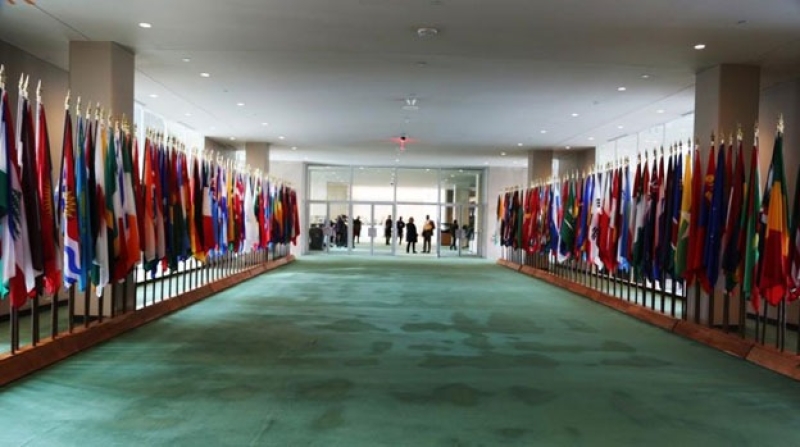
Credit: United Nations
Judging by the mass US withdrawal from 66 UN entities—including UN conventions and international treaties—is it remotely possible that the unpredictable Trump administration may one day decide to pull out of the United Nations and force the Secretariat out of New York, despite the 1947 UN–US headquarters agreement?
Beyond the 66 entities, the withdrawals also include exits from the Human Rights Council, the WHO, UNRWA and UNESCO, alongside drastic funding cuts for the remaining UN bodies that the US has not yet formally left.
So, will the United Nations, which has come under sustained attack, be far behind?
That possibility is reinforced by the critical views of the UN expressed by both President Trump and senior US officials.
Dr Stephen Zunes, Professor of Politics at the University of San Francisco, who has written extensively on issues relating to the United Nations, told IPS that even US presidents most hostile to the UN—such as Ronald Reagan and George W. Bush—recognised the importance of the world body in advancing US interests. This included an understanding of the need to maintain the UN system as a whole, even while violating certain legal principles in specific cases.
Similarly, he noted, the United States had been willing to participate in various UN bodies to wield influence, even while disagreeing with some of their policies or overall mandates.
“The Trump administration, however, appears to be rejecting the post–World War II international legal system as a whole. His statements, particularly since the attack on Venezuela, seem like a throwback to 19th-century imperial prerogatives and a rejection of modern international law,” Zunes said.
“As a result, it is possible that Trump could indeed pull the United States out of the United Nations and force the UN out of New York,” he added.
Addressing the General Assembly last September, Trump remarked, “What is the purpose of the United Nations? It’s not even coming close to living up to its potential.”
Dismissing the UN as an outdated and ineffective organisation, he claimed, “I ended seven wars, dealt with the leaders of each and every one of these countries, and never received a phone call from the United Nations offering to help finalise the deal.”
Martin S. Edwards, Associate Dean of Academic and Student Affairs at the School of Diplomacy and International Relations at Seton Hall University, told IPS that this amounted to “dubious language about cutting inefficiency and fighting diversity, wrapped up in red meat to feed President Trump’s base”.
He said it was a ploy to use foreign affairs to distract voters for whom Trump had yet to deliver. The fact that follow-up documents had not been received by the Secretary-General, Edwards added, revealed the pattern: the president stakes out maximalist positions but ultimately achieves very little.
However, Edwards warned of a broader challenge on two fronts.
First, he said, the policy would continue to reduce US influence at the UN rather than increase it. Stable foreign relations are built on credibility, and as the US squanders its standing, other countries will fill the vacuum.
Second, he noted, while the policy might make for a strong social media message, it makes little sense in practice. “What the White House appears to want is a line-item veto over every aspect of UN operations. But assessed contributions are not an à la carte menu,” Edwards said.
Mandeep S. Tiwana, Secretary-General of CIVICUS, a global alliance of civil society organisations, told IPS that the Trump administration’s retreat from international institutions amounted to an attack on the legacy of President Franklin D. Roosevelt, who delivered the New Deal and envisioned the UN as a bold framework to overcome the horrors of the Second World War.
“Many of the affected international institutions were built through the blood, sweat and tears of Americans. Pulling out of them is an affront to those sacrifices and reverses decades of multilateral cooperation on peace, human rights, climate change and sustainable development,” he said.
Meanwhile, attacks on the UN have continued unabated.
In an interview with Breitbart News, US Ambassador to the United Nations Mike Waltz said, “A quarter of everything the UN does, the United States pays for.”
“Is the money being well spent? I’d say right now, no—because it’s being spent on all these other woke projects rather than what it was originally intended to do, what President Trump wants it to do, and what I want it to do, which is focus on peace,” he said.
Historically, the United States has been the largest financial contributor to the UN, typically covering about 22% of its regular budget and up to 28% of its peacekeeping budget.
Yet, ironically, the US is also the organisation’s biggest defaulter. According to the UN’s Administrative and Budgetary Committee, member states currently owe $1.87 billion of the $3.5 billion in mandatory contributions for the current budget cycle.
Former US House Republican Conference Chair Elise Stefanik of New York, once nominated for the post of US ambassador to the UN, was quoted as saying, “In the UN, Americans see a corrupt, defunct and paralysed institution, more beholden to bureaucracy, process and diplomatic niceties than to the founding principles of peace, security and international cooperation laid out in its charter.”
In a veiled attack on the UN, Secretary of State Marco Rubio said, “What we term the ‘international system’ is now overrun with hundreds of opaque international organisations, many with overlapping mandates, duplicative actions, ineffective outputs, and poor financial and ethical governance.”
Even institutions that once performed useful functions, he said, have increasingly become inefficient bureaucracies, platforms for politicised activism, or instruments that run counter to US national interests.
“Not only do these institutions fail to deliver results, they obstruct action by those who wish to address these problems. The era of writing blank cheques to international bureaucracies is over,” Rubio declared.