

- Rising seas, rising stakes: What higher sea-levels mean to humanity |
- Nepal Disaster and Hydropower |
- Govt to Compensate Victims of Enforced Disappearance |
- Maersk Line Keen to Invest in Bangladesh’s Shipbuilding Sector |
- PM Sets 4-Month Deadline for ETC Rollout in Dhaka |
Govt to Compensate Victims of Enforced Disappearance
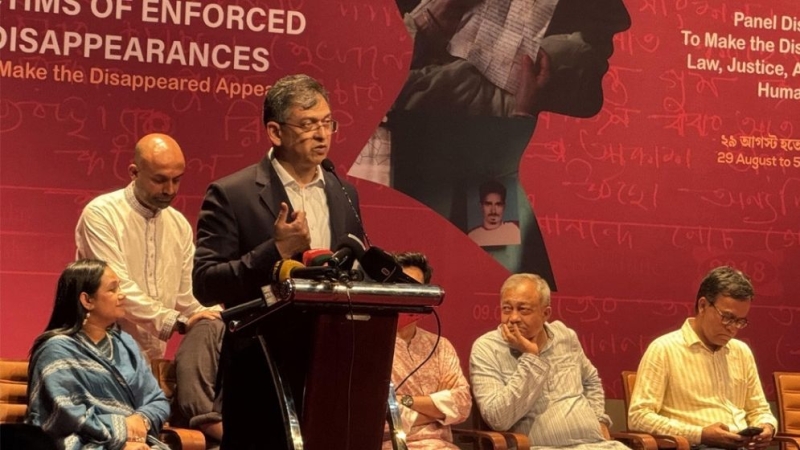
Home Minister Salahuddin Ahmed said on Saturday that the government has enacted a strict and modern law to ensure justice and compensation for victims of enforced disappearance.
He said cases of enforced disappearance in the past were largely limited to investigations, while the new law gives victims a direct legal avenue to seek redress through the courts.
The law also provides for the death penalty as the maximum punishment, depending on the nature of the offence, he said.
The home minister made the remarks at a photography exhibition and discussion organised by Mayer Dak at the National Museum to mark the International Day of the Victims of Enforced Disappearances.
Elaborating on the Enforced Disappearance Prevention and Redress Act 2026, Salahuddin said the law defines enforced disappearance as an offence and prescribes appropriate penalties.
It also allows families of missing persons to use and manage their property to support themselves during their absence, he said.
The law provides for compensation to be recovered from perpetrators and, where that is not possible, for the state to compensate victims of enforced disappearance, the minister added.
Salahuddin said provisions of the International Crimes Tribunal (ICT) Act for prosecuting systematic and widespread enforced disappearances would remain in force.
At the same time, provisions of the Code of Criminal Procedure (CrPC) have been strengthened to facilitate the trial and enforcement of punishments for enforced disappearance-related offences in regular courts.
The minister said there was scope to amend the law if necessary and urged stakeholders to submit constructive suggestions.
Referring to the law enforcement situation inherited from the previous government, he said the government had been working for the past six months to restore the morale of police personnel and improve their performance.
“We inherited a fragile force. For the past six months, we have been working to restore their morale and motivate them. From now on, a reward-and-punishment policy is being implemented,” he said.
Salahuddin said the government was building a modern law enforcement force capable of tackling technology-driven crimes while ensuring accountability and respect for human rights.