

- Global food prices rise amid weather strain, trade disruptions |
- Dhaka Seeks Ganges Treaty With Guarantee on Water Share |
- Navi Pillay Wins 2026 Nobel Peace Prize |
- Bangladesh Steps Up Anti-Trafficking Efforts, US Says |
- Cheap reading glasses remain key conduit to better quality of life |
'Nazrul too should have been awarded Nobel': Dinesh Trivedi
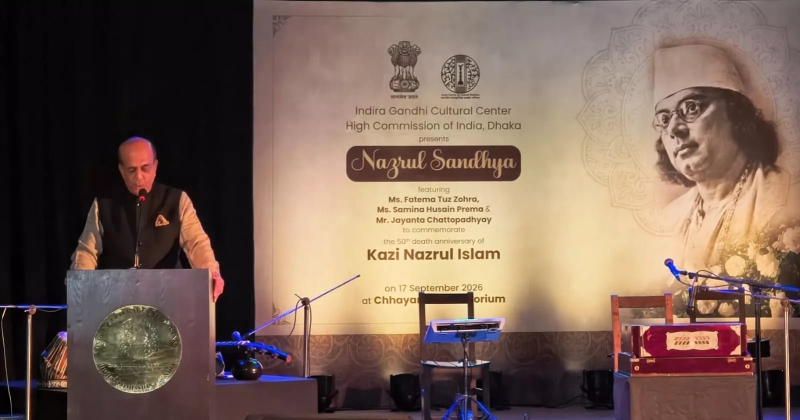
Indian High Commissioner to Bangladesh Dinesh Trivedi has said that Kazi Nazrul Islam should also have been awarded the Nobel Prize, citing the Bengali poet’s extraordinary literary contribution and influence on collective consciousness.
“Coming to this point in time, my realisation is that Nazrul too should have been given the Nobel Prize,” Trivedi said at a special cultural evening in Dhaka on Thursday.
He was speaking at ‘Nazrul Sandhya’, organised by the Indira Gandhi Cultural Centre (IGCC) of the High Commission of India at Chhayanaut Auditorium to commemorate the 50th death anniversary of the National Poet.
Trivedi highlighted Nazrul’s role in challenging established ideas and inspiring people through his poetry and writings.
“Kazi Nazrul Islam fought against all odds to revolutionise our collective consciousness,” he said, describing the poet as a symbol of resilience and creative genius.
The Indian envoy also described Nazrul as the ultimate “setu” or bridge between India and Bangladesh, pointing to the poet’s enduring place in the shared cultural heritage of the two countries.
“As we honour him tonight, let us strengthen this bridge, ensuring our bilateral bond remains as unbreakable as the verses of the Rebel Poet himself,” he said.
Nazrul’s body of poetry, songs, essays and other writings addressed themes of humanism, equality, freedom, love and resistance. Born in Churulia in present-day West Bengal, the poet spent the final years of his life in Bangladesh and died in Dhaka in 1976.
His works continue to be widely performed and studied in both Bangladesh and India, while his songs and poetry remain deeply embedded in Bengali cultural life.
Bangladesh’s Cultural Minister Nitai Roy Chowdhury, who attended Thursday’s programme as the Guest of Honour, also emphasised the universal character of Nazrul’s works.
He described Nazrul as a poet of humanism who transcended divisions of religion and caste.
Nitai Roy Chowdhury also noted that the Government of Bangladesh has declared 2026 as ‘Nazrul Borsho’ to commemorate the life and legacy of the National Poet.
State Minister of Cultural Affairs Ali Newaz Mahmud Khiyam was also present at the event, along with prominent Nazrul artists, cultural personalities, government representatives and representatives of various cultural organisations.
The cultural evening featured performances by Nazrul Sangeet exponent Fatema Tuz Zohra, actor and recitation artist Jayanto Chattopadhyay, and Manipuri dancer and choreographer Samina Husain Prema.
Fatema Tuz Zohra presented selected Nazrul compositions, while Jayanto Chattopadhyay recited the poet’s works. Samina Husain Prema presented dance interpretations inspired by Nazrul’s creative world.
Through music, recitation and dance, the programme explored different dimensions of Nazrul’s artistic legacy and his recurring themes of humanity, equality, harmony, love and freedom.
The event formed part of commemorations marking 50 years since Nazrul’s death and also underscored the poet’s continuing significance in the cultural ties between Bangladesh and India. -UNB