

- Customs blocks import of nearly 2000 drones by Chawk Bazar trader |
- Bangladesh Faces Volatile Monsoon With Resilient Response |
- Tarique Put Bangladesh’s Interests First at UN: Mahdi |
- Crackdown on extortionists, criminals to be intensified : Home Minister |
‘Drug recovery requires continuous care and support’
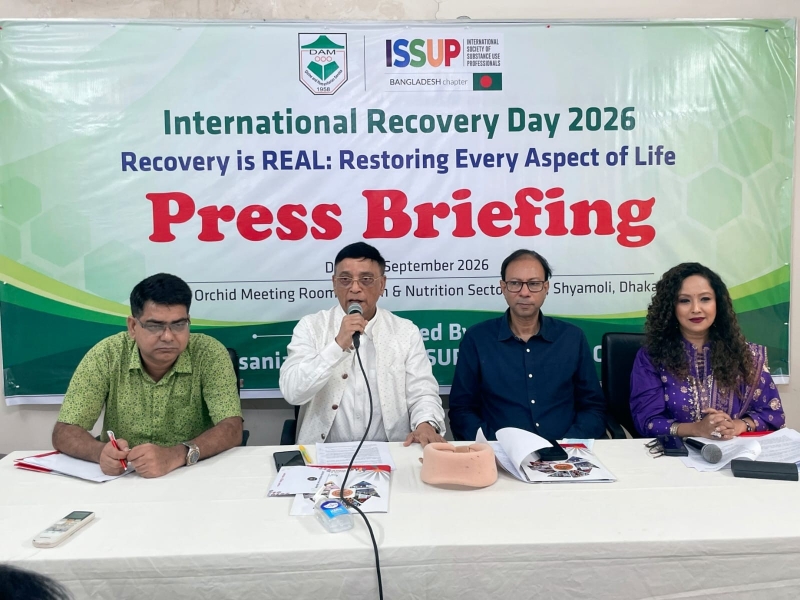
Prof Dr MA Mohit Kamal, psychiatrist and chairman of the Bangladesh Chapter of ISSUP addressing a press briefing in Dhaka on Wednesday 30 Sept 2026.
Dhaka, Sept 30 - Recovery from drug addiction is an ongoing process that requires continuous care and support to help people overcome the harmful effects of substance use and lead healthy, meaningful and fulfilling lives, speakers said on Wednesday.
They made the remarks at a discussion organised jointly by Dhaka Ahsania Mission (DAM) and the Bangladesh Chapter of the International Society of Substance Use Professionals (ISSUP) at the DAM office in Shyamoli on the occasion of Recovery Day 2026.
September is observed globally as Recovery Month, with this year’s theme being “Recovery Is Real: Restoring Every Aspect of Life”, highlighting the importance of helping people rebuild different aspects of their lives during recovery.
Prof Dr MA Mohit Kamal, psychiatrist and chairman of the Bangladesh Chapter of ISSUP, said sustainable recovery requires more than medical treatment and depends on family support, aftercare, peer support, relapse prevention, and access to education, employment and social opportunities.
He said a continuum of care—from early intervention and treatment to rehabilitation, aftercare and community-based support—is essential to sustain recovery and prevent relapse.
Mohit noted that returning to the same environment after treatment, unemployment, family conflicts and social stigma may increase the risk of returning to substance use.
Calling for people with drug dependence not to be labelled as “addicts” or with other derogatory terms, he stressed the importance of recognising them as individuals experiencing a health condition.
The psychiatrist said a person’s current challenges do not define their entire identity, adding that compassion rather than stigma can make the path to recovery easier and help people rebuild healthy and meaningful lives.
In his keynote presentation, Iqbal Masud, director of the Health & Nutrition Sector of Dhaka Ahsania Mission and General Secretary of the Bangladesh Chapter of ISSUP, said a recent national study found that about 8.2 million people in Bangladesh use some form of drugs, accounting for 4.88 percent of the total population.
He said substance use often begins at an early age, with about 33 percent of users reporting that they started using drugs between the ages of 8 and 17, while 59 percent started between 18 and 25.
Nearly 90 percent of users reported that drugs were easily accessible to them, according to the study.
The study also found that about 69 percent of respondents wanted treatment or rehabilitation services, while 62 percent wanted counselling support. However, only 13 percent had access to treatment or rehabilitation services.
The speakers emphasised that recovery should not end when a person completes a treatment programme.
Recovery requires a continuum of care that connects prevention, early intervention, treatment, rehabilitation, aftercare, relapse prevention, social reintegration and long-term community support, they said. - UNB