

- Bidisha Siddique Arrested in Fraud Case |
- As wars spread, the global food system unravels |
- Holy Eid-e-Miladunnabi Wednesday |
- EU sees Bangladesh as partner of growing strategic importance: Miller |
- Journalism’s main task is to question power: Swapon |
President Urges Following Prophet’s Teachings for Peaceful Bangladesh
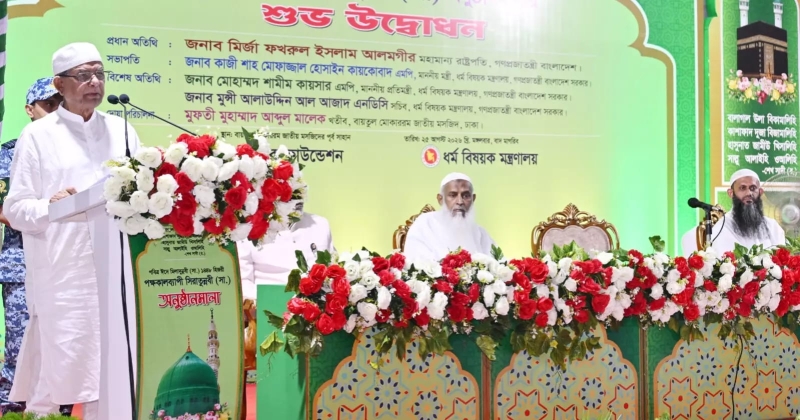
President Mirza Fakhrul Islam Alamgir on Tuesday urged people to follow the life and teachings of Prophet Hazrat Muhammad (PBUH) and uphold truth, justice, honesty, tolerance, equality and humanity to build a peaceful, just and prosperous Bangladesh.
“Let us spread the message of peace and humanity of Islam instead of division and discrimination in the name of religion,” he said.
The President made the remarks while inaugurating a fortnight-long Sirat-un-Nabi (PBUH) programme organised by the Islamic Foundation at Baitul Mukarram National Mosque in Dhaka on the occasion of Eid-e-Miladunnabi.
He said the occasion is sacred and significant for Muslims around the world and extended greetings to the people of Bangladesh and Muslims worldwide.
Referring to the life and ideals of Prophet Muhammad (PBUH), Mirza Fakhrul said his character embodied truthfulness, justice, forgiveness, patience, humanity and compassion.
He said the Prophet taught respect for the rights of women, children, neighbours and workers and stressed that no one should be discriminated against based on religion, race, tribe, language, region or social status.
“Establishing human dignity and building a society based on justice and fairness were among his foremost teachings,” the President said.
He said these teachings remain highly relevant at a time when hatred, conflict, intolerance, discrimination, extremism and moral degradation are spreading across the world.
The President also highlighted the teachings of the Prophet’s Farewell Hajj sermon on human dignity, equality, brotherhood, justice and mutual rights.
Mirza Fakhrul said Bangladesh has a long tradition of communal harmony and religious coexistence. He called for creating a society where people of all faiths can practise their religions freely and live with safety and dignity.
He urged ulema, scholars and religious leaders to play a stronger role in combating corruption, drugs, terrorism, communal hatred, rumours, violence and intolerance.
The President also called for national unity to prevent authoritarianism, injustice and what he described as fascism from returning.
He said the government is committed to improving the welfare and dignity of religious leaders. Monthly honorariums have already been introduced for imams, muezzins and khadims, while similar support is being considered for service providers at other places of worship.
He expressed hope that all mosques and other places of worship across the country would come under the monthly honorarium scheme before 2030.
Mirza Fakhrul praised the Islamic Foundation for its role in religious education, Islamic culture, research, publications and mosque-based activities.
He formally opened the fortnight-long Sirat-un-Nabi programme and expressed hope that it would help promote peace, harmony and human welfare.