

- Midterm Election Results: One of Biggest Reversals in US History |
- Republicans face midterm backlash over Trump's economic policies, Poll reveals |
- Waterlogging in Kumarkhali: Potential farm loss Tk35 crore annually |
- Substitute Ibrahim powers Bangladesh to 1-0 win over Bhutan in SAFF |
- Trump Threatens to ‘Destroy’ What Remains of Iran |
Wealthy People Buy Climate Protection as Poorer Suffer
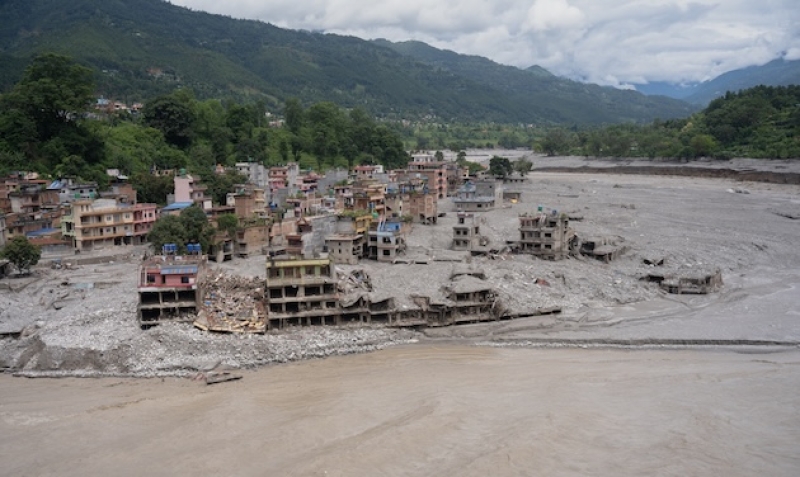
Houses damaged by the flood in Trishuli Bazaar, Nuwakot.
The world's wealthiest people are responsible for a disproportionate share of climate pollution, while poorer communities bear the heaviest costs of floods, heatwaves, food insecurity and other climate disasters, according to a new report by Oxfam International.
The report, titled Disaster Divide: How Climate Chaos Deepens Inequality and Enriches the Few, published on October 27, 2026, argues that climate change is not merely an environmental crisis but also a force deepening existing economic and social inequalities.
It highlights a growing divide between those who contribute most to global emissions and those most exposed to their consequences.
Wealthy households can often afford safer homes, insurance, private transport and alternative accommodation when disasters strike. Poorer families, however, may lose their homes, livelihoods and savings, often without the resources needed to rebuild.
“The richest 0.1% of people generate more consumption-based emissions than the poorest 3.5 billion combined,” the report said, highlighting the enormous gap between the environmental footprints of the world's wealthiest and poorest populations.
Oxfam argues that tackling the climate crisis requires more than reducing emissions. Governments must also address the concentration of wealth, improve access to climate finance and ensure that disaster recovery policies protect vulnerable communities rather than disproportionately benefiting the already wealthy.
Wealth Buys Protection From Climate Disasters
Mateo Adarve Zuluaga, Global Research and Advocacy Lead at Oxfam GB, said the report shows how wealth can buy protection from the climate crisis.
In an interview, he said wealthy people can purchase safer homes in better-protected communities and absorb rising food and water costs more easily. Some billionaires even buy islands and build underground bunkers.
He cited California's wildfires as an example of the divide. Wealthy residents can receive early warnings, hire private firefighters and evacuate by helicopter to luxury hotels, with costs sometimes covered by insurance.
Such insurance policies can carry annual premiums of up to six figures and are typically available only for properties valued above $1 million.
Poorer communities cannot afford similar protection. In Altadena, a historically Black and brown middle-class community with a legacy of generational home ownership, many homeowners had no insurance or only partial coverage.
When wildfires struck in 2025, countless families lost their homes and, with them, wealth accumulated over decades. Some were forced to sell damaged properties at discounted prices to real estate companies, losing both financial security and community ties.
For people already living in poverty, every flood, drought, wildfire or heatwave can destroy homes and livelihoods, deplete scarce resources and push families into debt, displacement or homelessness.
The report describes climate disasters as “inequality machines”, creating a cycle in which inequality increases people's vulnerability to disasters, while disasters deepen existing inequalities.
Making Wealthy Polluters Pay
Zuluaga said emissions from the super-rich and major corporations are driving the climate crisis. Along with historically high-emitting wealthy countries, they have a responsibility to reduce emissions first and fastest and help address the damage caused, particularly in low-income countries.
He called on governments to adopt ambitious national climate plans aligned with the Paris Agreement and the principle of fair responsibility, with the goal of limiting global warming to 1.5°C.
Under this principle, wealthy countries and individuals whose emissions far exceed those of others should lead the way with rapid and substantial reductions.
He also identified taxation as a key tool, urging governments to introduce permanent progressive taxes on the wealth and income of the richest one per cent.
Other proposals include higher taxes on fossil fuel corporations, polluting investments and high-emission luxury activities such as private jet travel. Governments should also regulate corporations and investors, requiring them to disclose emissions across their operations and supply chains and establish science-based reduction targets.
Zuluaga said governments should introduce taxes on fossil fuel companies' excess profits, with the revenue supporting climate action in developing countries.
He noted that the wealth of the richest one per cent had increased by $33.9 trillion since 2015, while billionaires paid only around 0.3 per cent in real taxes.
To protect workers and consumers, he called for energy to be treated as a human right and public good, with public and community ownership, transparency and oversight.
Protecting Vulnerable Communities
Oxfam also called for stronger safeguards to ensure that public disaster-relief funds reach vulnerable people rather than reinforcing existing inequalities.
Zuluaga said resilience should be measured by how well societies protect one another, not by how much hardship people can endure.
He called for enforceable rules governing corporate conduct during emergencies, including limits on excessive profits from emergency contracts and temporary caps on prices and margins for essential goods during declared disasters.
He also urged governments to oversee insurance markets to prevent excessive premiums or the withdrawal of coverage, while introducing measures to make insurance more affordable.
Food systems require particular attention, he said. Governments should prevent excessive market concentration in agricultural inputs and commodities, regulate speculative food trading during crises and cap prices of essential food and farming inputs in emergencies.
He added that the public sector should take the lead in disaster response and recovery, reducing reliance on private contractors. Public funding should take priority over private finance and be provided as grants rather than loans, so that relief does not increase the debt burden of affected communities.
South Asia Faces Climate Inequality
Pubudini Wickramaratne, Land Rights Policy Lead at Oxfam International, said Nepal illustrates one of the major injustices of the climate crisis: those who contribute least to global warming often suffer its worst consequences.
Despite contributing less than 0.1 per cent of global greenhouse gas emissions, Nepal faces increasingly severe climate impacts, including glacier melt, flooding, extreme heat and landslides.
She said the same pattern can be seen across South Asia and other parts of the world, where communities with smaller carbon footprints are often more exposed to climate disasters.
According to Oxfam, the richest one per cent account for around 17 per cent of global emissions, while the richest 0.1 per cent have contributed nearly 400 times more than the poorest half of humanity to the increased likelihood of extreme heat events.
The report calls for climate funding to prioritise vulnerable populations without adding to the debt burdens of countries already struggling with climate-related losses.
It also urges governments to examine how public policies determine who benefits from economic growth and who bears its environmental costs.
Oxfam argues that reducing emissions must go hand in hand with policies that make societies fairer and better prepared for climate shocks.
The report concludes that climate disasters should not be treated as isolated events affecting everyone equally. Instead, they form part of a cycle in which inequality increases exposure to harm, disasters deepen poverty and economic losses make future recovery more difficult.
Breaking that cycle will require both stronger climate action and policies that address the unequal distribution of wealth and resources.
Source: IPS