

- Dhaka's air 5th worst in the world this morning |
- Around 7,500 Bangladeshis imprisoned in Saudi Arabia: Shama Obaed |
- Bangladesh Outperforms India in Global Hunger Index 2026 |
- Covered van hits Gazipur police patrol team, killing SI, BNP leader |
- Korean City scrambles to rescue dusky shark after it returns to canal |
Bangladesh Must Urbanize Its Social Safety Nets
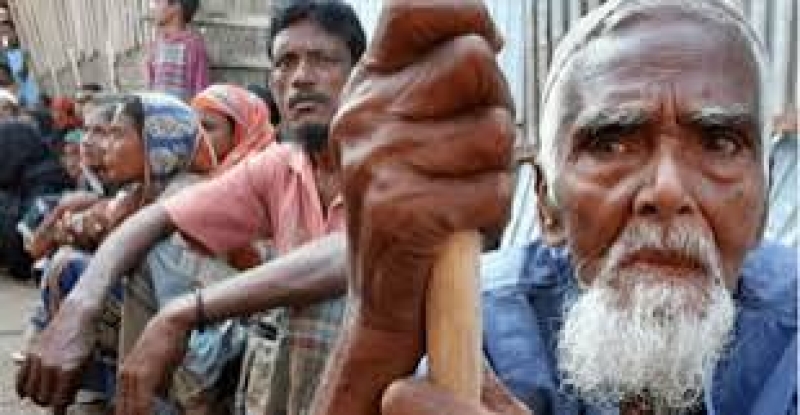
Dhaka, the planet’s second most populous city, is on track to become the world’s largest city by 2050, according to the UN World Urbanization Prospects 2025 report. This dramatic rise is largely due to the millions of rural-to-urban migrants seeking work, safety, and survival in the city. Urban Bangladesh is quite literally built by migrants, yet the state’s social safety nets are designed as if the urban poor, predominantly rural-to-urban migrants, do not exist.
When more inclusive social safety nets are imagined, they miss the spatial realities that structure migrants’ everyday lives in Bangladesh’s cities. More bluntly, Bangladesh’s social protection efforts continue to have a rural bias. Research by the Centre for Policy Dialogue (2023) emphasizes, for instance, that urban poor households remain systematically excluded from more than 115 safety net schemes nationwide. The government’s fears that urban safety nets might encourage migration are often cited to justify exclusion, even though allowance amounts are far too small to offset the cost of urban living. We, therefore, end up in a social safety net architecture that treats urban migrants as invisible people rather than legitimate city dwellers.
The Scale of Urban Exclusion
The scale of urban migrant exclusion from social safety net programmes (SSNPs) is well documented. A 2025 UNDP policy brief stated that while nearly one-third of Bangladesh’s population now lives in cities, only about 20 per cent of social protection beneficiaries are urban, and programmes exclusively targeting urban populations receive just 4 percent of total social protection spending. Nearly two-thirds of extremely poor urban households receive no social protection at all, a far higher exclusion rate than in rural areas. Even flagship programmes such as old-age, widow, and disability allowances show minimal urban reach, and in some cases such as the widow allowance they are not operational in city corporation areas. As a result, poor urban migrants are left to survive the city without any social buffer.
The Bangladesh state is cognizant of the urban gap in its SSNPs. In 2020, the government developed the Urban Social Protection Strategy and Action Plan, explicitly acknowledging that Bangladesh’s social protection system had failed to recognise the vulnerabilities of the urban poor, including migrants living in informal settlements. The strategy recognised that urban poverty is not only about income, but about insecure housing, lack of tenure, informal employment, weak social networks, exposure to violence, and exclusion from basic services, arguably making urban deprivation harsher than rural poverty. The action plan proposed a three-part framework: expanding rural programmes into cities, introducing urban labour-market interventions, and developing social insurance for urban workers.
Yet five years on, this agenda remains stalled. The action plan called for expanding allowances, food security programmes, urban workfare, and national social insurance; for creating a single registry; for ensuring portability for mobile populations; and for addressing land tenure insecurity in slums. None of this has come to pass. Perhaps, the action plan’s stalled status provides us an opportunity to imagine a more robust, security and resilience oriented, city-specific approach to social safety nets for urban migrants.
Missing Urban Social Safety Net is a Security and Climate Risk
Afterall, the absence of urban social safety nets is not only a poverty issue. It is a security and climate risk. In cities like Dhaka, migrants are concentrated in the most heat-exposed, flood-prone, and polluted neighbourhoods, while working in the most climate-sensitive and informal jobs. Without income protection, healthcare, housing, or legal recognition, climate shocks quickly translate into displacement, illness, conflict, and social unrest. Policing and disaster response cannot compensate for this structural vulnerability. Urban social protection is therefore the frontline for climate adaptation and preventive security rolled into one.
Need to Embed Social Safety Nets in Everyday Spaces
Existing policy recommendations still imagine social protection as a set of programmes delivered through eligibility lists and transfers. But migration is a spatial process, and protection must respond to that reality. Global comparative research on urban safety nets shows that income support alone is insufficient in cities; protection must be linked to housing, healthcare, childcare, employability, and violence prevention. In dense urban settings, social protection works only when it is spatiallyembedded.
If urbanizing Bangladesh is serious about protecting migrants, social protection must begin at the moment of arrival, in the places where migrants arrive over and over. We need welcome centres at bus terminals, truck stands, and transport hubs, places where migrants first enter the city. These centres can register inflows and outflows, provide first aid, drinking water, washing and ablution spaces, and connect people to jobs, housing, healthcare, schools, and legal support. They can also issue simple, non-punitive work licences or tokens that enable access to income without criminalising informality.
Beyond arrival, protection must secure the conditions of everyday life. This means safe dormitories and WASH facilities, pathways to family housing, health insurance and a strengthened urban primary healthcare system, and schools that welcome mobile populations rather than excluding children for lack of fixed addresses. Public health must be treated as a right: enforcing food safety standards, maintaining minimum air-quality thresholds, and guaranteeing water, sanitation, and waste services in migrant settlements. Social protection must also include security and care; stronger law-and-order protection in vulnerable neighbourhoods, and public spaces for sports and recreation that help rebuild social ties in harsh urban environments.
Vulnerable people often are not aware of programmes or schemes that may help them. This is why they should be able to access social safety nets precisely in the places where they experience vulnerability, meaning the city’s terminals, pavements, worksites, clinics, schools, streets, and so on. A migrant-centred safety net must be synced to the spatial and lived everyday realities of migrants. Bangladesh must, in other words, urbanize its social safety nets. As our cities continue to grow through migration and climate stress, they cannot function with security and resilience without protecting migrants. We are certainly grappling with a political failure to act on commitments, but perhaps more profoundly we are grappling with the failure to imagine an everyday lived social safety net approach for urban migrants.
By Mohammad Azaz and Efadul Huq.
Mohammad Azaz is the Administrator of Dhaka North City Corporation.
Efadul Huq, Phd, is Assistant Professor of Environmental Science & Policy and Urban Studies at Smith College.
Disclaimer: The views and opinions expressed in the article are those of the respective authors, reports UNB.