

- Dhaka's air 5th worst in the world this morning |
- Around 7,500 Bangladeshis imprisoned in Saudi Arabia: Shama Obaed |
- Bangladesh Outperforms India in Global Hunger Index 2026 |
- Covered van hits Gazipur police patrol team, killing SI, BNP leader |
- Korean City scrambles to rescue dusky shark after it returns to canal |
Pay Panel Proposes Tk20,000–Tk160,000 Salary Scale
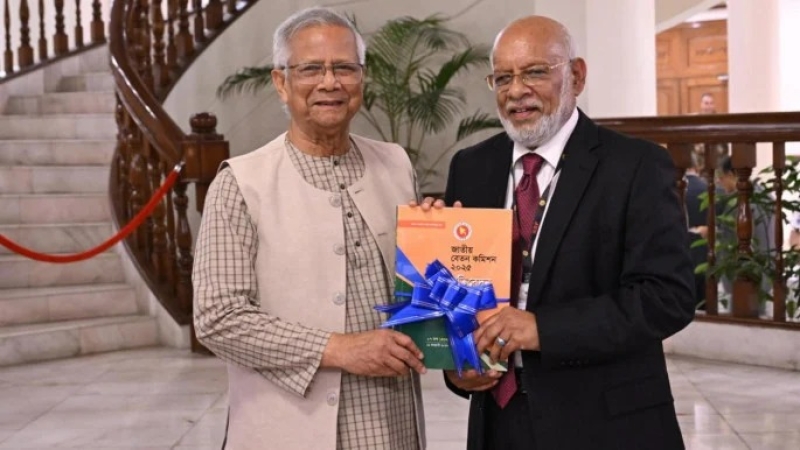
National Pay Commission Chairman Zakir Ahmed Khan hands over their report on a new pay scale for government employees to Chief Adviser Muhammad Yunus at Jamuna on 21 January 2026.
The 9th National Pay Commission has proposed a major revision of government salaries, recommending increases ranging from 100% to 147% under a new pay structure that sets the minimum salary at Tk20,000 and the maximum at Tk160,000.
Under the proposal, pay would be revised across 20 grades. The lowest grade (20th) is set to rise from Tk8,250 to Tk20,000, while the highest grade (1st) would increase from Tk78,000 to Tk160,000.
The 23-member commission, chaired by Zakir Ahmed Khan, submitted its report to Chief Adviser Muhammad Yunus at the state guest house Jamuna on Wednesday, according to an official statement.
The report outlines new pay scales and revised allowances for government officers and employees. Zakir Ahmed Khan said implementation of the proposed structure would require an additional Tk106,000 crore. Currently, the government spends about Tk131,000 crore on salaries for around 14 lakh employees and pensions for nearly 9 lakh retirees.
Among welfare measures, the commission has recommended a monthly allowance of Tk2,000 for government employees with children with disabilities, limited to a maximum of two children per family.
The report also proposes retaining the tiffin allowance while increasing its amount. For employees in grades 11 to 20, the monthly allowance is recommended to be raised from Tk200 to Tk1,000.
After receiving the report, Chief Adviser Yunus expressed satisfaction, describing the work as a long-awaited and complex task.
The handover ceremony was attended by Finance Adviser Salehuddin Ahmed, the Chief Adviser’s Special Assistant Anisuzzaman Chowdhury, Finance Secretary Khairuzzaman Majumder, and members of the commission.
Beyond pay and allowances, the report includes proposals to introduce health insurance for government employees, reform the pension system, reconstitute the Government Employees Welfare Board, establish a Service Commission, rationalise pay grades, review allowances through specialised committees, and strengthen human resource development in the health and education sectors.
The commission noted that sharp changes in global and domestic economic conditions over the past decade, particularly rising prices of essential commodities, have made it increasingly difficult for government employees to cope with living costs without a timely pay revision.
Finance Adviser Salehuddin Ahmed said the recommendations would not be implemented immediately. He noted that the proposals would first be examined by relevant committees and undergo a review process, which typically takes three to four months, before any final decision is made.