

- NYC BNP leaders, activists upbeat ahead of Tarique Rahman’s arrival |
- PM off to New York to attend UNGA |
- 8 Killed in Ashulia Garment Factory Fire |
- Apratim Murder Suspects Confessed, Says Home Minister |
- Dhaka's air decorded unhealthy for sensitive groups Sunday morning |
ASEAN’s Contemporary Response to South China Sea Dispute
Indonesia’s Pivotal Role as Mediator And Defender of Maritime Rights
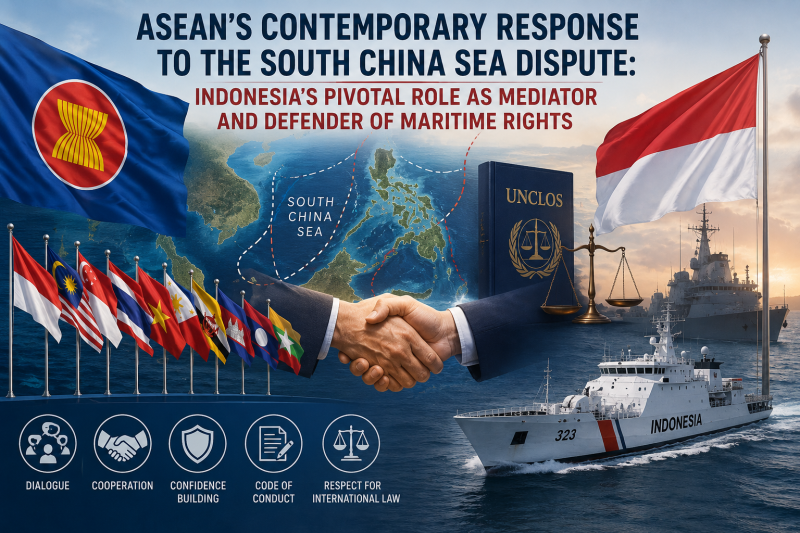
Asean contemporary response to the South China Sea Dispute.
By Khalisha Ainna Putri
ABSTRACT
The South China Sea dispute remains one of Southeast Asia's most persistent maritime security challenges, testing ASEAN's capacity to preserve regional stability while confronting divergent national interests and growing major-power competition. This study examines ASEAN's contemporary response to the dispute and analyses how Indonesia balances its role as a regional mediator with its responsibility to defend its maritime rights in the North Natuna Sea. It employs qualitative content analysis of secondary documentary sources, including scholarly literature, official ASEAN and Indonesian documents, policy reports, international legal instruments, and publications by research institutions. Neorealism and Constructivism are applied as complementary analytical frameworks. The findings show that ASEAN's response is best understood as institutionalised conflict management rather than conflict resolution. Through dialogue, confidence-building measures, the Declaration on the Conduct of Parties, continuing Code of Conduct negotiations, and repeated reliance on UNCLOS, ASEAN has preserved a regional diplomatic framework; however, its effectiveness remains constrained by consensus-based decision-making, internal divisions, and limited enforcement capacity. Indonesia responds to these limitations through a strategy of controlled assertiveness. It maintains its identity as a non-claimant and regional mediator while defending its UNCLOS-based sovereign rights through calibrated deterrence, civilian maritime enforcement, and limited naval signalling. This balance enables Indonesia to protect national interests without abandoning ASEAN centrality, strategic autonomy, or engagement with China. The study concludes that Indonesia's mediator and defender roles can be mutually reinforcing, although the balance remains fragile and requires stronger maritime-agency coordination and a more effective regional Code of Conduct.
Keywords: ASEAN, South China Sea, Indonesia, North Natuna Sea, controlled assertiveness, maritime security
Introduction
The South China Sea (SCS) dispute is one of the world's most complicated and long-running maritime conflicts, involving overlapping territorial claims from China, Vietnam, the Philippines, Malaysia, Brunei, and Taiwan. Although the dispute began to gain international attention during the Cold War, tensions have grown significantly over the last two decades due to China's rapid economic growth and military modernization. Today, competition over maritime resources, shifting regional power dynamics, and the growing rivalry between China and the United States have further intensified the situation. Under President Xi Jinping, China's increasingly assertive actions in the South China Sea have reshaped the regional balance and turned the area into one of the most strategically contested waters in the world (Southgate, 2019).
As the leading regional organization in Southeast Asia, the Association of Southeast Asian Nations (ASEAN) has long attempted to manage tensions and maintain regional stability through what is commonly known as the "ASEAN Way." This approach emphasizes respect for state sovereignty, consensus-based decision-making, informal dialogue, and quiet diplomacy rather than confrontational legal measures. Through platforms such as the ASEAN Regional Forum (ARF) and the ASEAN Defence Ministers' Meeting Plus (ADMM+), ASEAN seeks to encourage dialogue, build trust, and manage relations between regional and external powers. In addition, ASEAN has promoted frameworks such as the 2002 Declaration on the Conduct of Parties (DOC) and ongoing negotiations for a Code of Conduct (COC) in an effort to create a rules-based regional order grounded in international law and peaceful dispute management (Chuong, 2025).
Despite these efforts, ASEAN's contemporary response has increasingly been questioned due to its limited ability to prevent the continued escalation of maritime tensions in the South China Sea. The non-binding nature of the DOC and the slow progress of the COC negotiations have highlighted ASEAN's institutional limitations, particularly its consensus-based decision-making process and internal divisions, which have constrained the organisation's ability to formulate a unified and effective regional response. Consequently, ASEAN continues to face challenges in maintaining its centrality and credibility amid intensifying geopolitical competition in the region (Kim, 2026).
Against this backdrop, Indonesia has assumed a pivotal role within ASEAN by acting as both a regional mediator and a defender of its maritime rights. This role is closely linked to its long-standing Bebas Aktif (independent and active) foreign policy, which emphasizes neutrality toward major powers while encouraging active involvement in conflict resolution and regional diplomacy (Sukma, 1995). Through this approach, Indonesia has consistently sought to preserve ASEAN centrality, strengthen regional unity, and promote respect for the United Nations Convention on the Law of the Sea (UNCLOS).
However, Indonesia now faces a growing dilemma. On one hand, it seeks to maintain its image as a neutral mediator within ASEAN. On the other hand, it must also protect its own national interests, particularly against repeated maritime incursions in its Exclusive Economic Zone (EEZ) around the North Natuna Sea. This creates a strategic tension between Indonesia's responsibility to uphold its credibility as an honest broker and its obligation to strengthen its maritime defence in safeguarding its sovereignty and sovereign rights. As a result, Indonesia must constantly balance multilateral diplomacy with stronger national security measures. This dual role has become increasingly significant as Indonesia's national interests intersect with ASEAN's broader objective of preserving regional stability and a rules-based maritime order (Dipua et al., 2020).
To better understand these dynamics, this study applies two complementary theoretical perspectives: Neorealism and Constructivism. From a Neorealist perspective, the study examines how rising maritime tensions create a security dilemma in which states prioritize national interests and survival within an anarchic international system. In contrast, the Constructivist perspective focuses on how shared norms, regional identity, and the "ASEAN Way" influence cooperation and shape Indonesia's role as an "honest broker."
Against the backdrop of rising geopolitical tensions and increasing competition between major powers, this study explores ASEAN's contemporary response to the South China Sea dispute and Indonesia's pivotal role in supporting ASEAN's efforts to preserve regional stability. More specifically, the research examines how Indonesia balances its role as an ASEAN mediator with its responsibility to defend its maritime rights in the North Natuna Sea. Ultimately, the study contributes to broader discussions on maintaining peace, stability, and a rules-based regional order in Southeast Asia under international maritime law, particularly UNCLOS.
To examine these issues, this study addresses two central research questions:
1. How has ASEAN responded to contemporary developments in the South China Sea dispute?
2. How does Indonesia balance its role as an ASEAN mediator with its responsibility to defend its maritime rights in the North Natuna Sea?
2.Literature Review
2.1. ASEAN and the South China Sea
The South China Sea dispute remains one of Southeast Asia's most persistent maritime security challenges, involving overlapping territorial claims and competing strategic, economic, and security interests. Its significance extends beyond the claimant states because developments in the South China Sea affect regional stability, freedom of navigation, international trade, and the broader balance of power in Southeast Asia (Severino, 2010).
ASEAN has consequently assumed an important diplomatic role in managing the dispute, although its effectiveness remains constrained by institutional limitations, divergent national interests, and China's growing regional influence (Muhibat, 2022).
ASEAN's approach has primarily relied on dialogue, confidence-building, and peaceful dispute settlement rather than coercive mechanisms. The 2002 Declaration on the Conduct of Parties in the South China Sea (DOC) institutionalised this approach by committing ASEAN members and China to self-restraint, freedom of navigation, peaceful dispute settlement, and cooperation in accordance with international law, particularly the 1982 United Nations Convention on the Law of the Sea (UNCLOS). The DOC also established the political foundation for developing a more comprehensive Code of Conduct (COC) (ASEAN, 2002). However, its non-binding character and lack of enforcement mechanisms have limited its ability to constrain state behaviour or address the underlying questions of sovereignty and maritime delimitation (Kim, 2026).
The prolonged COC negotiations reflect both the continuity and limitations of ASEAN's diplomatic approach. The proposed COC seeks to establish clearer rules for state behaviour and strengthen mechanisms for managing maritime tensions, but negotiations have remained difficult because of disagreements concerning its geographic scope, legal status, and enforcement mechanisms. China's reservations toward stronger legal constraints, together with differing preferences among ASEAN members, have prevented the emergence of a unified negotiating position (Valencia, 2017; Thayer, 2013; The Star, 2026).
These difficulties are closely connected to ASEAN's institutional structure. The ASEAN Way emphasises consensus, sovereignty, non-interference, and consultation, principles that have historically contributed to regional cohesion but can restrict decisive collective action. Member states also differ considerably in their exposure to the South China Sea dispute and their political and economic relationships with China. Claimant states generally have stronger incentives to support a more assertive regional response, whereas some non-claimant members prioritise broader relations with Beijing. ASEAN's effectiveness is therefore shaped by a fundamental institutional tension: the same consensus-based framework that preserves regional cohesion can also constrain its capacity to formulate timely and unified responses to maritime security challenges (Li, 2018; Muhibat, 2022; Pu, 2025).
2.2. Indonesia's Dual Role in the South China Sea
Indonesia occupies a distinctive position in ASEAN because of its political influence, economic capacity, geographical size, and historical contribution to regional institution-building. Often regarded as ASEAN's first among equals, Indonesia has played an important role in shaping regional norms of consensus, non-interference, dialogue, and peaceful dispute settlement while promoting ASEAN centrality in the wider regional architecture (Anwar, 2024).
This regional role is closely connected to Indonesia's Bebas Aktif foreign policy, which combines strategic independence with active participation in maintaining international peace and cooperation. In the South China Sea, this principle has supported Indonesia's preference for ASEAN-led diplomacy, non-alignment, international law, and peaceful dispute settlement. Indonesia has consequently positioned itself as an honest broker and confidence builder, including through the Workshop on Managing Potential Conflicts in the South China Sea, the Donut Proposal, its contribution to the DOC, and continued support for COC negotiations (Weatherbee, 2017; Dipua et al., 2020).
Indonesia's position has nevertheless become more complex as maritime tensions have increasingly affected its interests in the North Natuna Sea. Although Indonesia does not regard itself as a claimant to the wider South China Sea territorial dispute, China's nine-dash line overlaps with Indonesia's EEZ. Indonesia has therefore strengthened maritime patrols, defence preparedness, and its capacity to protect its sovereign rights while continuing to promote regional diplomacy. The Global Maritime Fulcrum reflects this increasing emphasis on maritime security and demonstrates that Indonesia's contemporary approach combines diplomatic engagement with national defence rather than relying exclusively on either strategy (Budiana et al., 2019).
This dual position creates the central analytical issue examined in this study. Indonesia's diplomatic credibility partly depends on maintaining its identity as a non-claimant and neutral regional actor, while repeated challenges to its maritime rights require credible national enforcement. Its behaviour in the South China Sea therefore involves balancing two interconnected responsibilities: preserving diplomatic space for regional conflict management while demonstrating the capacity and willingness to protect its maritime interests.
2.3. Theoretical Framework
This study employs Neorealism and Constructivism as complementary frameworks for analysing Indonesia's dual role. Neorealism provides an explanation for Indonesia's increasing emphasis on maritime capability and sovereignty protection in response to an uncertain regional security environment. Under conditions of unequal power and strategic competition, Indonesia cannot rely exclusively on regional institutions to guarantee its maritime security. The security dilemma is particularly relevant because measures intended to strengthen national security may simultaneously contribute to greater suspicion and regional tension, creating incentives for Indonesia to combine deterrence with restraint (Telhami, 2002; Tang, 2009).
Constructivism complements this material explanation by examining how Indonesia's behaviour is shaped by established identities and regional norms. Indonesia's self-understanding as an independent regional actor and honest broker, together with Bebas Aktif, ASEAN centrality, dialogue, and peaceful dispute settlement, influences how it pursues its interests. These norms help explain why greater concern for maritime security has not resulted in the abandonment of ASEAN-led diplomacy or strategic autonomy (Guzzini & Leander, 2005).
Combining the two perspectives allows Indonesia's diplomatic and security behaviour to be examined as interconnected rather than contradictory. Neorealism accounts for the material pressures encouraging stronger maritime defence, while Constructivism explains the normative and identity-based constraints shaping how that defence is exercised. The framework therefore provides a basis for analysing how Indonesia reconciles national maritime security with its continuing regional diplomatic role.
2.4. Research Gap
The existing scholarship provides substantial analysis of ASEAN's management of the South China Sea through the DOC, COC negotiations, and the institutional constraints created by consensus and differing member-state interests (Kim, 2026; Valencia, 2017; Thayer, 2013; Muhibat, 2022). At the same time, studies of Indonesia have examined its regional leadership, Bebas Aktif foreign policy, honest-broker role, and growing maritime defence posture in the North Natuna Sea (Dipua et al., 2020; Budiana et al., 2019).
However, these strands of literature have generally treated Indonesia's diplomatic and security roles separately. Less attention has been given to how Indonesia simultaneously maintains its position as an ASEAN mediator while defending its maritime rights in the North Natuna Sea. This separation limits understanding of how diplomatic identity, regional commitments, and national security pressures interact within Indonesia's contemporary South China Sea policy.
This study addresses this gap by examining these roles as part of a single foreign policy strategy. By integrating Neorealism and Constructivism, it analyses how material security pressures interact with Indonesia's diplomatic identity and regional norms. In doing so, the study connects ASEAN's contemporary management of the South China Sea with Indonesia's efforts to balance regional diplomacy and maritime defence, providing a more integrated explanation of Indonesia's role in the dispute.
3. Methodology
This study adopts a qualitative content analysis approach to examine ASEAN's contemporary response to the South China Sea dispute, with particular emphasis on Indonesia's role as a mediator and defender of its maritime rights. Qualitative content analysis is appropriate for this research because it enables the systematic examination and interpretation of textual materials to identify meanings, patterns, policy positions, and relationships within their broader political and institutional contexts. Rather than measuring variables quantitatively, the study analyses how ASEAN's institutional responses and Indonesia's foreign and maritime policies have evolved in addressing the South China Sea dispute through the interpretation of documentary evidence.
The study relies exclusively on secondary documentary sources, including academic books, peer-reviewed journal articles, official ASEAN documents, government publications, policy reports, legal instruments, and publications by international organisations and research institutes. Key documents include the ASEAN Charter, the Treaty of Amity and Cooperation (TAC), the Declaration on the Conduct of Parties in the South China Sea (DOC), documents concerning the Code of Conduct (COC) negotiations, the United Nations Convention on the Law of the Sea (UNCLOS), Indonesian foreign policy publications, and reports concerning maritime security in the South China Sea. These materials provide the empirical and contextual foundation for examining ASEAN's institutional response and Indonesia's evolving diplomatic and maritime security roles.
The selected documents are examined through a systematic process of reviewing, organising, comparing, and interpreting textual information relevant to the research questions. The analysis identifies recurring arguments, policy developments, institutional responses, and diplomatic practices concerning ASEAN's management of the South China Sea dispute and Indonesia's position within the regional framework. Particular attention is given to ASEAN's institutional constraints, the implementation of the DOC, developments in the COC negotiations, Indonesia's Bebas Aktif foreign policy, its position as an honest broker, and its evolving maritime defence posture in the North Natuna Sea. Rather than treating individual documents in isolation, the analysis compares perspectives across different sources to identify areas of continuity, divergence, and change. These findings are subsequently interpreted in relation to the research questions to assess ASEAN's contemporary response and explain how Indonesia reconciles its regional diplomatic role with the protection of its maritime rights.
The interpretation of the findings is guided by Neorealism and Constructivism. Neorealism, particularly through the security dilemma, provides an analytical basis for examining Indonesia's efforts to strengthen its maritime capabilities amid changing regional security dynamics. Constructivism complements this perspective by examining how Indonesia's diplomatic identity, Bebas Aktif principle, and commitment to ASEAN centrality influence its regional behaviour. Applying these perspectives together enables the study to assess Indonesia's maritime defence posture alongside the normative and diplomatic considerations that continue to shape its engagement with ASEAN and the wider South China Sea dispute.
Several methodological limitations must nevertheless be acknowledged. First, the study's exclusive reliance on secondary and publicly available documentary sources means that it does not incorporate primary data from interviews with policymakers, diplomats, maritime officials, or ASEAN representatives. Consequently, the analysis cannot fully capture informal negotiations, internal policy debates, strategic calculations, or behind-the-scenes decision-making that may influence ASEAN's and Indonesia's positions. Official documents may also present institutional positions without revealing the disagreements or compromises that occurred during their formulation. The findings therefore reflect what can be established through publicly accessible evidence rather than the complete internal decision-making processes of the actors concerned.
Second, reliance on existing literature introduces the possibility of publication and source bias. Academic studies, policy reports, government publications, and media sources may emphasise different interpretations of the dispute according to their institutional, national, or analytical perspectives. Certain developments may also receive greater scholarly and media attention than others, creating an uneven documentary record. To mitigate this limitation, the study draws on different categories of sources and compares academic literature with official documents, policy analysis, legal instruments, and contemporary reporting rather than relying on a single type of evidence.
Finally, the South China Sea remains a dynamic and continuously evolving dispute. Maritime incidents, diplomatic relations, defence policies, major-power competition, and the COC negotiations may change after the completion of this research. The findings should therefore be understood as an assessment of developments within the period covered by the selected sources rather than as a definitive account of future regional dynamics. Despite these limitations, qualitative content analysis provides an appropriate method for systematically examining the relationship between ASEAN's institutional response and Indonesia's diplomatic and maritime strategies.
By acknowledging the constraints of secondary-source research and comparing evidence across multiple documentary sources, the study seeks to provide a transparent and analytically grounded assessment of ASEAN's contemporary response to the South China Sea dispute and Indonesia's dual role as regional mediator and defender of its maritime rights.
4. Findings and Analysis
4.1. ASEAN's Contemporary Response to the South China Sea Dispute
ASEAN's contemporary response to the South China Sea dispute is best understood as a form of institutionalised conflict management rather than conflict resolution. Its reliance on dialogue, confidence-building measures, the 2002 Declaration on the Conduct of Parties in the South China Sea (DOC), and negotiations toward a Code of Conduct (COC) reflects an approach designed primarily to contain tensions rather than settle competing sovereignty claims. This distinction is significant because ASEAN's limited progress toward resolving the dispute does not necessarily indicate the absence of a regional response. Instead, ASEAN has concentrated its institutional capacity on preventing political and maritime tensions from developing into wider regional confrontation while preserving a diplomatic framework within which competing parties remain engaged (Vo et al., 2024; Hu, 2023).
The durability of this approach is particularly visible in the continued pursuit of the COC. More than two decades of negotiations without a final agreement can be interpreted as evidence of ASEAN's limited ability to produce binding outcomes. However, the persistence of negotiations also demonstrates ASEAN's capacity to keep China engaged within an ASEAN-led multilateral process despite fundamental disagreements over maritime claims. Hu (2023) argues that ASEAN's effectiveness should therefore not be assessed simply through whether it has resolved the dispute, but through its ability to secure important objectives while making compromises on others. From this perspective, ASEAN's achievement lies less in determining the outcome of the dispute than in establishing itself as a legitimate institutional actor in its management. China's continued participation in the COC process reinforces this role, even though ASEAN remains unable to compel a rapid or comprehensive settlement (Hu, 2023; Vo et al., 2024).
The renewed urgency surrounding the COC further demonstrates how ASEAN's institutional response has adapted to deteriorating maritime conditions without fundamentally changing its diplomatic character. Increasing confrontations between China and the Philippines have strengthened demands for clearer rules capable of preventing maritime incidents from developing into diplomatic or security crises. Under the Philippines' 2026 ASEAN Chairmanship, the COC consequently gained renewed political importance, with its conclusion framed not only as a matter of claimant-state security but as a wider regional interest because instability in the South China Sea carries implications for trade and regional order (Cepeda, 2026; Yang, 2026).
This development suggests that the COC increasingly functions as more than a negotiating objective. It has become a test of whether ASEAN can translate its established role as a forum for dialogue into a more effective mechanism for regulating behaviour at sea.
International law performs a similarly important function within ASEAN's response. ASEAN's repeated emphasis on UNCLOS, freedom of navigation, self-restraint, and peaceful dispute settlement provides a common normative framework without requiring member states to adopt identical positions on individual sovereignty claims. This distinction enables ASEAN to defend general principles governing maritime conduct while avoiding the politically more difficult task of determining which claimant's territorial position should prevail. The emphasis on UNCLOS therefore represents both a strength and a limitation of ASEAN diplomacy: it creates a common legal reference around which member states can organise their collective position, but it does not automatically produce agreement over how those principles should be applied to particular disputes.
The response to the 2016 South China Sea Arbitral Award illustrates this tension. ASEAN has repeatedly recognised UNCLOS as the principal legal framework governing maritime affairs, yet it has been unable to develop a unified position on an arbitral decision derived from that same legal framework (Long & Lam, 2026). This inconsistency is analytically significant because it reveals the boundary between normative consensus and political consensus within ASEAN. Member states can agree on the importance of international law at the level of general principle while remaining divided when its application produces political consequences for relations with China.
ASEAN's rules-based position is therefore strongest as a common diplomatic principle and considerably weaker when collective endorsement would require members to accept strategic or economic costs.
This limitation is closely connected to ASEAN's consensus-based institutional structure. Differences between member states are not simply disagreements over the South China Sea itself; they reflect different levels of exposure to the dispute, security priorities, and relationships with China. Claimant states have stronger incentives to seek clearer legal and diplomatic responses, whereas non-claimant states may place greater importance on preserving broader political and economic relations with Beijing. Consensus consequently produces a structural trade-off. It protects ASEAN unity by preventing collective positions from being imposed on reluctant members, but the same mechanism reduces the organisation's capacity to respond decisively when national preferences diverge. ASEAN centrality is therefore maintained partly through a decision-making structure that simultaneously constrains the strategic effectiveness of that centrality (Hu, 2023).
The prolonged COC process reflects the same structural tension. Its continuation preserves ASEAN's diplomatic relevance, but its slow progress exposes the limits of that relevance. ASEAN has succeeded in keeping dispute management within a multilateral framework and in sustaining Chinese participation, yet it has considerably less influence over the pace and eventual substance of the negotiations. The COC therefore demonstrates that institutional access should not be equated with institutional control. ASEAN can shape the diplomatic environment within which the dispute is managed without possessing sufficient leverage to determine its outcome. This helps explain why heightened maritime confrontations repeatedly generate renewed urgency for the COC without necessarily producing corresponding breakthroughs in negotiations (Hu, 2023; Yang, 2026).
Major-power competition further reinforces the importance of this institutional role while simultaneously making it more difficult to perform. Greater US-China competition increases the strategic significance of the South China Sea, but stronger alignment with either side could undermine ASEAN's ability to function as a regional platform acceptable to states with different strategic preferences. ASEAN's continued emphasis on dialogue and engagement can therefore be interpreted as an effort to preserve political space between competing powers rather than merely an unwillingness to take stronger positions. Its restraint helps sustain ASEAN centrality by avoiding the transformation of ASEAN mechanisms into instruments of either Chinese or American strategic competition. At the same time, such restraint limits the extent to which ASEAN can collectively challenge behaviour that individual member states consider threatening. ASEAN's centrality thus depends on maintaining a balance between relevance and neutrality: becoming more confrontational may increase its immediate strategic influence but risk weakening the consensus on which its regional role depends.
Taken together, these findings indicate that ASEAN's contemporary response contains a persistent tension between institutional resilience and strategic limitation. Its resilience lies in its ability to maintain dialogue, sustain the COC process, promote UNCLOS, and preserve a regional framework for managing tensions despite repeated maritime confrontations. Its limitation lies in its inability to convert these mechanisms consistently into collective positions or enforceable outcomes when member-state interests diverge. ASEAN should therefore neither be characterised simply as ineffective because the dispute remains unresolved nor treated as fully effective because diplomatic engagement continues. Its contribution is more specific: ASEAN has been comparatively more capable of institutionalising restraint and managing escalation than altering the underlying distribution of interests and power that sustains the dispute (Hu, 2023; Vo et al., 2024).
This distinction provides the clearest answer to how ASEAN has responded to contemporary developments in the South China Sea. ASEAN has responded by preserving an institutional environment in which confrontation can be moderated through dialogue, legal norms, and continuing negotiation, rather than by attempting to impose a settlement on the parties involved. The approach contributes to regional stability by keeping communication open and establishing common expectations regarding maritime conduct, but its effectiveness remains conditional on the willingness of member states and China to operate within those mechanisms.
ASEAN's contemporary role is therefore primarily that of a manager of regional tensions rather than an arbiter capable of resolving them.
The limits of collective conflict management also explain why the behaviour of individual ASEAN members remains consequential. Regional institutions can establish diplomatic and legal frameworks, but states continue to bear responsibility for protecting their own maritime interests when those frameworks cannot provide direct enforcement. Indonesia is particularly relevant in this respect because its position combines continued investment in ASEAN-led diplomacy with increasingly visible measures to protect its maritime rights in the North Natuna Sea. Examining Indonesia therefore moves the analysis from the institutional management of the dispute to the question of how an individual ASEAN member reconciles regional diplomatic commitments with national security requirements.
4.2. Indonesia's Dual Role as ASEAN Mediator and Defender of Maritime Rights
Indonesia’s position in the South China Sea is defined by a persistent strategic tension between preserving diplomatic credibility and defending maritime rights in the North Natuna Sea. This tension is not best understood as a choice between diplomacy and defence. Rather, Indonesia has increasingly integrated both within a single strategy in which stronger maritime enforcement is deliberately constrained by legal, diplomatic, and regional considerations. The significance of Indonesia’s approach therefore lies not simply in the coexistence of two policy instruments, but in the way each is used to limit the weaknesses of the other.
The distinction Indonesia maintains between the wider South China Sea sovereignty disputes and its own UNCLOS-based maritime entitlements is central to this strategy. By refusing to redefine itself as a claimant state, Indonesia preserves the diplomatic space required to remain engaged in ASEAN-led conflict management while simultaneously rejecting activities that challenge its EEZ. This legal and political separation reduces the risk that maritime enforcement in Natuna is interpreted as participation in a broader sovereignty confrontation. More importantly, it allows Indonesia to defend national interests without undermining the diplomatic credibility required to support ASEAN-led dispute management. By framing the North Natuna issue as a question of maritime entitlement rather than competing sovereignty, Indonesia can take a firmer position in defending its own jurisdiction while continuing to promote dialogue, confidence-building, and peaceful dispute management within ASEAN. Existing scholarship similarly recognises that Indonesia’s South China Sea position combines sovereignty protection with its roles as mediator, honest broker, and confidence builder (Dipua et al., 2020).
The growing security dimension of Indonesia’s policy nevertheless complicates this diplomatic position. Maulana (2022) interprets Indonesia’s use of naval capabilities in the Natuna Sea as a form of gunboat diplomacy, indicating that maritime power has become a more explicit instrument for defending national jurisdiction. This interpretation is important because it challenges any assumption that Indonesia’s contemporary response remains primarily diplomatic. The increasing use of deterrent signalling suggests that Jakarta has become less willing to rely on normative or diplomatic persuasion alone when its maritime rights are directly contested.
Yet the analytical significance of this development should not be overstated. Maulana (2022) also demonstrates that naval deterrence has produced only limited and temporary effects, as repeated incursions have continued despite stronger deployments. This weakens the argument that Indonesia is moving towards a predominantly military solution. If naval assertiveness were becoming the organising principle of policy, one would expect a more sustained effort to transform the regional balance or impose durable deterrence. Instead, Indonesia’s use of maritime power remains limited in scope and linked to specific challenges to national jurisdiction. Even within the gunboat-diplomacy interpretation, deterrence does not appear to have displaced Indonesia’s diplomatic identity as an honest broker and regional norm-setter.
A stronger counter-perspective is provided by Asy’ari et al. (2026), who identify elements of partial securitisation in Indonesia’s response. Their argument is significant because it captures the gradual expansion of security instruments within Indonesia’s South China Sea policy. However, their analysis also illustrates the limits of this securitisation. Indonesia’s response remains diversified and calibrated rather than openly confrontational; stronger operational resistance is not accompanied by sustained balancing, formal alignment, or the construction of China as an explicit adversary. The value of this interpretation is therefore not that it disproves Indonesia’s mediator role, but that it demonstrates how far the security dimension of Indonesian policy has expanded without fully displacing diplomacy.
This distinction is crucial. The greater visibility of security instruments does not necessarily imply a decline in neutrality or the abandonment of Indonesia’s regional diplomatic role. Indonesia continues to frame the North Natuna issue in terms of sovereign rights and law enforcement rather than as a broader sovereignty confrontation (Asy’ari et al., 2026). The evolution therefore concerns the means through which Indonesia protects a relatively stable diplomatic and legal position, rather than a fundamental transformation of that position. Stronger enforcement can consequently coexist with mediation so long as its purpose and scope remain distinguishable from participation in the wider sovereignty dispute.
Alfarizi et al. (2026) provide further support for this interpretation by characterising Indonesia’s approach as calibrated deterrence rather than overt balancing. Their analysis highlights the narrow strategic space within which Indonesia operates: excessive military assertiveness could undermine its identity as an independent and non-aligned actor and weaken its credibility as an ASEAN mediator, while insufficient deterrence could expose its maritime rights to continued pressure. This creates a policy logic in which restraint is not the opposite of deterrence, but a condition for making deterrence compatible with Indonesia’s broader regional role. The central issue is therefore not whether Indonesia responds assertively, but how far that assertiveness can extend without undermining the diplomatic position it simultaneously seeks to preserve.
The increasing use of civilian maritime enforcement illustrates this logic particularly well. Alfarizi et al. (2026) argue that reliance on civilian maritime agencies allows Indonesia to assert jurisdiction while preserving the legal character of maritime encounters and avoiding unnecessary militarisation. The choice of enforcement instrument therefore carries strategic meaning. Indonesia is not simply determining whether to respond, but how to respond in a manner that demonstrates resolve without converting law-enforcement incidents into military confrontation. Civilian enforcement consequently provides an important link between the defender and mediator roles: it allows Indonesia to demonstrate that its maritime rights will be enforced while limiting the political and military consequences that could weaken its position within ASEAN-led diplomacy.
Taken together, these perspectives indicate that Indonesia’s evolving posture cannot be adequately described as either continued diplomatic restraint or straightforward militarisation. Maulana (2022) highlights the increasing importance of naval deterrence, Asy’ari et al. (2026) identify partial securitisation and diversification, while Alfarizi et al. (2026) emphasise calibrated deterrence and strategic restraint. What these interpretations collectively demonstrate is an expansion in the instruments available to Indonesia rather than a fundamental replacement of its diplomatic orientation. Indonesia has become more assertive in defending its maritime rights, but the political purpose and boundaries of that assertiveness remain limited.
Indonesia’s approach can therefore be conceptualised as controlled assertiveness. The concept captures the interaction between stronger security measures and the deliberate limits imposed on them. Indonesia’s maritime posture is assertive because it increasingly relies on credible enforcement, deterrent signalling, and legal resistance to challenge activities in the North Natuna Sea. It is controlled because these measures remain embedded within strategic autonomy, ASEAN-led diplomacy, continued engagement with China, and a consistent legal distinction between maritime rights and wider sovereignty disputes. Controlled assertiveness therefore explains not only why Indonesia has become firmer in protecting its maritime jurisdiction, but also why that firmness has not developed into overt balancing or sustained confrontation.
The balance between Indonesia’s mediator and defender roles consequently operates through mutual constraint rather than separation. Diplomatic restraint places limits on how maritime power is exercised, preserving the credibility and strategic autonomy necessary for Indonesia to remain active in ASEAN-led dispute management. At the same time, credible maritime enforcement ensures that participation in regional diplomacy does not require Indonesia to compromise its UNCLOS-based rights in the North Natuna Sea. The two roles are therefore mutually corrective: diplomacy constrains the escalatory potential of enforcement, while enforcement prevents diplomatic restraint from being interpreted as acquiescence. This balance nevertheless remains inherently fragile, as excessive securitisation could narrow Indonesia’s diplomatic flexibility, whereas insufficient enforcement could weaken the credibility of its maritime position. Institutional weaknesses in maritime governance, particularly fragmentation among agencies responsible for enforcing Indonesia’s EEZ, further complicate the maintenance of this balance.
Overall, Indonesia’s dual role is best understood as an effort to manage rather than eliminate the tension between national maritime interests and regional diplomatic responsibilities. Although security instruments have become more visible in Indonesia’s response, this does not amount to the displacement of diplomacy as the organising principle of its South China Sea policy. Instead, Indonesia has adapted its diplomatic role to a more demanding maritime environment by combining credible but limited enforcement with legal consistency, strategic autonomy, continued engagement with China, and support for ASEAN-led conflict management.
Controlled assertiveness therefore provides the clearest explanation of how Indonesia balances its two responsibilities: it allows Indonesia to defend its maritime rights without transforming those defensive measures into a broader strategic posture that would compromise its diplomatic role within ASEAN.
5. Discussion
ASEAN’s contemporary response and Indonesia’s dual role reveal two interconnected levels of managing the South China Sea dispute. At the regional level, ASEAN has relied primarily on institutional diplomacy, continued negotiation, confidence-building, and international legal principles to prevent maritime tensions from developing into wider conflict. At the national level, however, Indonesia faces the additional responsibility of responding directly when activities in the North Natuna Sea challenge its maritime rights. The relationship between these two levels is central to understanding Indonesia’s position: ASEAN provides the diplomatic and normative framework for regional stability, while Indonesia retains responsibility for protecting interests that ASEAN itself has limited capacity to enforce.
This relationship reflects an important limitation of ASEAN’s contemporary response. ASEAN’s emphasis on dialogue, consensus, and the continuing Code of Conduct negotiations enables it to maintain communication among states with competing interests, but these mechanisms cannot guarantee the maritime rights of individual member states. From a Neorealist perspective, this limitation helps explain why Indonesia cannot depend exclusively on ASEAN-led diplomacy when its own maritime jurisdiction is challenged. In an environment characterised by strategic uncertainty and unequal material capabilities, Indonesia has incentives to maintain sufficient national capability to protect its interests even while continuing to participate in regional cooperation (Telhami, 2002). Indonesia’s stronger maritime posture therefore does not necessarily contradict ASEAN’s diplomatic approach; rather, it responds to a security function that ASEAN is institutionally unable to perform.
However, stronger national defence introduces its own strategic risks. The security dilemma is relevant because measures adopted by one state to increase its security can be perceived by another as threatening, potentially encouraging countermeasures that increase insecurity for both sides (Tang, 2009). Indonesia’s efforts to strengthen maritime enforcement may be intended to protect its sovereign rights rather than challenge China strategically, but those intentions are not necessarily interpreted in the same manner by other actors. A substantially expanded military posture could encourage reciprocal responses, increasing rather than reducing tensions in the surrounding maritime environment. Indonesia therefore faces a more complex problem than simply determining how much defensive capability it requires: it must also consider how that capability is exercised and interpreted.
This provides an important explanation for the controlled nature of Indonesia’s assertiveness. The increasing visibility of maritime security instruments identified by Maulana (2022) and Asy’ari et al. (2026) demonstrates that Indonesia has become more willing to resist challenges to its jurisdiction. Yet greater security activity has not developed into sustained balancing against China or the abandonment of ASEAN-centred diplomacy. Instead, Indonesia has placed political and diplomatic limits around the use of its capabilities. The significance of this restraint lies in preventing measures intended to strengthen national security from contributing unnecessarily to an escalating action–reaction dynamic. Controlled assertiveness therefore addresses two forms of vulnerability simultaneously: insufficient enforcement could weaken Indonesia’s maritime position, while excessive military signalling could increase regional insecurity and undermine its diplomatic role.
Material security considerations alone, however, cannot fully explain why Indonesia consistently places these limits around its response. Indonesia’s behaviour is also shaped by its established identity as an independent regional actor, non-claimant in the wider South China Sea sovereignty disputes, supporter of ASEAN centrality, and mediator committed to peaceful dispute management. From a Constructivist perspective, these identities and associated norms influence what Indonesia considers an appropriate response to regional security challenges (Guzzini & Leander, 2005). Indonesia therefore does not respond solely according to the material capabilities available to it; its policy choices are also constrained by the regional role it seeks to maintain.
The distinction between Indonesia’s UNCLOS-based maritime entitlements and the wider sovereignty disputes is particularly important in connecting these material and normative dimensions. By defining incidents in the North Natuna Sea as challenges to sovereign rights and maritime jurisdiction rather than competing territorial sovereignty, Indonesia preserves the legal basis for enforcement without reconstructing itself as a claimant state. UNCLOS therefore performs more than a legal function in Indonesia’s strategy. It provides a common framework through which Indonesia can justify firmness in defending its EEZ while maintaining consistency with ASEAN’s broader emphasis on peaceful dispute settlement and a rules-based maritime order. In this sense, international law helps connect Indonesia’s national security interests with its regional diplomatic identity.
Indonesia’s behaviour consequently cannot be reduced either to Neorealist self-help or Constructivist adherence to regional norms. The two operate simultaneously. Structural uncertainty and ASEAN’s limited enforcement capacity create incentives for Indonesia to strengthen its ability to protect maritime rights, while Indonesia’s identity, strategic autonomy, ASEAN commitments, and adherence to international law shape the boundaries within which those capabilities are exercised.
Controlled assertiveness emerges from this interaction: Neorealist pressures explain why greater defensive credibility is necessary, while Constructivist considerations explain why that assertiveness remains restrained, legally framed, and connected to ASEAN-led diplomacy.
This interaction also provides a broader interpretation of Indonesia’s pivotal role in supporting ASEAN’s efforts to preserve regional stability. Indonesia does not support ASEAN centrality simply by exercising diplomatic restraint, nor does its regional contribution depend on avoiding national action. Rather, its significance lies in demonstrating that credible protection of national maritime rights can coexist with continued commitment to regional conflict management. ASEAN diplomacy provides the institutional space for dialogue and negotiation, while Indonesia’s national response demonstrates that adherence to ASEAN principles does not require acquiescence when legally recognised maritime rights are challenged. The two responses therefore operate at different but potentially complementary levels.
Their compatibility nevertheless depends on how Indonesia continues to manage this balance. A shift towards sustained militarisation or explicit strategic alignment could weaken Indonesia’s mediator credibility and contribute to the competitive dynamics that ASEAN seeks to contain. Conversely, excessive restraint could weaken the credibility of Indonesia’s maritime position and expose the limitations of relying solely on institutional diplomacy. Indonesia’s contribution to regional stability therefore rests less on choosing diplomacy over defence than on preventing either instrument from overwhelming the other.
Ultimately, the interaction between ASEAN’s institutional response and Indonesia’s controlled assertiveness provides a broader understanding of how peace and stability can be maintained in the South China Sea without resolving the underlying sovereignty disputes. ASEAN contributes by institutionalising dialogue, maintaining diplomatic engagement, and reinforcing principles of peaceful dispute settlement, while Indonesia demonstrates how a member state can defend its maritime rights without abandoning those regional commitments. UNCLOS is central to this relationship because it provides the legal foundation connecting national enforcement with the wider rules-based regional order. Regional stability therefore depends not on the absence of national defence measures, but on ensuring that such measures remain legally grounded, proportionate, and compatible with diplomatic mechanisms designed to prevent escalation.
6. Conclusion
In conclusion, this study finds that ASEAN’s contemporary response to the South China Sea dispute is best understood as a strategy of institutionalised conflict management rather than conflict resolution. Through continued dialogue, confidence-building measures, the Declaration on the Conduct of Parties (DOC), Code of Conduct (COC) negotiations, and repeated emphasis on UNCLOS, ASEAN has maintained a regional framework through which maritime tensions can be managed without escalating into wider confrontation. However, its capacity to produce stronger collective outcomes remains constrained by consensus-based decision-making, divergent national interests, and differing relationships between ASEAN member states and China.
ASEAN’s significance therefore lies primarily in its ability to sustain diplomatic engagement and institutionalise restraint rather than to resolve the underlying sovereignty disputes.
Within these institutional limitations, Indonesia demonstrates how national maritime defence can coexist with continued commitment to ASEAN-led diplomacy. Indonesia balances its role as a mediator and defender of maritime rights through what this study conceptualises as controlled assertiveness. Rather than choosing between diplomatic restraint and stronger enforcement, Indonesia combines credible but limited maritime measures with strategic autonomy, continued engagement, and a consistent reliance on UNCLOS. The distinction between its maritime entitlements in the North Natuna Sea and the wider South China Sea sovereignty disputes is particularly important, as it enables Indonesia to defend its EEZ without abandoning its position as a non-claimant and regional mediator. Indonesia’s mediator and defender roles are therefore mutually corrective: enforcement strengthens the credibility of its maritime position, while diplomatic restraint limits the possibility that such enforcement develops into broader confrontation.
The interaction between Neorealism and Constructivism further demonstrates that Indonesia’s behaviour cannot be explained exclusively through either security interests or diplomatic norms. Strategic uncertainty and ASEAN’s limited enforcement capacity create incentives for Indonesia to maintain sufficient capabilities to defend its maritime rights, while the security dilemma highlights the risk that stronger defensive measures could generate greater insecurity if interpreted as threatening. At the same time, Indonesia’s identity as an independent regional actor, its commitment to Bebas Aktif, ASEAN centrality, peaceful dispute management, and international law constrain how those capabilities are exercised. Controlled assertiveness therefore emerges from the interaction between material security pressures and normative restraint, allowing Indonesia to respond to a changing maritime environment without fundamentally abandoning its established regional role.
These findings also reinforce the importance of strengthening the regional mechanisms within which such national responses operate. The repeated emphasis on concluding an ASEAN-China COC across official and scholarly discussions demonstrates a strong regional orientation towards its actualisation. The priority should therefore be to translate this sustained political commitment into a substantive and effective framework capable of providing clearer expectations for maritime conduct, crisis prevention, and peaceful dispute management. A meaningful COC could provide a more sustainable framework for managing future tensions, particularly if it complements rather than weakens existing obligations under UNCLOS. ASEAN should also strengthen its crisis-management mechanisms by improving channels for rapid communication, maritime incident management, and confidence-building among relevant parties. These measures would help ASEAN move beyond maintaining dialogue towards developing greater institutional capacity to prevent individual maritime incidents from escalating into wider regional crises. The prolonged COC process and ASEAN's existing institutional constraints identified throughout this study make these improvements particularly important.
At the national level, Indonesia should further improve coordination among the institutions responsible for maritime security and law enforcement. Fragmentation among agencies responsible for protecting Indonesia’s EEZ can complicate the consistency of maritime responses and, consequently, the maintenance of controlled assertiveness. Stronger inter-agency coordination would allow Indonesia to respond more coherently while maintaining the distinction between civilian law enforcement and military deterrence that supports its wider diplomatic position.
Ultimately, preserving stability in the South China Sea will require neither diplomacy nor defence alone. A more sustainable regional order depends on strengthening ASEAN’s institutional capacity, maintaining credible but proportionate national enforcement, and ensuring that both remain grounded in international maritime law, particularly UNCLOS. In this respect, Indonesia’s experience demonstrates that the defence of national maritime rights and commitment to regional stability can remain compatible when assertiveness is legally grounded, strategically restrained, and embedded within continued regional diplomacy.
References
ASEAN. (2002). Declaration on the conduct of parties in the South China Sea. ASEAN Secretariat.
Anwar, D. (2024). Indonesia is ASEAN's natural leader and central to the Indo-Pacific concept.
Asy'ari, A., Akmalina, A., & Timur, F. G. C. (2026). Hybrid threats in the South China Sea: A neoclassical realist comparative response analysis of Indonesia, the Philippines, and Malaysia. Hasanuddin Journal of Strategic and International Studies (HJSIS), 4(2), 80–98.
Budiana, M., Fedryansyah, M., Djuyandi, Y., & Pancasilawan, R. (2019). Indonesia military power under the increasing threat of conflict in the South China Sea. Central European Journal of International & Security Studies, 13(4).
Cepeda, M. (2026, June 24). ‘ASEAN’s gift to the world’: Hormuz crisis sharpens Philippines’ push for South China Sea code. The Straits Times.
Chuong, N. A. (2025). ASEAN’s role in ensuring stability and security in the East Sea area. Veredas do Direito Direito Ambiental e Desenvolvimento Sustentável, 22(4), e223514.
Dipua, A., Hermawan, R., Puspitawati, D., Harahap, N., Nurdiansyah, D. R., & Prakoso, L. Y. (2020). An analysis of the South China Sea conflict: Indonesia's perspectives, contexts and recommendations. PalArch's Journal of Archaeology of Egypt/Egyptology, 17(4).
Guzzini, S., & Leander, A. (2005). Constructivism and international relations: Alexander Wendt and his critics. Routledge.
Hatta, M. (1953). Indonesia’s foreign policy. Foreign Affairs, 31(3), 441–452.
Hu, L. (2023). Examining ASEAN’s effectiveness in managing South China Sea disputes. The Pacific Review, 36(1), 119–147.
Kim, J. (2026). China’s South China Sea diplomacy: A negotiation perspective. In The future of the South China Sea: Disputes and negotiations (pp. 1–24). University of Michigan Press.
Long, N. T., & Lam, V. T. T. (2026, June 26). 10 years after the South China Sea arbitration: Will ASEAN remain silent? The Diplomat.
Marliani, M. (2024). Enhancing maritime security: Challenges and strategies in Indonesia’s Natuna Sea. Journal of Maritime Policy Science, 1(1), 32–39.
Muhibat, S. F. (2016). Whither the honest broker? Indonesia and the South China Sea. Maritime Awareness Project.
Muhibat, S. F. (2022). ASEAN: Challenges and opportunities to remain relevant. In NIDS ASEAN workshop.
Pu, X. (2025). Research on the ASEAN way and ASEAN integration. Academic Journal of Management and Social Sciences, 11(2), 155–158.
Putro, A. T., Legowo, E., Suwarno, P., Widodo, P., & Sukendro, A. (2023). Indonesian leadership policies and strategies in facing the South China Sea conflict. International Journal of Humanities Education and Social Sciences, 3(3).
Salleh, A., Permal, S., Vergara, L., Son, N., Laksmana, E., & Noor, E. (n.d.). The South China Sea: Realities and responses in Southeast Asia.
Severino, R. C. (2010). ASEAN and the South China Sea. Security Challenges, 6(2), 37–47.
Southgate, L. (2019). The South China Sea dispute. In ASEAN resistance to sovereignty violation: Interests, balancing and the role of the vanguard state (pp. 163–212). Bristol University Press.
Suhanto, Suhanto & Putri, Ayunita. (2023). Indonesia Policy In Resolving The North Natuna Sea Conflict With Tiongkok: A Case Study Of Illegal Fishing In 2019-2020. Populis : Jurnal Sosial dan Humaniora. 8. 48-56. 10.47313/pjsh.v8i1.2210.
Sukma, R. (1995). The evolution of Indonesia’s foreign policy: An Indonesian view. Asian Survey, 35(3), 304–315.
Taejun, K. (2025, April 25). China, ASEAN ‘committed’ to having legally binding sea code by 2026: Manila. Radio Free Asia.
Tang, S. (2009). The security dilemma: A conceptual analysis. Security Studies, 18(3), 587–623.
Telhami, S. (2002). Kenneth Waltz, neorealism, and foreign policy. Security Studies, 11(3), 158–170.
Thayer, C. A. (2013). New commitment to a code of conduct in the South China Sea? National Bureau of Asian Research.
The Star. (2026, May 13). Asean, China can no longer delay South China Sea code of conduct, experts say.
Thompson, D., & Chong, B. (2020). Built for trust, not for conflict: ASEAN faces the future. U.S. Institute of Peace.
Valencia, M. J. (2017). A South China Sea code of conduct? Don’t get your hopes up. The Diplomat.
Vo, V., Nguyen, B., & Tran, H. (2024). From declarations to negotiations: ASEAN's role in managing the South China Sea dispute. Contemporary Chinese Political Economy and Strategic Relations: An International Journal, 10.
Wanto, A. (2026). Prabowo’s transactional foreign policy and the future of Indonesia’s bargaining position: Between strategic sovereignty and the risk of policy inconsistency.
Weatherbee, D. E. (2017). Indonesia’s foreign policy in 2016: Garuda hovering. Southeast Asian Affairs, 163–176.
Wicaksana, I. G. W. (2019). Indonesia in the South China Sea: Foreign policy and regional order. Jurnal Global & Strategis, 13(2), 35–48.
Yang, C. (2026, July 22). Fresh South China Sea tensions add urgency to ASEAN-China code of conduct talks: Analysts. CNA.
Via International Movement for A Just World (JUST), Malaysia