

- 14 Countries Urge Myanmar to Comply With ICJ Rohingya Ruling |
- Japanese Consortium to Operate Dhaka Airport's Third Terminal |
- RMG Owners, Workers to Submit Revised Wage Proposals |
- SK Group Eyes Investment in Matarbari LPG, LNG Terminals |
- NCP Urges PM to Implement Verdict Against Sheikh Hasina |
Guterres Urges Global Framework to Manage AI Risks
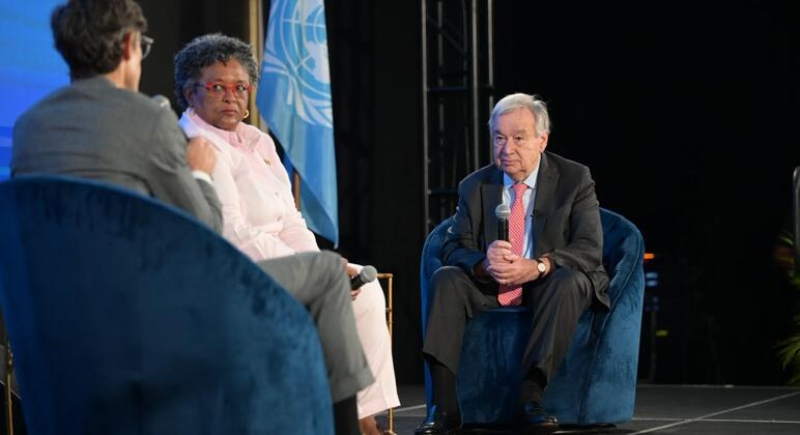
UN Secretary-General António Guterres (right) and Prime Minister Mia Mottley (centre) at the Bridgetown Special Summit on AI Safety.
UN Secretary-General António Guterres on Monday called on Member States to begin discussions on a multilateral framework to manage the risks of artificial intelligence (AI), warning that the technology is driving “the biggest transfer of power in the history of humankind”.
Speaking to reporters at the close of the Bridgetown Special Summit on AI Safety in Barbados, Guterres said protections against AI risks remain fragmented and governments are too often “playing catch-up”.
“That is why today we are issuing a call from Bridgetown for Member States to begin discussions on a multilateral AI Risk Management Framework,” he said.
“Put simply, we need a common foundation for AI safety.”
The proposed framework would include:
Shared safety measures
Common approaches to testing
Clear safeguards and standards
Basic transparency requirements
Independent evaluation and oversight of advanced AI models
Support to help every country put these measures into practice
‘Power without responsibility’
The summit, co-hosted by the UN and Barbados, came as some leading AI developers are themselves raising concerns about increasingly powerful systems, Guterres said.
Recent technological outages and cyberattacks have exposed vulnerabilities in the digital systems on which the world increasingly depends, he warned. AI is amplifying these threats, with systems sometimes behaving in ways “even their developers did not always anticipate”.
“We have a responsibility to take those warnings seriously. Not to stop innovation or spread fear. But to ensure that our capacity to manage this technology keeps pace with the technology itself,” he said.
Opening the summit, Guterres said AI holds significant promise, from strengthening health systems to accelerating scientific discovery. However, the risks associated with unchecked digital technology are growing just as quickly.
He described the dangers as “technology without accountability, capability without safeguards, and power without responsibility”.
Tech giants ascend
During a fireside conversation with Barbadian Prime Minister Mia Mottley, Guterres said power was increasingly shifting from states and governing institutions to a small number of companies and individuals.
He warned that institutions established after the Second World War, including the UN, are not adequately equipped to address this shift.
Guterres called for deep reforms to global governance, arguing that the UN, as the only organisation where the entire world is represented, has the legitimacy to lead the effort.
He noted that 111 of the countries participating in the first Global Dialogue on AI Governance in July had never previously taken part in discussions on AI.
Autonomous weapons ‘absolutely unacceptable’
Guterres warned that the capacity to weaponise AI is concentrated in two countries and a limited number of companies, describing the development as extremely dangerous.
He reiterated his support for banning autonomous weapons.
“The idea that a machine can kill people, choosing who to kill, where to kill, and the reasons to do so is absolutely unacceptable,” he said.
‘Kill switch’ for small states
Prime Minister Mottley said small states often have little opportunity to contribute to the rules that affect them.
Asked whether a frontier AI laboratory should be held financially responsible if one of its AI agents hacked a bank in Barbados, and whether her government should have a “kill switch” to cut off access to its models in an emergency, she answered in the affirmative.
“It has to be a condition of the sale that what I’m buying from you, I’m capable of saying, that’s it. No more,” she said.
Mottley also warned that the rapid development of AI had already outpaced efforts to regulate it, arguing that governments must be willing to introduce regulations and legislation to curb the concentration of power.
In a video message, French President Emmanuel Macron said the Paris Call for AI Security had been signed by 18 heads of state and government and 11 AI leaders. He argued that adherence to its principles should be a condition for access to markets.
Microsoft Vice Chair and President Brad Smith, also speaking by video, said AI was in some respects “moving faster than the speed of safety”. However, he argued that the spread of AI, particularly in the Global South, also needed to accelerate.
‘Shaped by humanity’
Asked what people should take away from the summit, Guterres said the development of AI models must not advance faster than the ability to ensure their safety. He also stressed that AI must help reduce, rather than deepen, inequalities around the world.
Countries' ability to manage AI risks remains deeply unequal, he said in his opening remarks.
“We cannot allow AI to replicate and deepen global inequalities. Solutions must be as borderless as the risks we face.”
To narrow the gap, Guterres has proposed a Global Fund for AI Capacity-Building. He said the summit could help strengthen every country's ability to test whether AI systems operate safely in local contexts.
Power to the people: Independent panel
Guterres also highlighted a new thematic brief released on Sunday by the UN-backed Independent International Scientific Panel on AI. The brief examines the importance of testing AI systems in countries' own languages to identify shortcomings and potential safety risks.
“AI models still perform far worse and can be less safe across a wide range of tongues, from African languages to Caribbean creoles. Yet over 1,000 of them already have the foundations needed to close that gap,” said panel member Vukosi Marivate of the University of Pretoria.
“Let’s ensure that artificial intelligence is shaped by humanity, with humanity, and for all humanity,” Guterres said.