

- Rooppur NPP: Rosatom installs automated control system at Unit-1 |
- Mount Everest season opens late, despite huge ice block, high travel costs |
- 2 more children die with measles-like symptoms in Sylhet |
- Dhaka again ranks world’s most polluted city Friday morning |
- Speed up nationality verification for ‘illegal’ migrants: Delhi |
Maiden Session of Unique 13th Parliament Was Noisy
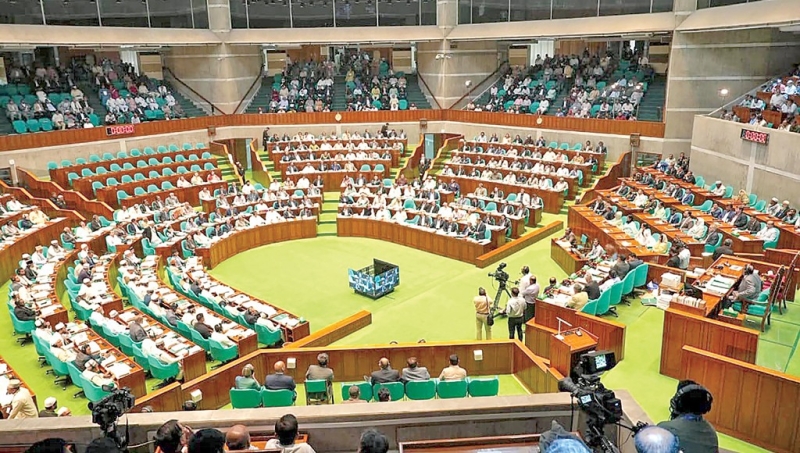
The thirteenth Parliament of Bangladesh elected 18 months following the July 2024 mass upsurge has its maiden voice amid democratic noise over the inaugural address made by President Mohammed Shahabuddin as the opposition led by Dr. Shafiqur Rahman stated a walk out in protest. Otherwise, the atmosphere of the session was serene with both the treasury and the opposition benches assuring cooperation to each other.
This Parliament is unique in many respects. Both the Prime Minister and the Leader of the House, Tarique Rahman and the Leader of the Opposition Dr. Shafiqur Rahman are newcomers in the legislative body and sufferers in the nearly 16 years of autocratic rule of the Awami league. Those years often saw fascists outburst of the ruling party with a declared aim to remain at the helm at least until the year 2041.
Popularly called Jatiya Sangsad, this House represents the political parties which suffered repression and oppression from 2009 onwards, although BNP’s sufferings started right after the 1/11 takeover, by the Moinuddin-Fakhruddin coterie with foreign blessings and left after delivering a lopsided Parliament that gave the opposition only 30 seats. Three times former prime minister of Bangladesh, Begum Khaleda Zia had predicted this when BNP’s political ally Bangladesh Jamaat-e-Islami mounted tremendous pressure on her to join the December 2008 election that she wanted to boycott.
For PM Tarique Rahman it is a similar experience that his mother Begum Khaleda had in 1991 when she had entered Parliament as a beginner assuming to role of the Prime Minister and the Leader of the House. The start of the 1991 Parliament session was also noisy with the opposition, despite being a decisive minority wanted decisions in the session to be taken by a division.
The oath of the MPs of the fifth Parliament like the present one was also administered by the Chief Election Commissioner, that time it was Justice Abdur Rouf, as the elected members of that Parliament had refused to have the swearing in from Speaker Shamsul Huda Chowdhury of an autocratic government ousted through nine years of democratic movement. Chowdhury however did preside over the maiden session that had elected Speaker Abdur Rahman Biswas who later became President and Deputy Speaker Shaikh Razzaque Ali who was subsequently elected Speaker of Parliament.
This Parliament has rather had a unique maiden session with seniormost member Dr. Khandakar Mosharraf Hossain in the chair, as the Speaker of the last Parliament Dr. Shirin Sharmin Chaudhury resigned and was no longer available in public view while the Deputy Speaker of the same House, Md Shamsul Haque Tuku was in jail in a case. Dr. Mosharraf Hossain presided over the unanimous election of Major Hafiz Uddin Ahmed Bir Bikram as Speaker and Barrister Kayser Kamal as Deputy Speaker as Jamaat refrained from nominating an MP for the position before the settlement of the issue of the July Declaration implementation, and the creation of a constitutional council that it envisages.
Some political pundits see the walkout by Nahid Islam Chief Whip of the opposition, and chief of the National Citizen’s Party (NCP) as a double standard because he had taken oath to become an adviser under the same President in the Interim Government led by Nobel Laureate Dr. Muhammad Yunus.
It was clear that the opposition had come prepared to make the noise over the July Declaration that all these parties and adopted and signed, an in opposition to the inaugural address of President Mohammed Shahabuddin who was elected by the Awami League-led Parliament. They carried printed placards that they brandished in the House. On the second point the gap in the thought of the opposition is that the July Upsurge that had dislodged the Awami League government but did neither dismiss the President who holds a constitutional post nor throw away the prevailing order. The incumbent government thus has no option other than going through the prevailing system to pursue constitutional changes that they have promised.
When the newly elected Speaker Hafiz Uddin Ahmed announced the time of arrival President Mohammed Shahabuddin to the House, opposition members rose in their seats and shouted at the chair brandishing placards. As soon as the President was invited to make his inaugural speech the Leader of the Opposition raised sounds apparently seeking floor to speak. The Speaker remained firm and advised the opposition members to resume their seats and listen to the President’s speech. Other opposition members jointed their leader Dr. Shafiqur Rahman and shouted at the chair as they slowly walked out of the House.
President Shahabuddin was visibly shaken and the beginning of his speech was interrupted by the noise. The Seargeant at Arms standing nearby advised him to continue delivering the speech prepared by the government as per the Constitution and the Rules of Procedure. A man who rarely came to public programmes in the last three-plus years made a failed gesture to calm the opposition down by raising his left hand.
Earlier the leader of the House and Prime Minister Tarique Rahman made a welcome statement reiterated his vow to establish a human and democratic Bangladesh, acknowledged the sufferings of the people during the nearly 16 years of fascist rule that failed to stop their democratic aspirations. He recalled the contributions of former Prime Minister Begum Khaleda Zia to the establishment of Parliamentary democracy and her relentless struggle to revive the same when the Parliament was turned into a laughing stock and democracy and human rights flouted by extrajudicial killings, enforced disappearances, filing fabricated cases and throwing opposition leaders and workers to jails. He sought to the cooperation of all opposition members for smooth functioning of the Parliament for the restoration of democracy and rule of law. He proposed the name of Dr, Khandakar Mosharraf Hossain to chair the inaugural sitting by following a 1973 precedent when Moulana Abdur Rashid Tarkabagish was invited by then Prime Minister Sheikh Mujibur Rahman to preside over the first sitting of Parliament.
Jamaat MP Abdullah Mohammad Taher supported the Prime Minister’s proposal for Dr. Khandaker Mosharraf Hossain to preside over the first sitting. He however said that the opposition would have been happier if this was discussed with them beforehand. The proposal was earlier seconded by BNP member and Minister for Local Government Mirza Fakhrul Islam Alamgir.
Dr. Shafiqur Rahman in his statement made in the inaugural session welcomes the Speaker and the Deputy Speaker and said after their election to the chair they were no more office-bearers of the BNP but guardians of the House and make it function transparently to achieved the hopes and aspirations of the people and the drams of the martyrs of the July Mass Uprising. Opposition Chief Whip Nahid Islam who spoke in the inaugural session wanted trial for all killings committed during the autocratic rule.
The House adopted a condolence motion on the demise of three times former Prime Minister Begum Khaleda Zia, the martyrs of the July Mass Upsurge and the noted persons who died or were killed during the 17 years of autocratic rule.
In the seating arrangement Mirza Fakhrul Islam Alamgir came second, apparently poised to become the deputy Leader of the House and Finance Minister Amir Khasru Mahmud Chowdhury. The position of Deputy Prime Minister remains abolished since the restoration of parliamentary democracy in 1991. (This story has been published in the March print edition of the GreenWatch)