

- ‘Violence will only defer a problem’: UN Assembly President |
- Ninth Pay Scale Gazette Issued, Higher Salaries From July |
- 11-Party Alliance Begins Dhaka-Rangpur Long March |
- Iran claims it hit an oil tanker in the Strait of Hormuz |
- Dhaka Air Quality Unhealthy for Sensitive Groups Saturday |
UN peacekeeping under pressure
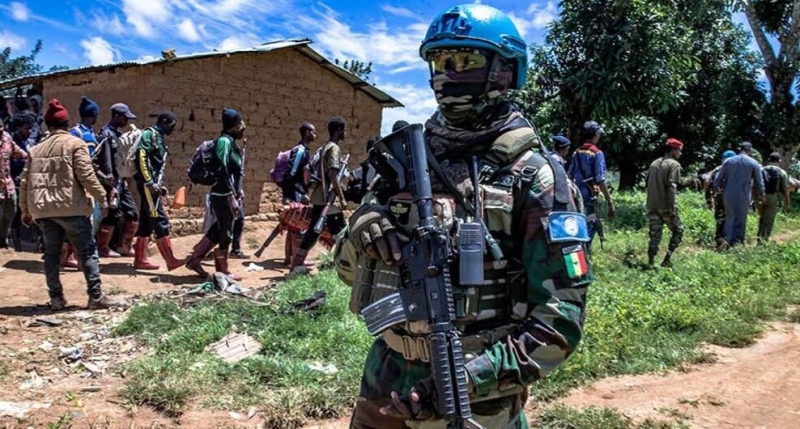
A UN peacekeeper patrols in the Central African Republic.© MINUSCA-Leonel Grothe
18 September 2026 - UN peacekeepers have increasingly been sent into places where there is no peace to keep – under resourced, outgunned and exposed to violence they are not equipped to counter. The Security Council meets this afternoon in New York to confront that problem, with Secretary-General António Guterres briefing ambassadors on how to close the gap.
At the Security Council, Secretary-General António Guterres and Member States discussed the future of UN peacekeeping amid active conflicts, financial constraints and evolving security threats. Speakers examined how missions can become more agile and effective while remaining anchored in political solutions.
Discussions highlighted pressure on peacekeeping operations from shrinking resources, increasingly complex mandates and threats to personnel. Delegations stressed the importance of realistic mandates, adequate resources, host-State ownership and stronger consultation with troop- and police-contributing countries.
The Secretary-General urged the Council to put peacemaking first, while Member States called for clearer mandates, stronger political strategies, improved peacekeeper safety and transitions tailored to conditions on the ground. Several speakers cautioned that efforts to improve efficiency should not undermine missions’ ability to carry out their mandates.
Peacekeeping must align with host States’ political objectives, Japan says
Yamazaki Kazuyuki (Japan) said peacekeeping remains one of the UN’s most effective tools for promoting international peace and security. He called for realistic, focused and effective mandates that give greater weight to the views of troop-, police- and financial-contributing countries, while stressing that peacekeeper safety and capabilities are paramount.
Peacekeeping works best when aligned with host States’ long-term political objectives, he said, calling for stronger links among UN, development and humanitarian actors. Japan also backed nimbler, more adaptable missions and closer integration of civilian, military and support components rather than creating new coordination structures.
Peacekeeping mandates must be matched with adequate resources, India stresses
P. Harish (India) said peacekeeping remains “irreplaceable”, but operations must be anchored in political solutions, with the Council remaining engaged in the political process. Mandates must be matched with resources from the outset so peacekeepers are not asked “to do more with less”, while troop- and police-contributing countries should have a structured role in shaping them.
He also called for greater peacekeeper safety, accountability for attacks and rationalization of missions whose operational rationale has diminished. Technology and renewable energy can improve efficiency, he added, while women peacekeepers remain central to mandate delivery.
India has deployed nearly 300,000 troops across more than 50 UN missions, he noted.
Indonesia calls for agile, adaptive peacekeeping anchored in political solutions
Widya Sadnovic (Indonesia) said UN peacekeeping must become more agile, adaptive and cost-efficient while remaining anchored in political solutions. He called for an inclusive, Member State-driven implementation of the Secretary-General’s review, with close coordination among the Special Committee on Peacekeeping Operations, Security Council and Secretariat.
He stressed the need to protect peacekeepers through stronger deterrence, digital tools, real-time situational awareness and counter-threat technology, warning against arbitrary cost-cutting that compromises safety. Indonesia will also co-host the 2027 UN Peacekeeping Ministerial in Jakarta with the Netherlands.
Peacekeeping must evolve, keep host States at centre, DR Congo says
Zénon Mukongo Ngay (Democratic Republic of the Congo) said streamlining peacekeeping must not mean weakening missions, warning that reduced resources can undermine their ability to fulfil Council mandates. Transitions should be responsible, coordinated and reversible when security conditions change.
Peacekeeping should be more closely linked with peacebuilding, prevention and mediation, he said, stressing that host-State consent and partnership must remain central throughout a mission’s life.
He also urged Member States to pay assessments fully and on time, warning that liquidity shortages weaken civilian protection, and called for predictable financing for regional peace operations.
United States calls for ‘realistic, achievable’ goals for UN peacekeeping
Jeffrey Bartos (United States) said his country has lost confidence that peacekeeping, as currently designed and resourced, delivers results proportionate to its costs and footprint. He called for rigorous mission assessments, accountability for defined outcomes and realistic, achievable goals focused on security functions supporting a political plan.
The Council should stop adding language that produces lengthy, unfocused mandates and distracts missions from core efforts, he said. He also called for rigorous application of the zero-tolerance policy on sexual exploitation and abuse and continued strategic cost efficiencies that do not undermine mandate implementation.
Beijing calls for aligning mandates with ground reality
Fu Cong of China said: "Peacekeeping operations are faced with new circumstances, new challenges and new requirements."
Mandates should be streamlined on the basis of actual needs, he said, urging the Council to be “grounded in reality” to determine the task and objectives in a solid manner.
“No selectivity should be practiced on peace missions”, he said, also stressing the need to improve quality and efficiency, with new technology to be leveraged actively and prudently to enhance capabilities such as situational awareness, early warning and logistical guarantees.
The liquidity issue remains a bottleneck constraining peacekeeping missions, he said, emphasizing the need to further strengthen the communication between the Council, Secretariat and host countries and troop-contributing countries to improve the links between mandates, implementation of operations and resource guarantees.
UN chief outlines five peackeeping priorities
Addressing the UN Security Council debate on United Nations Peacekeeping Operations, Secretary-General António Guterres argued that peacekeeping must remain a political tool that supports, rather than replaces, political solutions.
He warned that conflicts are becoming more complex, with fewer peace agreements, growing attacks on civilians and peacekeepers, emerging technologies such as drones and AI-driven disinformation, and shrinking resources.
Stressing that “the ground has shifted. Too often, our mandates have not,” he called for a comprehensive reset of UN peace operations.
Guterres outlined five priorities: putting peacemaking first, building stronger partnerships with host States, adapting mandates to current realities, empowering peace operations with adequate resources and technology, and strengthening cooperation with regional organizations.
He emphasized that “we cannot keep peace where there is no peace to keep” and urged Security Council unity in preventing conflicts and supporting political solutions.
Concluding that “peace cannot be imported,” he called for renewed investment in peace, accountability, and collective action to create lasting pathways to peace. – UN News