

- Hindu community celebrate Janmashtami |
- Global Food Prices Reach Highest Level Since 2022: FAO |
- Religious Freedom, Peace and Harmony Key Govt Goals: Home Minister |
- Dhaka ranks 6th in global air quality index |
- UN, Partners Continue Delivering Aid to Gaza Amid Restrictions |
Knowledge-based politics key to nation’s progress: Law Minister
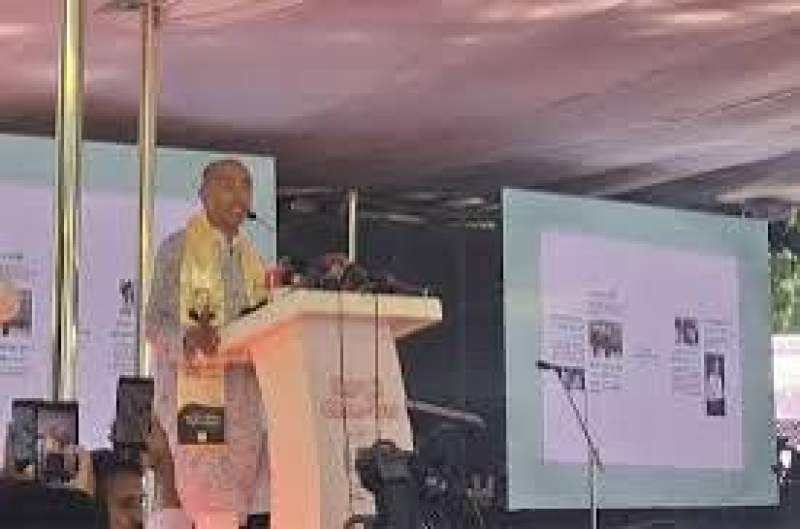
Minister for Law, Justice and Parliamentary Affairs Md. Asaduzzaman today said that knowledge-based politics is essential to take the nation forward and to build a future generation.
“Political slogans alone are not enough for the upcoming Gen-Z era,” he said while addressing the "Zia Smriti Boimela-2026 as the chief guest at Bangla Academy premises here this afternoon.
Noting that the name 'Zia Smriti Pathagar' aptly reflects its objectives, he said the initiatives undertaken in honour of heroic freedom fighters, Sector Commander and former President Ziaur Rahman, would elevate nationalist politics to a new height.
Asaduzzaman said that the country’s major achievements were the result of Ziaur Rahman’s contributions and leadership.
He recalled that when the nation was in a dilemma and the political leadership hesitated during the turbulent days of 1971, Ziaur Rahman made the clarion call of independence and showed the path to liberate the country.
Highlighting Ziaur Rahman's contribution to defining national identity, he noted that it was Ziaur Rahman, who introduced the concept of "Bangladeshi Nationalism" uniting all ethnicity, religions, and groups—including Bengalis, Chakmas, Marmas, and Santals—under one single national umbrella.
The law minister said Ziaur Rahman was an exception who opened the door of multi-party democracy after the establishment of the one-party BAKSAL rule in 1975, restoring fundamental rights, press freedom, and the independence of the judiciary.
He lauded the uncompromising leadership of BNP’s former Chairperson and former Prime Minister Begum Khaleda Zia.
In this context, he referred to her (Khaleda Zia’s) relentless struggle for democracy from 1982 to 1990, the re-establishment of parliamentary democracy in 1991, and her steadfast refusal to compromise with anti-democratic forces during the 1-11 caretaker government regime.
In the programme, the law minister announced that he would personally donate a complete set of the "Bangladesh Code" containing all the laws of the country to the ‘Zia Smriti Pathagar’ from the law ministry.
Speaking as special guest Managing Director (MD) and Chief Editor of Bangladesh Sangbad Sangstha (BSS) Kader Gani Chowdhury described former President Ziaur Rahman as the architect of the nation's identity and the country's sole statesman over the past 55 years.
"Amid the post-independence turbulent political and military landscape and deep-rooted domestic and foreign conspiracies, President Zia guided a directionless nation toward hope. He was a true beacon for us," he said.
He said that during his short three-and-a-half-year tenure, Ziaur Rahman transformed the nation from a "bottomless basket" into a self-reliant economy through significant advancements in agriculture, industry, and human resource development, while introducing multi-party democracy and Bangladeshi nationalism.
"No title fully captures his immense contributions. At every critical junction of the nation, he stood fearlessly, risking everything to safeguard a distressed country with visionary leadership, wisdom, and patriotism," Chowdhury noted.
He added that Zia's remarkable achievements by the age of 45 remain rare in the world history.
Reflecting on the post-1971 political backdrop, Chowdhury stated that while Bangladesh gained independence in 1971, democracy remained elusive.
He remarked that the establishment of the one-party BAKSAL rule in 1975 suppressed political freedom, human rights, and press freedom, turning the nation into a virtual prison.
"Upon assuming power, Ziaur Rahman opened the doors to democracy. Recognizing the need for political pluralism, he promulgated the Political Parties Regulation in 1976, which paved the way for the revival of all political parties, including the Awami League," he said.
He described BNP as a unique creation of Ziaur Rahman, established during a critical juncture to protect sovereignty, restore democracy, and replace politics of sycophancy with a politics of production and development.
Chowdhury added that Zia mobilized citizens for nation-building efforts—such as canal digging, literacy drives, and infrastructure development—which boosted economic productivity and restored international respect, shifting Bangladesh from poverty toward an emerging economic power.
Dhaka University Vice-Chancellor Professor Dr. ABM Obaidul Islam was also present, reports BSS.