

- 109 BGB Platoons Deployed in Dhaka, Five Other Districts |
- Bangladesh-Denmark May form Trade and Investment Committee |
- Bangladesh—Pakistan trade crosses $1 b |
- Dhaka Ranks 5th Among World's Most Polluted Cities on Friday |
- PM seeks to make Bangladesh a reliable brand in global livestock market |
AL scrapped caretaker govt system to cling to power: Rizvi
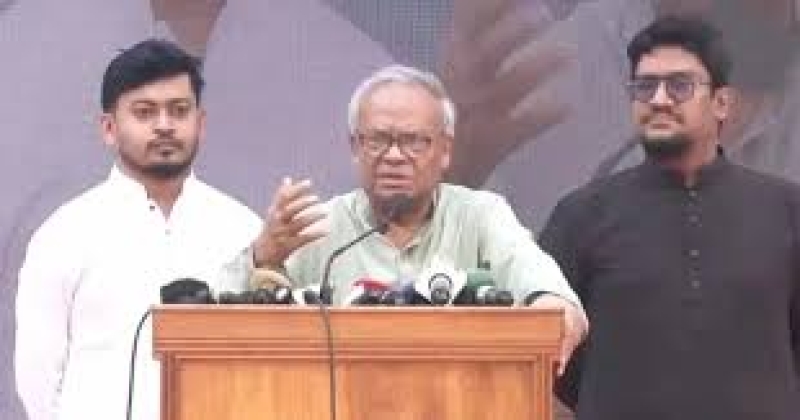
BNP acting Secretary General Ruhul Kabir Rizvi on Friday said the Awami League had abolished the caretaker government system to cling to power, despite having earlier spearheaded a movement demanding its introduction.
“Although the Awami League once led a movement demanding a caretaker government, it scrapped the system after coming to power. They did so mainly to consolidate their hold on power,” he said.
Rizvi made the remarks while addressing, as the chief guest, a discussion at the Dhaka Medical College (DMC), marking the 36th martyrdom anniversary of Dr Shamsul Alam Khan Milon, who was killed during the 1990 mass uprising against autocracy.
He said democracy in Bangladesh had repeatedly stumbled under the grip of authoritarian rule, and the failure to resolve the underlying problems had allowed authoritarianism to return time and again.
Describing the caretaker government system as a relatively effective mechanism for safeguarding democracy, the BNP leader said the system should have been made permanent to ensure neutral elections.
He said democracy took different forms in different countries, depending on their institutional structures and political circumstances. “Its fundamental principle, however, is the rule of the people and the reflection of their will,” he said.
Rizvi said Bangladesh had adopted the caretaker government system as a mechanism to ensure credible elections because of a lack of public confidence in elections held under a government in power.
“Even if elections under a caretaker government were not perfect, they were as neutral as possible,” he said, adding that elections held under interim or caretaker governments had not resulted in the repeated return of the same political party to power.
The BNP leader alleged that those who helped keep the Awami League government in power for 17 years included people from groups with a history of opposing democracy.
He specifically referred to Jatiya Samajtantrik Dal (JASAD), saying it had a documented history of anti-democratic activities.
Rizvi also said the people who had helped sustain the former government had betrayed the broader democratic cause for which Dr Milon sacrificed his life.
He said Dr Milon's contribution should not be confined to the political identity of any particular party, as he had given his life for the larger cause of democracy.
Dr Milon was shot dead during the anti-autocracy movement on November 27, 1990. His death further intensified the mass uprising against the then military regime.
BNP Standing Committee members Amanullah Aman and Farhad Haleem, Chairman’s Adviser Habibur Rahman Habib, Joint Secretary General Khairul Kabir Khokon and Jatiyatabadi Swechchhasebak Dal Vice-President Dr Zahidul Kabir, among others, attended the programme, reports UNB.