

- Toyota Tsusho briefs PM on plan to manufacture vehicles in Bangladesh |
- Security, sacrifice or opportunity: Climate action visions differ |
- Four New Subjects to Join Curriculum From 2027 |
- Strong children mean a stronger Bangladesh: PM |
Govt committed to healthy ties with media: Dr Zahed
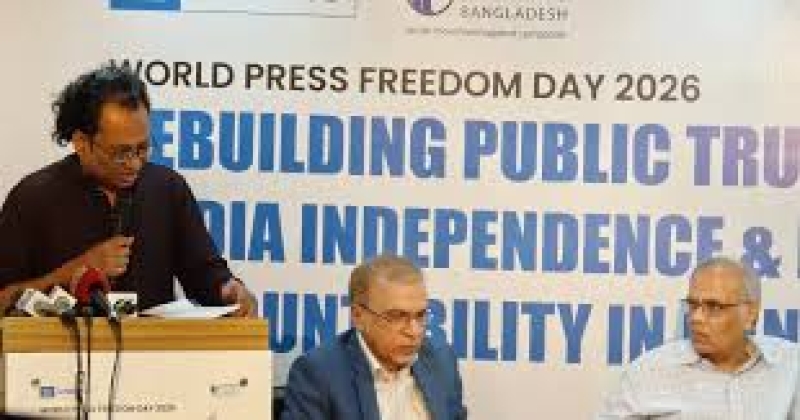
Prime Minister's Adviser on Policy and Strategy Dr Zahed Ur Rahman on Sunday said the government is committed to fostering a ‘healthy and constructive’ relationship with the media, emphasising that a democratically elected government should never be in conflict with the press.
"The Prime Minister also shared this view. We want a healthy media environment where criticism is welcomed," he said at an interactive discussion jointly organised by UNESCO and Transparency International Bangladesh (TIB) at MIDAS Centre in the capital to mark World Press Freedom Day 2026.
The event was convened under the theme, "Rebuilding Public Trust: Media Independence and Democratic Accountability in Bangladesh."
Dr Zahed encouraged media outlets to continue offering constructive criticism, assuring that the government would carefully consider such inputs in policymaking.
TIB Executive Director Iftekharuzzaman moderated the programme.
The event was held in two phases.
During the inaugural session, Iftekharuzzaman delivered the welcome address and introduced the theme and objectives of the programme.
Opening remarks were delivered by Susan Vize, Head of Office and UNESCO Representative to Bangladesh, and Paola Castro Neiderstam, First Secretary for Human Rights, Democracy and Gender Equality at the Embassy of Sweden.
The second phase featured an interactive panel discussion and audience dialogue.
The panelists included Kamal Ahmed, Consulting Editor of The Daily Star; Fahim Ahmed, Chairman of the Broadcast Journalists Center; senior television journalist Shahnaz Munni; and Reaz Ahmad, Editor of Dhaka Tribune.
The discussion was followed by an open floor session where journalists, experts and participants exchanged views on the challenges and prospects of independent journalism in Bangladesh.
Addressing the gathering, Zahed said the government has taken seriously the growing problem of cyberbullying, particularly targeting journalists and women.
He said the Prime Minister's Office will establish a dedicated cell to monitor cyberbullying. The government is committed to protecting media freedom while tackling digital abuse, he added.
Zahed also confirmed that the government would hold discussions with the Media Reform Commission.
He stressed the need for self-criticism within the media, observing that prolonged autocratic rule had significantly influenced media culture.
Many journalists who entered the profession over the past 15 to 17 years may have developed a different understanding of journalism, contributing to internal challenges, he added.
He said media organisations must reassess their understanding, standards and boundaries of journalism.
Questioning the current relevance of state-owned broadcasters, Zahed said Bangladesh Television (BTV) and Bangladesh Betar are no longer central sources of news in an era dominated by private media.
He said BTV operates on a budget exceeding Tk 300 crore while generating only around Tk 15-16 crore in revenue, making it heavily subsidised.
He questioned what BTV currently offers beyond news and suggested that it should focus more on public welfare and national interest.
Zahed expressed hope that BTV would be utilised in a manner that genuinely serves the public as a national broadcaster.
Emphasising the importance of media literacy, he said such education should begin at the school level, where foundational learning takes place.
He observed that media literacy remains particularly weak across South Asia and many other regions, worsening media-related challenges.
Zahed underscored the need to distinguish between subjective opinions including harsh criticism and outright fake news.
World Press Freedom Day, proclaimed by the United Nations General Assembly in 1993, is observed globally to reaffirm press freedom and freedom of expression as essential pillars of democratic governance and sustainable development.
At a crucial juncture in Bangladesh's ongoing reform process, the organisers said the event aimed to provide a platform for reflection on the role of independent and professional journalism in promoting transparency, countering misinformation and fostering informed democratic participation.
The programme brought together government representatives, media professionals, civil society members, academics, development partners and youth to discuss the challenges facing the media and identify practical ways to strengthen media credibility and restore public trust, reports UNB.