

- Ismail Elfath, referee for England-Argentina semifinal |
- BSEC approves liquidation of Vanguard AML BD Finance Mutual Fund One |
- 200 economists for urgent action to tackle AI's impact on jobs, economy |
- PM Launches National Startup Platform for Entrepreneurs |
- HSC Examinees Block Roads, Demand Exam Suspension |
Global Support for Refugees Remains Strong: UNHCR
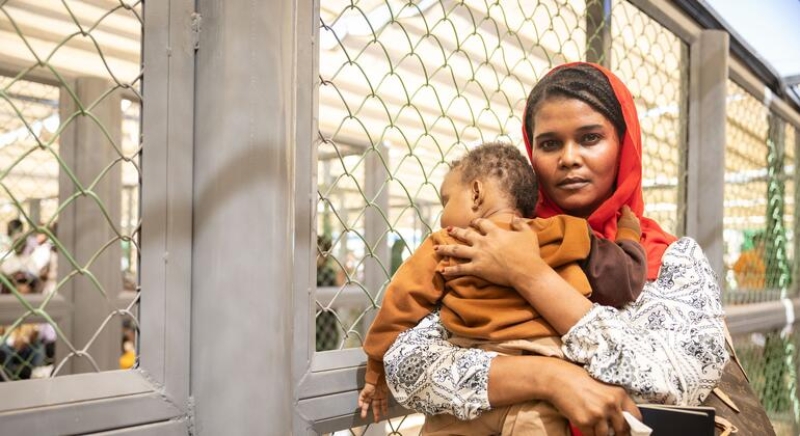
A Sudanese refugee carrying her child at a UNHCR registration center in Cairo, Egypt.
Protection for refugees has been enshrined in international law for more than seven decades, but public support for those fleeing conflict and persecution remains a key question.
New data released on Tuesday by the UN refugee agency (UNHCR) showed that despite the growing spread of misinformation and hate speech about asylum seekers, public support for refugees remains stronger than public debate often suggests.
The findings indicate that support has remained broadly stable for years despite political tensions, economic pressures and increasingly polarized public discourse.
"This support has remained broadly stable for years, despite political tension, economic pressure and, as you all know very well, a very polarized debate," said Dominique Hyde, UNHCR's Director of External Relations.
Conducted jointly with Ipsos, the survey found that two in three people across 29 countries believe people fleeing war or persecution should be allowed to seek refuge in another country.
Mixed Views on Asylum
At the same time, a similar proportion of respondents believe that many asylum seekers do not genuinely require protection.
"Many of these people hold both views at the same time," said Trinh Tu, Managing Director of Ipsos UK.
"What we see at the moment is a tension between people wanting to support those in desperate need while also having doubts about whether the system is working as it should, particularly asylum systems, border management and integration," she said.
Support Remains Despite Concerns
Ms. Tu said this contradiction is evident in the United Kingdom, where concerns about immigration remain high despite declining net migration.
Meanwhile, support for refugees remains relatively strong in Germany and Sweden, both of which host significant refugee populations. However, support has weakened in Türkiye and Poland compared with previous years.
Ms. Hyde stressed that countries hosting large refugee populations continue to need international assistance.
"Generosity cannot replace international responsibility," she said.
Recalling a recent visit to Busuma camp in eastern Burundi, which shelters more than 57,000 Congolese refugees, she described severe shortages of shelter, food and safe drinking water.
"I sat with mothers and fathers who barely had enough to eat," she said. "Many families lived in overcrowded shelters, while others had no shelter at all. They told me they lacked safe and sufficient water and endured freezing nights at high altitude and intense daytime heat."
Gen Z Shows Greater Empathy
The survey, which gathered responses from more than 21,500 people, found younger generations significantly more supportive of refugees than older age groups.
Nearly half of Generation Z respondents, born between 1997 and 2012, believe refugees will successfully integrate into society, compared with 39 per cent of Baby Boomers, born between 1946 and 1964.
UNHCR said Gen Z respondents were also less likely to support border closures or question refugees' motives, although concerns about integration and asylum systems remained across all age groups.
Strongest Support in Europe
Support for refugees was highest in Sweden and the Netherlands, where 78 per cent of respondents backed refugee protection, followed by Spain at 76 per cent.
Australia, Brazil and the United States recorded the most positive attitudes towards refugee integration.
Several countries also recorded notable increases in support over recent years. In Japan, support for refugees rose to 64 per cent from 23 per cent in 2019, while in France it increased to 68 per cent from 43 per cent during the same period.
When asked how they would respond to refugee crises, respondents favoured direct humanitarian assistance, diplomatic efforts and temporary protection.
The findings suggest that while many people support alternatives to permanent resettlement, they still consider resettlement an essential protection pathway for the world's most vulnerable refugees, 75 years after the adoption of the Refugee Convention in Geneva.
"What we know is that many people support the right to seek safety while also questioning whether asylum systems are fair, efficient and properly managed," Ms. Hyde said.
"This anniversary reminds us that the challenge is not only to defend the Refugee Convention but also to ensure that its promise is fulfilled."
Rising Needs, Shrinking Resources
UNHCR said conflicts, violence and persecution continued to displace millions of people in 2025, while climate shocks, economic instability and political fragility further increased humanitarian needs.
The agency aimed to assist and protect 129.4 million people in 2025, nearly the same as in 2024. However, available funding fell by $1.2 billion to $3.9 billion, forcing UNHCR to respond to near-record levels of displacement with resources comparable to those available in 2016, when the number of forcibly displaced and stateless people was less than half today's total.
Resettlement Falls Sharply
UNHCR helped more than 37,000 refugees depart for resettlement in third countries during 2025, mainly from Türkiye, Lebanon, Ethiopia, Bangladesh and Rwanda.
The agency submitted 35,000 refugees for resettlement to 23 countries, including 1,181 emergency quota places for refugees requiring expedited processing or living in countries with limited or no resettlement quotas.
However, refugee resettlement submissions dropped sharply from 188,800 in 2024, highlighting the growing gap between humanitarian needs and available opportunities for protection.