

- PM Orders Study on Restoring Universal Stipends for Girls |
- President urges KSA to make hajj more convenient for Bangladeshi pilgrims |
- Second Teesta Bridge: Costly shortcut that heavy vehicles cannot take |
- March in Stockholm for stronger climate action ahead of polls |
- Dhaka ranks 18th in global air quality ranking Monday morning |
Rohingya repatriation needs sustained pressure, security strategy: PM’s adviser
Prime Minister’s Defence Adviser Brigadier General (retd) AKM Shamsul Islam on Monday said Bangladesh must maintain active and sustained pressure for the repatriation of Rohingyas, backed by a coordinated diplomatic and credible, sustainable security strategy.
“The Rohingya crisis is not merely an issue for Bangladesh. It is simultaneously a humanitarian security concern, a national security challenge at the diplomatic level and a growing threat to regional stability,” he said.
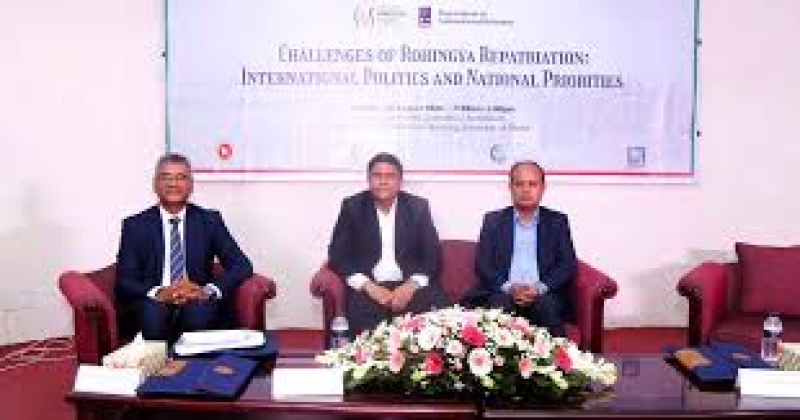
The adviser made the remarks while addressing as the chief guest a seminar titled “Challenges of Rohingya Repatriation: International Politics and National Priorities”, jointly organised by the Department of International Relations and the Centre for Genocide Studies of Dhaka University.
The seminar was held at the Professor Muzaffar Ahmed Chowdhury Auditorium of the Faculty of Social Sciences. DU Vice-Chancellor Prof Dr ABM Obaidul Islam attended the session as the guest of honour, while Department of International Relations Chairman Prof Dr ASM Ali Ashraf chaired it.
Shamsul Islam said the government is committed to ensuring the country’s security and sovereignty and doing everything possible for Bangladesh’s development.
“Bangladesh has shown extraordinary generosity over the past nine years. But this generosity cannot be confused with an indefinite commitment to a single problem,” he said, stressing that Bangladesh did not create the Rohingya crisis and cannot resolve its underlying causes alone.
The adviser said permanently taking responsibility for the Rohingyas is neither morally nor strategically acceptable for a state like Bangladesh.
“Simply waiting and hoping that the situation will improve means that it will get worse every day,” he said, adding that the only viable course for Bangladesh is to maintain active and sustained pressure for repatriation, supported by a coherent diplomatic and credible security strategy, reports UNB.
Shamsul Islam also called for international cooperation in addressing the crisis.