

- 109 BGB Platoons Deployed in Dhaka, Five Other Districts |
- Bangladesh-Denmark May form Trade and Investment Committee |
- Bangladesh—Pakistan trade crosses $1 b |
- Dhaka Ranks 5th Among World's Most Polluted Cities on Friday |
- PM seeks to make Bangladesh a reliable brand in global livestock market |
UN Refugee Agency Seeks $7.1 Billion for 2027
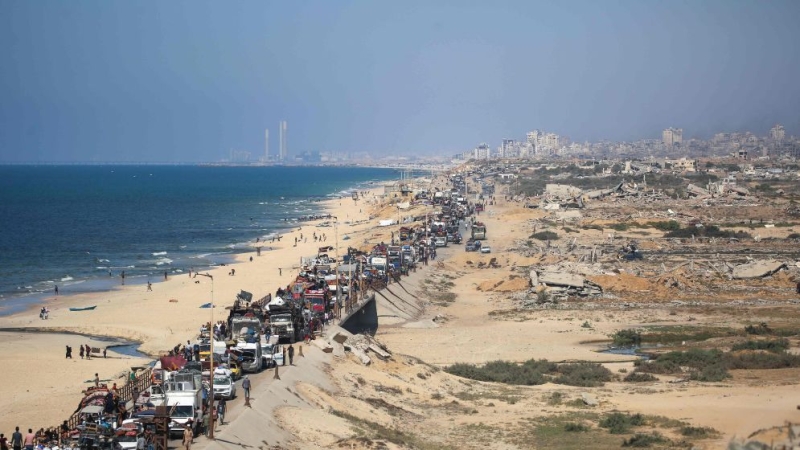
Displaced Palestinians move with their belongings southwards on a road in the Nuseirat refugee camp area in the central Gaza Strip following renewed Israeli evacuation orders for Gaza City on 14 September 2025.
The United Nations refugee agency has appealed for $7.1 billion in 2027 to protect stateless people and respond to emergencies, amid growing humanitarian needs and a severe global funding shortfall.
The agency's chief warned last month that it was being asked to do the impossible as funding shortages and near-record levels of displacement placed enormous pressure on its operations.
The agency's 2026 appeal targeted $8.5 billion, but it has raised only $2.9 billion so far.
The 2027 appeal comes amid immense humanitarian needs and an exceptionally difficult funding environment. As a result, the agency said its budget prioritises the most urgent requirements.
If fully funded, the agency plans to provide protection services to 13.6 million refugees and asylum seekers and 6.7 million internally displaced people (IDPs) next year.
It also aims to provide financial assistance to 3.9 million refugees and two million IDPs, as well as shelter and housing support to 1.8 million refugees and 850,000 IDPs.
According to the agency, around 117.8 million people worldwide were forcibly displaced from their homes at the end of 2025, slightly down from the record 123.2 million in 2024.
Of the total, 35.6 million were refugees under the agency's mandate, with two-thirds originating from Afghanistan, Sudan, Syria, Ukraine and Venezuela.
Despite the scale of displacement, the agency has been forced to reduce its workforce because of budget cuts.
The United States, traditionally the world's largest donor, has cut foreign aid under President Donald Trump, while several other major donors have also reduced their spending.
Since 2024, nearly 8,000 employees have left the agency, reducing its workforce from almost 20,000 to just under 12,000.
In 2025, the agency sought $10.6 billion but received only $3.8 billion. In 2024, it appealed for $10.8 billion and secured $5.3 billion.
The agency said its strategy remained focused on protecting people forced to flee, responding quickly to emergencies and helping refugees move beyond dependence on aid.
The appeal was launched ahead of the agency's annual pledging conference, scheduled to take place in Geneva on Tuesday.