

- CA Yunus pays homage to Liberation War martyrs on Victory Day |
- Bangladesh capital market extends losing streak for second day |
- Bangladesh celebrates Victory Day Tuesday |
- 'Different govts presented history based on their own ideologies': JU VC |
Refugees Fill Gaps as Funding, Power, and Legal Rights Shrink
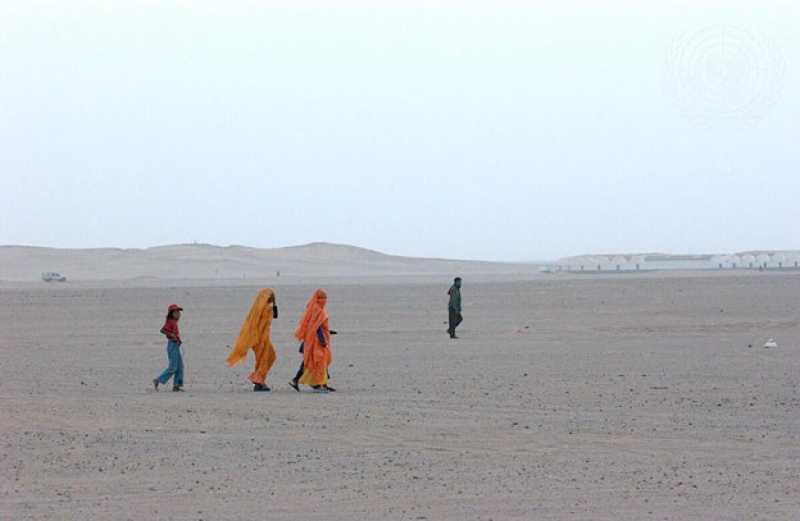
Sahrawi refugees walk near the Awserd Refugee Camp in the Tindouf Province of Algeria.
The global refugee system is under increasing strain as funding cuts, institutional reforms, and shifting donor priorities reshape the delivery of protection and assistance.
A new report, From the Ground Up: Regional Perspectives on Advancing the Global Compact on Refugees, highlights the challenges faced by refugees in the Middle East and Africa. Drawing on regional roundtables in East Africa and the Middle East and North Africa, followed by a global consultation in Geneva, the report identifies what works, what fails, and what must change ahead of the 2025 Global Refugee Forum progress review.
Refugee-led and community-based organizations are increasingly taking on responsibilities, yet they lack funding, legal recognition, and decision-making power. As international agencies scale back under the Humanitarian Reset and UN80 reforms, refugees are expected to fill widening gaps without the authority or resources to do so safely and sustainably.
In East Africa, roundtables held in Kampala with refugee organizations from Uganda, Kenya, and Ethiopia highlighted both progress and persistent challenges. Countries in the region host millions displaced by conflict, hunger, and climate stress from South Sudan, Sudan, Somalia, and the Democratic Republic of the Congo. Laws and frameworks promise freedom of movement, inclusion in national systems, and meaningful participation, but the lived reality remains uneven.
Education emerged as a central concern. Refugee children are enrolling in schools at higher rates where integration exists, yet access remains unequal. Students struggle to have prior qualifications recognized, refugee teachers often face lower pay or exclusion, and language barriers and limited psychosocial support hinder learning. Refugee-led groups are stepping in with mentorship, counseling, and bursary support, though funding is fragile and reach limited.
Documentation and freedom of movement are critical issues. While Uganda is praised for rapid issuance of refugee IDs, gaps remain in urban areas. In Ethiopia, travel documents are difficult to obtain, limiting cross-border movement, livelihoods, and participation in policy forums. Refugee organizations without legal registration operate under constant uncertainty.
Access to justice is another persistent challenge. Language barriers, xenophobic profiling, and limited legal aid prevent refugees from claiming rights. Refugee-led organizations provide mediation, paralegal support, and court accompaniment, often serving as the first point of contact with authorities, yet their work is rarely formalized or funded at scale.
Webinars with refugee leaders highlighted both progress and limitations. Comparisons across countries revealed differences in exit visa requirements, civil documentation, and access to courts. In the Middle East and North Africa, tighter civic space and restrictive laws limit legal recognition for refugee organizations. Despite these constraints, local initiatives are filling gaps in education, protection, and livelihoods.
The report warns of a growing paradox: localization is advancing by necessity rather than design. International agencies withdraw while refugees absorb risk without authority or resources. Participation is often tokenistic, with refugees present in meetings but absent from real decision-making.
Speakers stressed that refugee empowerment requires more than services—it requires shifting power and resources to refugee-led organizations. Without sustained support, protection systems risk collapse, leaving refugees to rely on themselves. Investing in refugee-led organizations, the report concludes, is not a luxury but the last line of hope for those on the ground.