

- UN Declares International Day to Eliminate Child Marriage |
- 32-year-old Bangladeshi-American plans a cotton warehouse in Ctg |
- Govt's 180 days good start; Oppositoon Road March unhelpful |
- Chinese Scientists Warn Wars Could Spread Into Space |
- 11-Party Alliance Begins Dhaka-Chattogram Long March |
Rare Total Solar Eclipse Today: Where It Can Be Seen
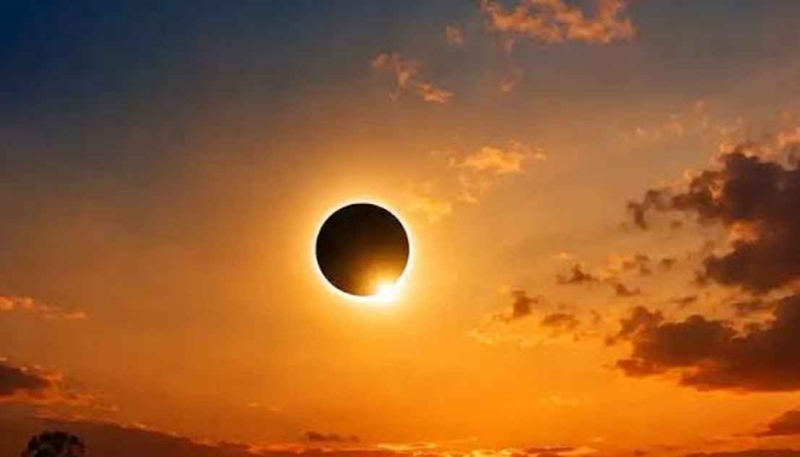
Rare total solar eclipse sweeps Northern Hemisphere
A rare total solar eclipse will occur on Wednesday (12 August), sweeping across large parts of the Northern Hemisphere. Although nearly 1 billion people may have an opportunity to witness the celestial event, it will not be visible from Bangladesh or much of Asia due to their geographical locations.
According to astronomers, the path of totality will begin in the Arctic region and extend across Greenland and Iceland to Spain. In parts of Spain, the Sun will be completely obscured by the Moon for around 2 minutes and 18 seconds.
A partial eclipse will also be visible from parts of Western Europe, including London and Paris, northwestern Africa and some areas of North America.
Bangladesh, however, lies outside the eclipse's visibility zone, meaning the phenomenon will not be visible from anywhere in the country.
Astronomers forecast that the next solar eclipse visible from Dhaka will occur on 2 August 2027. That will be a partial eclipse, with only 3.3 percent of the Sun expected to be covered by the Moon at its peak. The eclipse will reach its maximum phase in Dhaka at around 5:12pm local time.
Several more partial solar eclipses will be visible from Dhaka over the next two decades. The most significant is expected on 20 March 2034, when around 58 percent of the Sun will be obscured by the Moon.
Other notable eclipses visible from Dhaka are expected in 2031, when about 42 percent of the Sun will be covered; 2035, when around 43 percent will be obscured; and 2042, when approximately 45 percent will be covered.
The rare total solar eclipse on 12 August has generated considerable interest among astronomy enthusiasts around the world. People in Bangladesh, however, will have to wait until next August for their next opportunity to witness a solar eclipse.