

- Bangladesh to Introduce New Law to Curb Extortion, IGP Says |
- UN Marks 81 Years of Global Cooperation and Peace |
- Dhaka's air 5th worst in the world this morning |
- Around 7,500 Bangladeshis imprisoned in Saudi Arabia: Shama Obaed |
- Bangladesh Outperforms India in Global Hunger Index 2026 |
AI Reshapes Work as Risks to Workers Grow
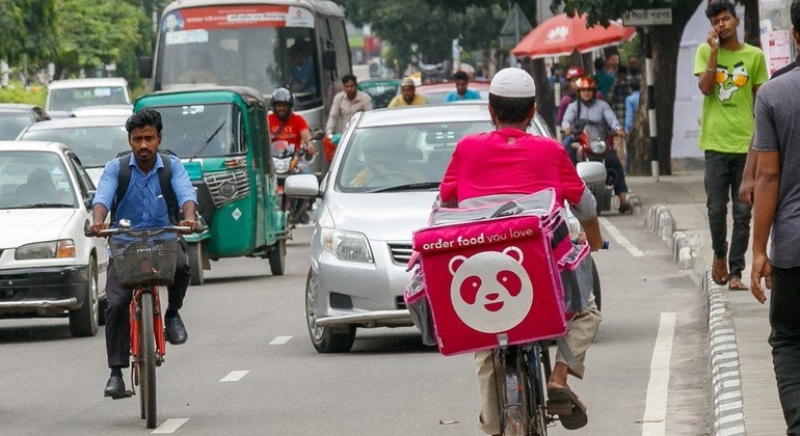
A cyclist delivers food in the Uttara suburb of Dhaka, Bangladesh. (file)
From delivery couriers compelled to follow algorithm-driven instructions to content moderators who confront pornography and graphic violence while training artificial intelligence (AI) systems, the impact of new technologies on working conditions is becoming increasingly evident.
Experts from around the world recently shared concerns about how AI is transforming the workplace and proposed ways to harness these technologies to protect rights and promote prosperity during a webinar organised by the International Labour Organization (ILO) and the International Telecommunication Union (ITU).
“The key issue is not whether AI will transform work; it already is,” said Sher Verick, ILO coordinator for digitalisation and AI. “The central question is how to ensure that this transformation advances decent work and social justice.”
At the first meeting of the Independent International Scientific Panel on AI, UN Secretary-General António Guterres highlighted the panel’s “huge responsibility” in helping shape the trajectory of artificial intelligence for the benefit of humanity.
“Individually, you come from diverse regions and disciplines, bringing outstanding expertise in AI and related fields,” he said. “Collectively, you represent something the world has never seen before.”
Making AI ‘Trustworthy’
Artificial intelligence is increasingly being used in systems with real consequences for people’s livelihoods, including hiring decisions and access to services, said Bilel Jamoussi, Deputy to the Director of the ITU Telecommunication Standardization Bureau.
He stressed the importance of global standards and skills development, noting that while technical standards can make AI systems more trustworthy, the decisive factor remains how governments and societies choose to deploy them.
The ‘Invisible’ Workforce Behind AI
Behind chatbots, social media algorithms and automated tools stands an often invisible workforce.
Ben Richards of UNI Global Union explained that workers in the data supply chain mainly fall into two categories: content moderators who review harmful material to keep platforms safe, and data labelers and annotators who structure information so machines can learn.
Wherever his organisation engages with such workers, they report similar conditions: extreme pressure, constant monitoring, low pay and serious mental health impacts.
Trauma Behind the Screens
Major technology companies often rely on workers in countries across the Global South for content moderation and data annotation.
In India alone, tens of thousands are engaged in this work. For many rural residents, particularly women, advertisements promising work-from-home opportunities requiring only an internet connection appear attractive.
However, workers frequently report that they are unaware of the nature of the content they will review before being hired. Many must sign non-disclosure agreements preventing them from discussing their work, even with family members.
Some workers have described reviewing hundreds of disturbing videos daily, including scenes of sexual violence, fatal accidents and other graphic material. Human rights advocates warn that such conditions can cause lasting psychological harm.
Algorithmic Pressure and Safety Risks
Beyond content moderation, workers worldwide are experiencing increased stress from algorithmic management systems that determine work pace, task allocation and performance evaluation.
According to a 2025 study by the University of Cambridge, around two-thirds of drivers and couriers in the United Kingdom report anxiety linked to unfair feedback systems and sudden schedule changes imposed by algorithms. More than half said they risk their health and safety to meet delivery targets.
Trade unions warn that such systems can intensify work pressure and contribute to unsafe practices, even if companies do not explicitly instruct workers to break safety rules.
Evelyn Astor of the International Trade Union Confederation cautioned that without proper regulation, AI could deepen existing inequalities and workplace hazards.
Shaping AI for Human Benefit
Speakers at the webinar stressed that technological progress must be governed by strong safeguards to prevent exploitation and ensure fair distribution of benefits.
The ILO and ITU are advancing initiatives to guide international approaches to AI governance, including the AI for Good platform and the Global Coalition for Social Justice.
For the United Nations system, the central challenge remains ensuring that artificial intelligence expands human potential rather than undermines workers’ rights, safety and wellbeing — shifting the focus from innovation alone to governance grounded in human rights, equality and sustainable development.