

- Bidisha Siddique Arrested in Fraud Case |
- As wars spread, the global food system unravels |
- Holy Eid-e-Miladunnabi Wednesday |
- EU sees Bangladesh as partner of growing strategic importance: Miller |
- Journalism’s main task is to question power: Swapon |
Businesses Allege Bribery in Halal Certification
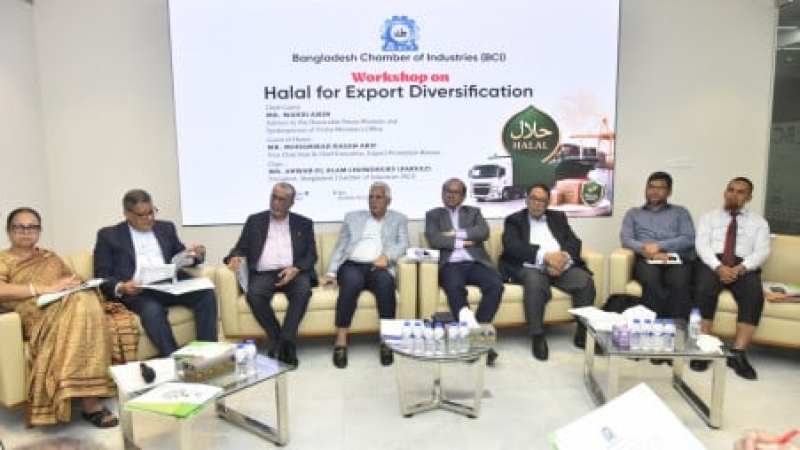
Bangladesh Chamber of Industries (BCI) organises a workshop titled Halal for Export Diversification in Dhaka today (18 July). Photo: Collected
Businesses have alleged that obtaining halal certificates from the Bangladesh Standards and Testing Institution (BSTI) and the Islamic Foundation involves bribery, high costs and lengthy procedures, urging the government to provide the certification free of charge through a single national authority.
They said the existing system discourages companies from obtaining official halal certification, undermining Bangladesh's competitiveness in the rapidly expanding global halal market. As a result, many exporters are forced to obtain internationally recognised halal certificates from organisations in countries such as India, Singapore and Thailand.
The concerns were raised at a workshop titled "Halal for Export Diversification", organised by the Bangladesh Chamber of Industries (BCI) in Dhaka on Friday.
Speaking at the event, Khurshid Ahmed Farhad, General Manager of Bombay Sweets and Company Ltd, said the certification process requires substantial fees, repeated factory inspections and numerous laboratory test reports.
He said his company initially paid between Tk 16 lakh and Tk 18 lakh in certification fees for several products. Although the fees were later reduced, the company has still not received the certificates despite paying around Tk 14.5 lakh.
Farhad also alleged that authorities require laboratory tests for heavy metals and pesticide residues, despite such testing facilities not being available in Bangladesh.
"There is a non-halal activity involved in obtaining halal certificates—bribes have to be paid," he alleged.
He further claimed that neither BSTI nor the Islamic Foundation is accredited by Saudi Arabia's recognised halal accreditation authority, forcing exporters to seek certification abroad for shipments to Saudi Arabia.
According to Farhad, his company had to remove halal logos from around 50 products, spending nearly Tk 62 lakh on redesigning packaging.
During the open discussion, BCI Director and Easy Process Food Chairman Zia Haider Mithu alleged that officials from the certification agencies also expect businesses to provide transport and meals during factory inspections.
"They ask us to arrange vehicles and hospitality for inspection teams, and then charge annual certification fees. The process has become too expensive for exporters," he said.
He added that some overseas buyers even advise exporters to print the word "halal" on packaging instead of going through the costly certification process.
Representatives from major exporters, including PRAN, Paragon, Akij, Meghna and Bengal Meat, echoed similar concerns during the workshop.
Export Promotion Bureau (EPB) Vice Chairman and CEO Mohammad Hasan Arif said the global halal economy is now worth about $5.2 trillion, but Bangladesh has yet to tap its full potential beyond food and agricultural products.
He said sectors such as pharmaceuticals, cosmetics, textiles, tourism, fintech, education and manufacturing offer significant opportunities, but the lack of a unified and internationally recognised halal certification authority remains a major obstacle.
Arif recommended establishing a single national halal authority similar to those operating in Malaysia and Türkiye.
Presenting the keynote paper, Md Mominul Islam, Assistant Professor at the International University of Business Agriculture and Technology (IUBAT), said separate certification systems operated by BSTI and the Islamic Foundation weaken Bangladesh's branding in the international halal market.
He also recommended creating a unified halal board to improve credibility and global recognition.
In his closing remarks, BCI President Anwar-ul Alam Chowdhury Parvez said Bangladesh currently exports only $850 million worth of halal products despite the sector's enormous global potential.
He said a unified certification system, internationally accepted accreditation and stronger laboratory capacity could significantly boost exports, employment and foreign exchange earnings.