

- India Reviewing Bangladesh’s Request to Extradite Hasina |
- Adani's 800MW Power Unit to Remain Shut for 25 Days |
- Dhaka Ranks 6th Among World's Most Polluted Cities on Wednesday |
- RMG Workers' Minimum Wage Raised 36% to Tk 17,000 |
- Decades of gains against AIDS could unravel as HIV funding dries up |
Chinese investors urged to set up factories in Bangladesh to reduce trade gap
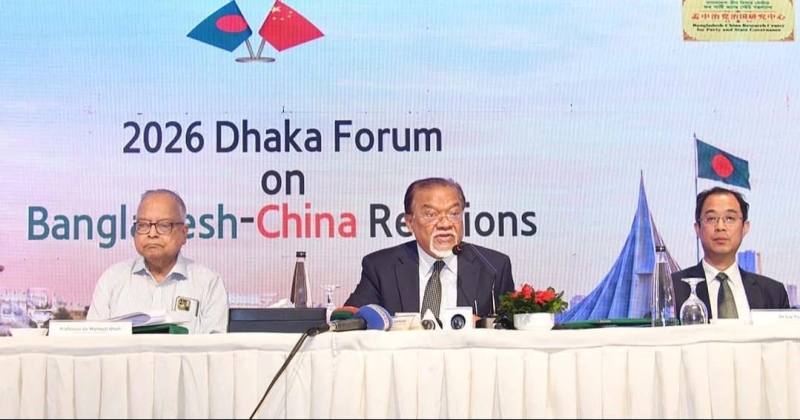
Prime Minister’s Adviser on Public Administration Md Ismail Zabiullah on Wednesday urged Chinese entrepreneurs to increase investment in Bangladesh’s manufacturing sector and set up factories here to reduce the trade deficit, create jobs and diversify exports.
He made the call while addressing a seminar titled “2026 Dhaka Forum on Bangladesh-China Relations”, jointly organised by the Bangladesh Institute of International and Strategic Studies (BIISS) and the Chinese Embassy in Dhaka.
Highlighting the trade imbalance between the two countries, Zabiullah said around 75 percent of Bangladesh’s total exports in FY2025-26 went to Western markets, including 18.85 percent to the United States, while exports to China accounted for only 1.71 percent.
He said bilateral trade should go beyond imports and exports to include joint investment, cultural exchanges, technology transfer and manufacturing cooperation.
Chinese entrepreneurs could set up factories in Bangladesh and use its geographical location, skilled workforce and market advantages to export products to Africa, the Middle East and Europe, he said.
Referring to the progress in bilateral relations, Zabiullah said high-level visits and communication between the two countries had increased following the political change on August 5.
He said the commitment to building a “Bangladesh-China Community with a Shared Future”, announced during Prime Minister Tarique Rahman's visit to China in June 2026, had given a new dimension to bilateral ties.
He stressed advancing the relationship through practical economic cooperation based on mutual respect, sovereignty and non-interference in each other's internal affairs.
The adviser also sought China's assistance in transforming Bangladesh's seaports into modern, environment-friendly logistics hubs.
He called for Chinese cooperation in developing another major port infrastructure like the Matarbari deep-sea port and stressed assessing the potential of Chandpur as a port and logistics hub.
He also highlighted the need for a Chandpur-Shariatpur bridge or tunnel and a joint Bangladesh-China shipping and logistics company modelled on Denmark-based global shipping giant Maersk.
Zabiullah said a China-Myanmar-Bangladesh economic corridor could open new opportunities for regional connectivity and economic cooperation.
Developing road and rail links from Kunming in China to Kyaukphyu in Myanmar, alongside a maritime connection between Kyaukphyu port and Chattogram port, could help establish an effective regional economic corridor, he said.
On the Rohingya crisis, he said regional peace and stability were essential for sustainable trade and investment.
Bangladesh expects China to play a strong and constructive diplomatic role in ensuring the safe, voluntary and dignified repatriation of Rohingyas and restoring stability in Myanmar's Rakhine State, he added.
Speaking as a special guest, Chinese Embassy Charge d'Affaires Dr Liu Yuyin stressed strengthening cooperation between Bangladesh and China in trade, investment, infrastructure, energy, education, healthcare and technology.
He said industrial development, technology transfer, skills enhancement and expanded economic cooperation could take bilateral relations to a higher level.
Referring to China's 15th Five-Year Plan, he also called for exploring new areas of regional and economic cooperation between the two countries.
BIISS Director General Major General Hussain Muhammad Masihur Rahman delivered the welcome address.
Dr Liu Zongyi, senior research fellow at the Shanghai Institutes for International Studies (SIIS) and director of its Centre for South Asian Studies, also spoke at the event.
National Professor Dr Mahbub Ullah chaired the inaugural session.
Senior government officials, Chinese Embassy representatives, former diplomats, military and civil officials, academics, researchers, university teachers and students, journalists and policymakers attended the seminar.