

- Saint Martin’s Island to Reopen for Tourists on Nov 1 |
- France Arrests More Than 1,300 After Nationwide Protests |
- Dhaka ranks world's third most polluted city this morning |
- Soldiers Guard Milan as Thousands Protest Across Europe |
- Cheese Industry Thrives In Thakurgaon Villages |
BIWTA dredging restores navigability of Sunamganj rivers; boosts trade
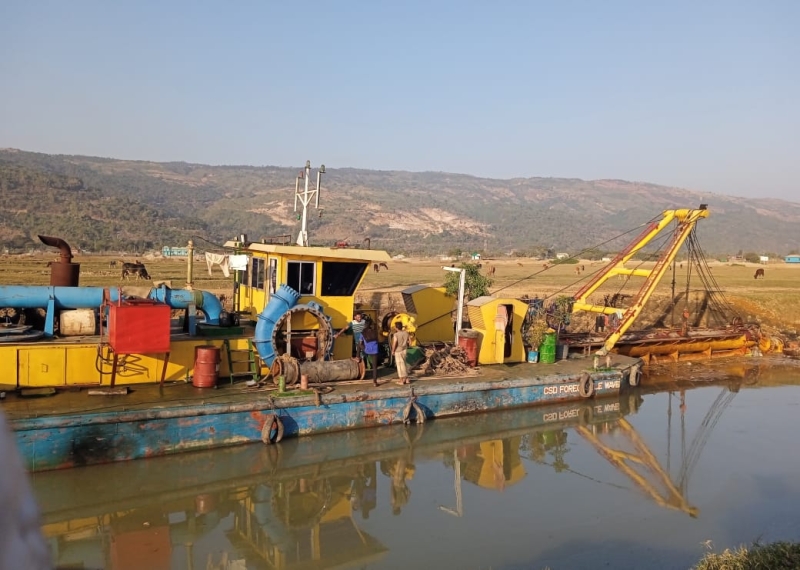
Dredgingh in rivers of Sunamganj. UNB
By Arun Chakroburty. Sunamganj, Jan 18 — Conservation dredging by the Bangladesh Inland Water Transport Authority (BIWTA) has significantly improved navigability of key waterways in Tahirpur upazila, reviving trade, easing transportation and creating fresh employment opportunities in the region.
As dredging has restored water flow in the Patlai, Baulai and Rakti rivers, cargo vessels carrying coal and stones are once again operating smoothly, particularly along the Takerghat–Mokshedpur route.
The development has brought long-awaited relief to traders, workers and local residents dependent on river-based trade.
For years, the three rivers would almost dry up during the dry season, crippling operations at the Barachhara, Charagaon and Bagli customs stations.
Importers of coal and stone suffered heavy losses as goods transport stalled and thousands of workers were left without regular employment.
To address the crisis, BIWTA has been carrying out conservation dredging over the past two to three years using cutter suction dredgers. As a result, navigability has improved markedly in the current fiscal year, allowing vessels to transport larger volumes of goods without disruption.
In Takerghat area, the Patlai River, which once dried up completely during the dry season—forcing people and livestock to cross on foot—now supports the movement of both small and large vessels.
Md Khasrul Alam, president of the Barachhara Coal Importers Group and former chairman of Sreepur Uttar Union Parishad, said the dredging had doubled business activities over the last two years.
“If capital dredging is undertaken in the future, trade will increase manifold,” he said.
BIWTA officials said dredged soil is being distributed free of cost for public welfare projects with due approval. The soil has been used to fill low-lying areas of government schools, colleges, mosques, madrasas, graveyards and rural roads across several unions, contributing to local development.
An executive engineer of BIWTA said filling work has already been completed in multiple locations under Sreepur North, Sreepur South and Baradal South unions during the 2025 fiscal year, while similar projects are continuing this year.
Md Haji Sabuj Alam, general secretary of the Barachhara Importers Group and former chairman of Baradal South Union Parishad, said river siltation caused by hill runoff had severely disrupted trade for years.
“With dredging making the waterway operational again, trade and commerce have regained momentum and development activities have expanded,” he said.
Labour leader and Baradal South Union Parishad member Md Yakub Hossain said more than one lakh workers depend on the three customs stations daily.
“Earlier, it took two to three days to transport 100 tonnes of coal or stone. Now, 200 to 300 tonnes can be moved in a single day,” he said.
However, BIWTA officials noted that dredging faces challenges during both dry and monsoon seasons due to surrounding haors, croplands and waterlogging, which slow down excavation work.
Despite the challenges, uninterrupted vessel movement along the Takerghat–Mokshedpur route has restored the region’s water transport system and injected new momentum into business and trade. - UNB