

- Ebola outbreak spreading exponentially, UN responders warn |
- Four sworn in as ministers, two more as state ministers |
- Mirza Fakhrul takes oath as 23rd President |
- New President visits Zia, Khaleda’s graves before Bangabhaban oath |
West Bengal to divert more Teesta waters by digging 2 canals
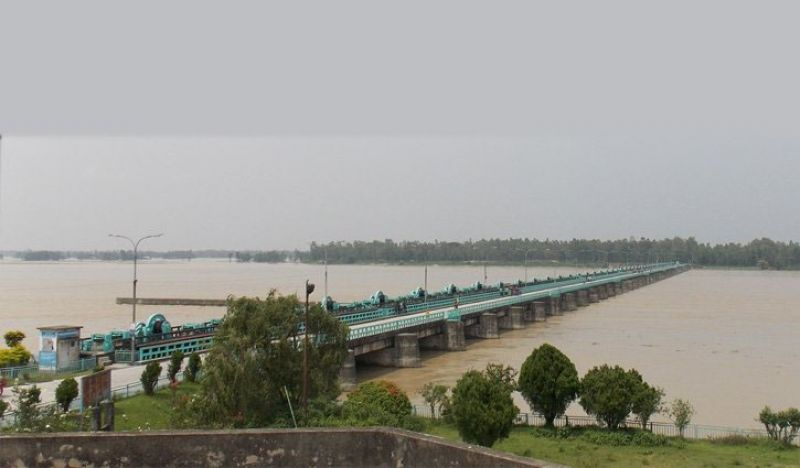
Teesta Barrage
Jehangir Hussain
The West Bengal government in India is planning divert more water from the Teesta River by digging two canals, the Telegraph of Calcutta reported on Saturday.
Around 100 cumecs (cubic metres per second) of water is available in the Teesta in the summer months. Around 1,600 cumecs are required to irrigate crop field in India and Bangladesh, said sources.
“Twelve small rivers have already dried up and two major rivers -- Teesta and Dharla -- have been turned into canals in northern Bangladesh due to lack of water flow from upstream India. Miles of shoals surfaced on the rivers,” according to Bangladesh Water Development Board(BWDB).
Bangladesh has been pressing India to sign an agreement to share the waters of the trans-border river.
Bangladesh needs about 60 per cent of the river’s waters to irrigate crop fields on both the banks of the Teeta in Bangladesh as the crops fields remain unused in the dry season due to lack of water in the Teesta, a tributary of the Brahmaputra.
Originating in the Teesta Kangse Glacier in nothern Sikkin the Teesta flows through Sikkim and West Bengal before entering Bangladesh.
The Teesta sharing issue has been on the negotiating table with India since 1954.
The Telegraph reported that a 32km-long canal would be dug by the West Bengal government up to Changrabandha in Cooch Behar district to divert Teesta waters and another 15km long canal will be dug on the left bank of the Teesta by West Bengal government also to divert Teesta water from the upstream, reported the Telegraph.
“The West Bengal irrigation department on Friday took possession of around 1,000 acres to dig two more canals under the Teesta Barrage Project to divert waters for irrigation,” the Telegraph reported.
The move is designed to irrigate crop fields in Jalpaiguri and Cooch Behar districts but would harm crop fields in Bangladesh.
Bangladesh has been pressing India to sign a Teesta water-sharing deal to solve its water scarcity in its northern districts.
India uses its Teesta Barrage at Gajoldoba in Jalpaiguri district to divert wtars from the upstream.
“The West Bengal irrigation department will assess in due course the total agriculture area that will benefit from the canals, which will help around one lakh farmers irrigate their crops. The project, however, suffered for decades and water reaches only around 1.04 lakh hectares now, however, the Jalpaiguri district administration handed over around 1,000 acres to the department in the presence of state irrigation minister Partha Bhowmik, reported the Telegraph.
India’s Teesta Barrage project was launched in 1975 to irrigate 9.22 lakh hectares of agricultural land. The plan was to route water from the Teesta through canals on either bank of the river. On the way, the canals would be fed by other rivers which flow through the region.
“The West Bengal government’s decision to dig new canals under the Teesta Barrage project after a gap of over 20 years was bound to increase Dhaka’s concern. New Delhi and Dhaka couldn’t clinch a pact to share the Teesta waters because of objections raised by West Bengal chief minister Mamata Banerjee in 2011. A political observer pointed out that by extending the reach of the Teesta project, Mamata is trying to prove that West Bengal needs water from the river,” the report said.
The Teesta and the Dharla used to flow all-year-round earlier just 10 years back, Teesta, which was once five km wide in Bangladesh has been reduced to about 30 metres in width, with only knee-deep water in summer.
Bangladesh repeatedly pointed out that India’s unilateral construction of a barrage across the Teesta at Gazaldoba, around 100 km above Bangladesh’s Teesta Barrage Irrigation Project at Dalia, Hatibandha upazila, has been the cause of poor condition of the river in Bangladesh.
Farmers in Bangladesh’s northern districts depend on Teesta water to irrigate their crop fields during the dry season, but unusually low flow of the river in Bangladesh due to India's unilateral water diversions from the upstream adversely affected farming and biodiversity in the region in Bangladesh.
jehangirh01@gmail.com