

- UK All-Party Parliamentary Group on BD Meets Humaiun Kobir |
- World Bank Keeps Bangladesh FY27 Growth Forecast at 3.4% |
- PM Joins Children’s Rights Day, Shishu Academy Anniversary |
- BATEXPO 2026 to showcase Bangladesh’s transformed RMG sector |
- Saudi Remittance Rises 38% as UAE, Malaysia Inflows Fall |
Sundarbans wildlife faces relentless survival struggle against tides
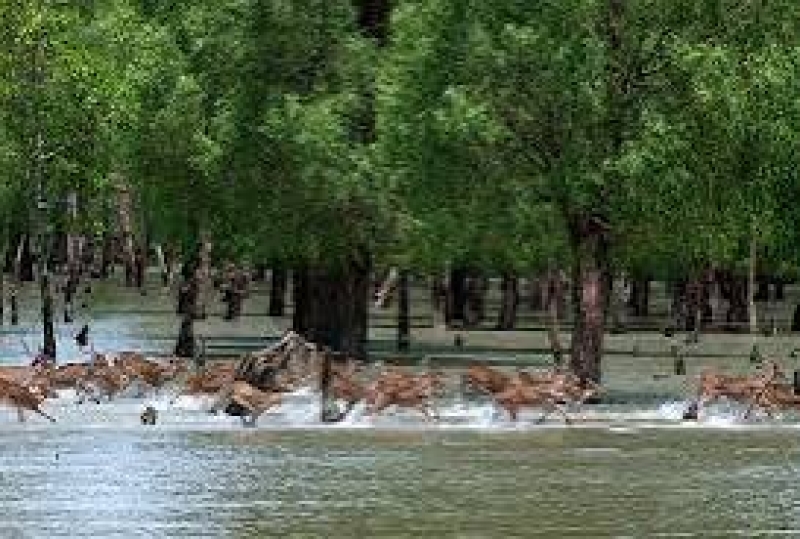
Wildlife, especially the Royal Bengal Tigers of the Sundarbans, world's largest mangrove forest, faces a relentless battle for survival against the brackish tidal waters that surge in twice a day.
In recent times, sea level rise driven by climate change and a succession of devastating cyclones have put the existence of these animals under serious threat. With tidal water rising to unusual heights and the forest's land area shrinking, its biodiversity faces an unequal struggle for survival every day.
When tidal water rushes in through the narrow canals and creeks, the calm of the forest turns to turmoil in an instant. Locals call the first surge 'pali'. Newborn spotted deer fawns and herds of wild boar are hit hardest, as they cannot swim well enough to hold their ground.
The current sweeps them into the main river, where hungry saltwater crocodiles lie in wait.
Tides on new-moon and full-moon nights are more dangerous than those by day. Monkeys, geckos and wild birds asleep on tree branches in the dark are caught by sudden flooding. Unable to judge the depth of the water or the strength of the current, animals often find their nests submerged. Seeking higher ground at night is far more perilous than by day.
During high tide, the Royal Bengal tigers of the Sundarbans become expert swimmers. Swimming miles against the current to move from one island to another is part of their daily routine.
Researchers have used camera traps set on trees across the forest, among other technologies, to observe how tigers swim against the tide and how deer stand motionless in groups on high ground for hours.
As the water rises, herds of spotted deer and wild boar rush towards relatively high ground or artificial earth mounds known as 'kellas'. Ordinary tides cause little trouble. But during spring tides around the new moon and full moons, or when a low pressure over the Bay of Bengal pushes the water three to five feet above normal, the entire Sundarbans is submerged.
At such times, the kellas are the main refuge for deer, wild boar and tigers. Hundreds of animals crowd onto them. With more animals than the mounds can hold and little food, a silent struggle for survival begins there too.
Tigers also face a brutal struggle among themselves. Each tiger marks out a territory with urine and scratches on tree bark. There are fears that climate change is shrinking these territories. As a result, tigers encroaching on each other's areas often fight bloody battles. Older or weaker tigers are sometimes killed or driven out and end up near human settlements.
When tidal water rises beyond the forest floor and touches the tree trunks, venomous snakes such as the king cobra leave their burrows and take refuge in the treetops. A monkey or a bird may be sheltering on the same tree. In such extreme peril, predator and prey are often found perching side by side on the same branch, waiting for the water to recede.
After the tide recedes, the animals' greatest struggle begins: the search for fresh water. The water in the Sundarbans' rivers and canals is highly saline. The only sources for animals to quench their thirst are a few freshwater ponds in the forest, some natural and some dug by people.
During a high tide or storm surge, saltwater enters the ponds and turns them saline. The animals cannot drink no matter how thirsty they are. Until it rains, they must struggle on.
The animals' normal life is also disrupted as local woodcutters and golpata gatherers, known as Bawalis, and fishermen venture too deep into the forest's canals. Frightened deer or tigers flee to areas where the tidal water is deeper, raising their risk of death.
Research by Bangladeshi and foreign scientists and field surveys have repeatedly borne out the reality of this struggle.
A joint study by Bangladeshi and Australian scientists (Sharif A Mukul and colleagues, 2019) found that if current trends in climate change and sea level rise continue, no suitable habitat for the Royal Bengal tiger will remain in the Sundarbans by 2070.
Earlier, a 2010 WWF-led study by Colby Loucks and colleagues, published in the journal Climatic Change, estimated that a 28-centimetre rise in sea level above the 2000 level would cut the tigers' remaining habitat in the Sundarbans by 96 percent. It said the number of breeding tigers would fall to fewer than 20.
A study led by Dr Md Abdul Aziz, a professor of zoology at Jahangirnagar University and a tiger expert, found that spotted deer account for about 78 percent of the biomass of the Sundarbans tiger's diet. Tiger density is also highest where spotted deer density is high.
According to the researchers, if deer numbers fall because of hunting, habitat loss or environmental factors, the survival of the tigers will be directly at risk.
News reports said the Sundarbans remained under tidal water and storm surge for about 36 hours during Cyclone Remal in May 2024. Media reports put the height of the surge at 8 to 12 feet.
In the rescue operations that followed, the Forest Department recovered 96 dead deer. Another report said 134 deer were recovered in seven days.
The same surge flooded 80 freshwater ponds inside the Sundarbans with saltwater, leaving wildlife and forest staff in acute shortage of drinking water.
In the western Sundarbans, sharply rising salinity is causing sundari, the main tree species, to suffer from malnutrition and top-dying disease, and its numbers are gradually falling. This is reducing the deer's main food source, which in turn is putting the tigers' food chain at serious risk.
Practical, science-based steps are urgently needed to protect the Sundarbans' biodiversity and shield its wildlife from tidal surges and saltwater.
The height of the artificial earth mounds, or kellas, must be raised so that they do not get submerged even in an abnormal storm surge. Salt-tolerant grasses and saplings that deer can feed on should be planted around them. New kellas should also be built in the deeper parts of the forest.
Keeping up the supply of safe fresh water is key to saving the wildlife. The banks of the ponds must be made higher and more durable so that saltwater cannot enter. Modern sluice gates could be fitted at the mouths of the ponds to stay closed at high tide and help retain rainwater.
The Forest Department must step up patrolling to eliminate poaching of deer and tigers. In remote and sensitive areas, round-the-clock surveillance with drones, in addition to camera traps, is needed to stop poachers from setting traps.
When storm surges turn the freshwater ponds saline, animals stray into human settlements in search of water and shelter and are killed by people. To prevent this, strong nylon fencing is needed along the forest's sensitive boundaries to keep animals out of settlements and ease human-tiger conflict.
Human entry into the core zones, the main breeding grounds of the wildlife, must be banned completely. Tourism must also be regulated so that tigers and deer, frightened by the noise of launches or speedboats, do not jump into deep water.
Rivers adjacent to the Sundarbans also need to be dredged to remove silt, so that they can hold more water and tidal water cannot cause prolonged waterlogging in the forest.
Bangladesh must continue to play a strong role in international forums.
In his first address to the United Nations General Assembly's general debate on September 24, Prime Minister Tarique Rahman said Bangladesh was among the countries most vulnerable to climate change despite contributing little to global carbon emissions. He called for stronger global action on climate justice, climate finance and adaptation support.
In the address, he said the government had begun implementing the Teesta Master Plan and the 'Padma Barrage' project to increase the flow of freshwater into the Sundarbans and conserve water through large reservoirs, reports BSS.