

- Efforts to build a clean Bangladesh must start now, PM tells students |
- Five killed as fire breaks out in Cox’s Bazar resort |
- PM visits hospitals and edu institutions to assess dengue situation |
- Dhaka Ranks Ninth Globally With ‘Unhealthy’ Air Today |
- IRGC Says Supertanker Caught Fire After Hitting Sea Mine |
New cicada species identified in Bangladesh
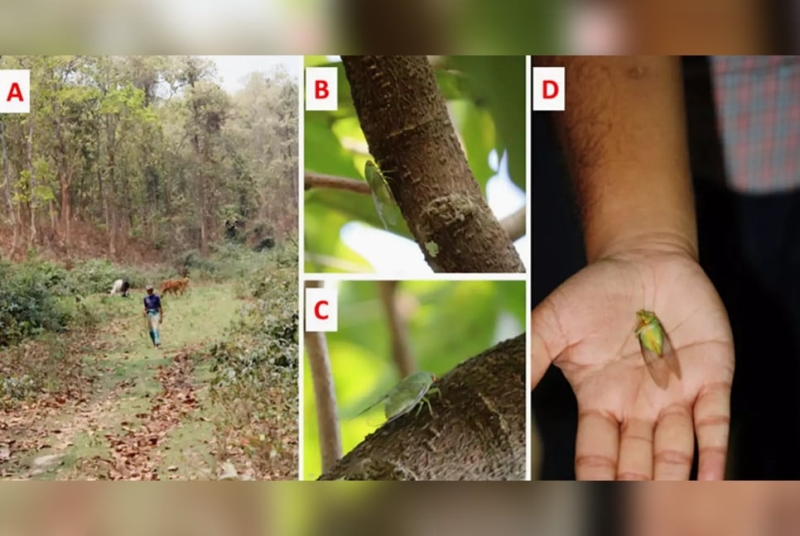
Researchers from Bangladesh, China and India have identified Dundubia annandalei, a species of cicada, in Bangladesh for the first time, adding a new species to the country’s recorded cicada diversity.
The identification was confirmed through field surveys, morphological analysis and an assessment of environmental data, according to the researchers.
The study was jointly conducted by Professor Dr Mohammad Abul Manjur Khan of the Department of Entomology at Bangladesh Agricultural University (BAU) and Kong Wei, a researcher at Northwest A&F University in China.
Indian researcher Babu Saddam and BAU postgraduate student Shahmot Jawad were directly involved in collecting field data and specimens and identifying the insect.
The research paper has been published in the international scientific journal Insects.
The research team told UNB that they collected 63 specimens during field surveys conducted in different parts of Bangladesh between February and March 2025. The specimens are preserved at the Entomology Department Museum at BAU.
One female cicada was collected from beneath a streetlight on the university campus.
The species was found in orchards of mango, litchi, dragon fruit, guava, pineapple, banana, jackfruit, lemon and orange.
Adult cicadas and their discarded exoskeletons were also identified on trees and in vegetation, including sal, bamboo, teak and jarul.
Morphological analysis showed that Dundubia annandalei is generally grass-green in colour when alive but turns brown when dried.
Although it resembles Dundubia terpsichore in appearance, a distinctive structural feature of the male insect is one of the key characteristics used to distinguish the species.
Before this discovery, only one species of the genus Dundubia — Dundubia ensifera — were documented in Bangladesh.
The researchers also used the MaxEnt species distribution modelling approach to assess the cicada’s current and potential future habitat suitability, Professor Manjur Khan said.
The model incorporated species occurrence records alongside environmental variables, including rainfall, temperature and elevation, to identify areas that could provide suitable habitats.
The findings showed that rainfall was the most influential factor in determining the species’ distribution. Variations in rainfall during warmer periods could particularly affect the availability of suitable habitats, while elevation and temperature were also important factors.
According to the researchers’ estimates, about 861,000 square kilometres within the study area are currently suitable for the species. Of this area, around 300,000 square kilometres were classified as highly suitable and 179,000 square kilometres as moderately suitable.
Climate change projections indicated that suitable habitat could expand to approximately 1.752 million square kilometres by 2060 and 1.94 million square kilometres by the end of the century under a relatively lower global warming scenario.
Under a higher-warming scenario, suitable habitat could temporarily contract around the middle of the century before expanding substantially, potentially reaching approximately 2.63 million square kilometres by 2100.
However, the researchers cautioned that these figures represent model-based projections of environmental suitability, not confirmed future distribution or evidence of increased agricultural damage.
Cicadas feed primarily on xylem sap — the fluid that transports water and minerals through plants during their immature stages. Although some cicada species can damage trees and crops, the study did not determine the extent to which the newly identified species affects agriculture in Bangladesh.
Professor Manjur Khan told UNB that cicadas are present in fruit orchards across the country.
Their loud breeding calls can often be heard around mango trees during the summer, particularly as mangoes mature, providing an indication of their presence in orchards.
He said commercial fruit cultivation was expanding in the country’s hilly regions, some of which the MaxEnt model identified as potentially suitable for the species.
However, insufficient research has been conducted to establish how the cicada affects commercial fruit orchards in those areas, particularly in terms of crop production and normal tree growth.
Identifying a new species is not enough; its distribution, life cycle, feeding habits and potential economic impact on agriculture must also be investigated, he said.
If the species is found to cause significant economic damage, effective management strategies will need to be developed.
Professor Manjur Khan stressed the need for long-term field research to assess potential agricultural risks.
He said cooperation from public and private institutions and funding agencies would be necessary to determine the species’ presence, the extent of any damage and appropriate management measures in commercial fruit orchards in hilly areas.
The researchers said sustained research support and systematic monitoring would help establish reliable evidence of the species’ ecological distribution and actual agricultural impact.
Such findings would enable authorities and researchers to take timely and effective preventive measures if future studies identify a risk of economic damage, reports UNB.