

- Dhaka's air 5th worst in the world this morning |
- Around 7,500 Bangladeshis imprisoned in Saudi Arabia: Shama Obaed |
- Bangladesh Outperforms India in Global Hunger Index 2026 |
- Covered van hits Gazipur police patrol team, killing SI, BNP leader |
- Korean City scrambles to rescue dusky shark after it returns to canal |
UN Warns of Rising Risks for Afghan Women Returnees
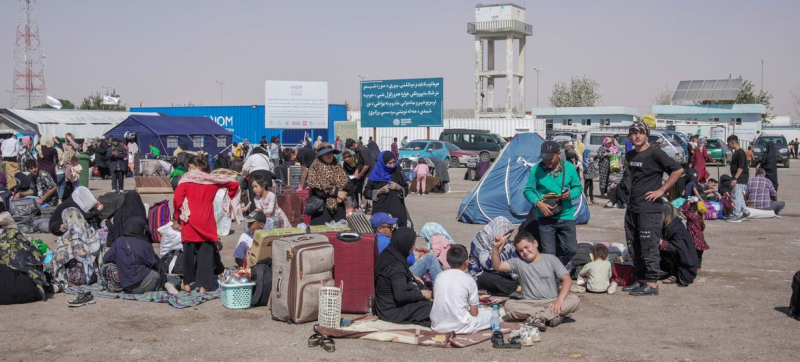
Afghan returnees from Iran gather at the Islam-Border, near Herat in western Afghanistan.
The international community must provide greater support to Afghan women and girl returnees from Iran and Pakistan, who face increased risks of impoverishment, early marriage, and growing threats to their rights and safety.
UN Women – which champions gender empowerment and equality – alongside the international humanitarian agency CARE International and partners, issued the call in a report published on Thursday. The report also highlights key challenges and the needs of women aid workers assisting the returnees.
The Gender Alert comes amid a surge in returnees to Afghanistan, where the Taliban has ruled for four years, implementing numerous decrees that restrict women’s rights amid economic crisis, climate shocks, and immense humanitarian needs.
Since September 2023, more than 2.4 million undocumented Afghan migrants have returned—or were forced to return—from Pakistan and Iran.
Women and girls account for a third of returnees from Iran so far this year, and about half of those coming from Pakistan.
Many arrive in a country they have never lived in, with no home, income, or access to education and healthcare.
Like all women and girls in Afghanistan, the returnees face increased risks of poverty, early marriage, violence, exploitation, and unprecedented restrictions on their rights, movements, and freedoms.
“Vulnerable women and girls arriving with nothing into communities that are already stretched to breaking point puts them at even greater risk,” said Susan Ferguson, UN Women Special Representative in the country.
“They are determined to rebuild with dignity, but we need more funding to provide the dedicated support they need and to ensure women humanitarian workers are there to reach them.”
The report outlines urgent and long-term needs such as safe and affordable shelter, livelihood support, and girls’ education.
As one participant in a focus group in Nangarhar province put it, “We need a place to stay, a chance to learn, and a way to earn.”
Currently, only 10 per cent of women-headed households live in permanent shelter, nearly four in ten fear eviction, and all girls are banned from attending secondary school.
Although women humanitarian workers at border points are critical to reaching female returnees, cuts in foreign aid and movement restrictions increasingly hamper their efforts.
For example, women humanitarians are required to be accompanied by a male guardian, or mahram, when travelling. However, “funding cuts have sharply eroded staff mahram support in the provinces of Kandahar and Nangarhar, leaving provision inconsistent, delayed, or absent altogether,” the report said.
The funding cuts have severely weakened the capacity of humanitarian organisations to respond. Women humanitarian workers at border points report being overwhelmed by the sheer number of arrivals and unable to meet even basic needs.
“Witnessing the volume of arrivals and the hardship faced by women, children, and families – many distressed, disoriented, and without hope – has left a deep impact on all of us responding to this crisis,” said Graham Davison, CARE Afghanistan Director.
He underscored the urgent need for support to provide basic services, safe spaces, and protection for women and girl returnees.
The report noted that Afghanistan is already facing one of the world’s most dire humanitarian crises, driven by decades of conflict, poverty, and natural disasters.
As this latest wave of returns threatens to push already fragile communities further into crisis, the partners urged the international community to act now to protect the rights of Afghan women and girls and to invest in the women humanitarians who support them.
Separately, the International Organization for Migration (IOM) also called for international support as Afghanistan confronts “one of the largest return movements in recent history.”
Returnee numbers are expected to rise, with one million more Afghans likely to return from Pakistan following the government’s decision not to extend their stay.
IOM operates four reception centres at major border crossings in Afghanistan, including Islam Qala and Milak with Iran, and Torkham and Spin Boldak with Pakistan.
The UN agency is appealing for additional funding to scale up its response and address growing needs at the borders and in return areas.